Table of Contents
- The Chemistry of Cyanoacrylate
- Understanding the Polymerization Process
- The Critical Role of Relative Humidity
- Temperature and Its Impact on Viscosity
- Mastering Retention Through Proper Surface Preparation
- Managing the Workplace Environment for Success
- Troubleshooting Common Adhesive Issues
- Advanced Storage Techniques for Professional Longevity
- Elevating Your Artistry Through Scientific Understanding
The Chemistry of Cyanoacrylate
To truly master the art of eyelash extensions, one must first become a student of the chemistry behind the bond. The primary ingredient in almost every professional lash adhesive is cyanoacrylate. This is not a traditional glue that dries through evaporation like school glue or wood glue. Instead, it is an acrylic resin that undergoes a chemical reaction to form a solid plastic bond.
There are several types of cyanoacrylate used in the beauty industry, including ethyl, methyl, butyl, and alkoxy. Ethyl cyanoacrylate is the most common in the lash world because it offers a fast set time and a very strong, rigid bond. However, it can also produce more fumes. Butyl and alkoxy versions are often found in sensitive formulas because they have lower odor and lower volatility, though they typically result in a slower curing time and slightly weaker retention.
Understanding this chemical foundation is essential for every lash artist. When you choose a product from Training Beauty & Beyond, you are working with formulas designed to balance these chemical properties for optimal performance. The strength of the bond is determined by how well the liquid monomer transforms into a solid polymer, a process that is entirely dependent on external environmental factors.
The Role of Stabilizers and Pigments
Beyond the base resin, adhesives contain stabilizers like hydroquinone which prevent the liquid from hardening inside the bottle. Carbon black is the most frequent additive used to give the adhesive its deep black color, allowing it to blend seamlessly with natural lashes. For clients with sensitivities to carbon black, clear adhesives are an excellent alternative, as they contain the same bonding power without the pigment.
Understanding the Polymerization Process
Polymerization is the scientific term for the curing process of lash adhesive. Unlike drying, which implies the loss of moisture, curing actually requires moisture to begin. When the liquid adhesive comes into contact with the moisture present in the air or on the natural lash surface, the molecules begin to link together in long chains.
This reaction happens almost instantly on a microscopic level. The moment you dip an extension into the adhesive and place it on the natural lash, the moisture acts as a catalyst. If there is too much moisture, the process happens too quickly, leading to shock curing. If there is too little, the process stalls, leading to poor retention and lashes that slide off hours or days later.
The transition from liquid to solid must be controlled to ensure the bond is flexible yet durable. A flash cure, which happens when the outside of the adhesive drop hardens while the inside remains liquid, is a common reason for premature shedding. This is why understanding the science of lash adhesive and how retention and humidity affect your work at Training Beauty & Beyond is a core component of professional development.
The Critical Role of Relative Humidity
Relative humidity is perhaps the most influential factor in a lash artist’s daily life. It measures the amount of water vapor present in the air compared to the maximum amount the air could hold at that specific temperature. Because moisture is the catalyst for cyanoacrylate, humidity dictates exactly how fast your adhesive will set.
- Low Humidity Environments: When the humidity is below forty percent, the adhesive lacks the catalyst it needs to cure. This results in a slow drying time, causing extensions to lean, flip, or create stickies where multiple lashes bond together.
- High Humidity Environments: When humidity exceeds sixty percent, the adhesive cures too rapidly. This often leads to the adhesive partially hardening before it even touches the natural lash, resulting in a brittle bond that pops off easily.
- The Ideal Range: Most professional adhesives are formulated to perform best between forty five and fifty five percent relative humidity.
Maintaining a stable environment is not just a suggestion; it is a requirement for consistent results. If you find your adhesive is behaving inconsistently, the first tool you should reach for is a hygrometer to check the moisture levels in your room.
Temperature and Its Impact on Viscosity
While humidity controls the speed of the cure, temperature controls the behavior of the liquid itself. Temperature affects the viscosity, or thickness, of the adhesive. When a room is too warm, the adhesive becomes very thin and runny, which can lead to it traveling up the extension or flooding the follicle. Conversely, in a cold room, the adhesive becomes thick and syrupy, making it difficult to pick up the correct amount.
Temperature also influences how much moisture the air can hold. Warm air holds more water vapor than cold air. This means that if you increase the temperature in your studio without adding a humidifier, your relative humidity will actually drop. This interconnected relationship is why professional environments must be climate controlled with precision.
Working in an environment that fluctuates can ruin your retention rates. Many students at Training Beauty & Beyond learn that keeping their room between 20 and 24 degrees Celsius is the sweet spot for most high performance adhesives. Consistency in temperature ensures that every drop of glue behaves exactly like the one before it.
Mastering Retention Through Proper Surface Preparation
Even the most expensive adhesive will fail if the natural lash surface is not prepared correctly. Retention is a two way street involving both the adhesive and the substrate. The natural lash is covered in oils, proteins, and salts that can act as a barrier to the chemical bond.
- Deep Cleansing: Using a lash safe foam cleanser is the first step. This removes makeup residue and oils.
- Priming: A primer can help balance the pH of the natural lash. Cyanoacrylate likes a slightly alkaline environment. If the lash is too acidic, the cure will be sluggish.
- Saline Rinsing: Some artists prefer a simple saline rinse to ensure all surfactants from the cleanser are removed, providing a pristine surface for the adhesive to grab onto.
When the surface is prepared, the adhesive can penetrate the microscopic scales of the hair cuticle, creating a mechanical and chemical lock. This level of detail in preparation is what separates a beginner from an expert.
Managing the Workplace Environment for Success
Controlling your environment requires more than just a thermostat. To achieve the best results, you must actively manage the air quality and movement in your lashing station.\
Humidity Control Tools
If your space is too dry, a cool mist humidifier is essential. Place it a few feet away from your bed rather than directly next to your stone to avoid over saturating the immediate area. If your space is too humid, a dehumidifier or air conditioner can help strip excess moisture from the air.
Air Flow and Fumes
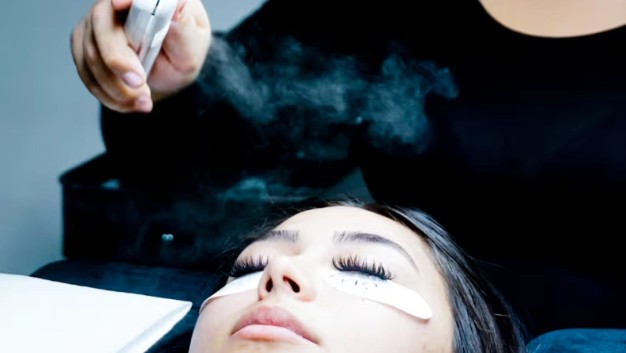
Direct airflow from a fan or an open window can cause the adhesive to cure prematurely on your tile. It can also push fumes toward the client’s eyes, causing redness and irritation. Using a small nano mister at the end of the service can help set the adhesive, but it must be used sparingly. The goal is to provide just enough moisture to complete the polymerization without causing shock curing, which turns the adhesive white and brittle.
Troubleshooting Common Adhesive Issues
Every artist encounters days where the adhesive simply does not want to cooperate. Recognizing the signs of environmental interference can help you pivot quickly.
- Extensions Popping Off: If the extension detaches cleanly from the natural lash without any adhesive remaining on the lash, your glue probably cured too fast. This is usually due to high humidity or taking too long to place the extension after dipping.
- The Presence of Stickies: If lashes are sticking together, your adhesive is curing too slowly. This is likely due to low humidity.
- Red Eyes and Irritation: This is often caused by adhesive fumes. Ensure your adhesive is fresh and that you are using a professional grade glue from a reputable source like Training Beauty & Beyond to minimize unnecessary chemical exposure.
- White Residue: Known as blooming, this occurs when the adhesive is exposed to too much moisture too quickly. This is a sign of shock curing and indicates that the bond is compromised.
Advanced Storage Techniques for Professional Longevity
How you store your adhesive when you are not using it is just as important as how you use it during a set. Cyanoacrylate is sensitive to light, heat, and moisture, all of which can degrade the product inside the bottle.
- Airtight Containers: Store your adhesive in an opaque, airtight container. Many artists use a specialized vacuum sealed jar designed for lash glue.
- Silica Packs: Keep silica beads or packs inside your storage container to absorb any stray moisture that enters when you open the lid.
- Upright Positioning: Always store the bottle upright to prevent adhesive from settling in the nozzle, which can lead to clogs and improper sealing.
- Temperature Consistency: Avoid extreme fluctuations. While some artists store unopened bottles in the fridge, once a bottle is opened, it should stay at room temperature in a cool, dark place.
Replacing your adhesive every four to five weeks is a standard industry practice. Even if the bottle is not empty, the constant exposure to air each time you open it will eventually change the chemical composition, leading to unpredictable retention.
Elevating Your Artistry Through Scientific Understanding
Mastering the science of lash adhesive is a journey of continuous observation. Every day brings different weather patterns and indoor climate shifts that require you to adapt your technique. By understanding the molecular behavior of your products, you move from being a technician who simply applies lashes to a specialist who engineers long lasting beauty.
The relationship between your tools and your environment is the foundation of a successful career. When you invest in your education through programs at Training Beauty & Beyond, you gain the technical insights necessary to troubleshoot any situation. This knowledge gives you the confidence to guarantee your work, knowing that the bonds you create are scientifically sound and built to last.
Retention is the ultimate measurement of a lash artist’s skill. While styling and mapping are important for the initial look, the longevity of the set is what keeps clients returning. By respecting the chemistry of cyanoacrylate, monitoring your humidity with vigilance, and maintaining a pristine workspace, you ensure that your artistry remains as durable as it is beautiful.
Write and Win: Participate in Creative writing Contest & International Essay Contest and win fabulous prizes.
About the Author