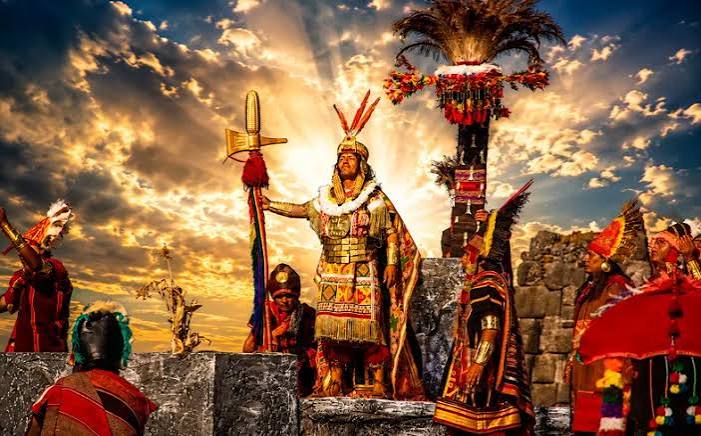
Every year, as winter begins to settle over the Southern Hemisphere and the shortest day of the year passes over the ancient city of Cusco, Peru, a vivid scene takes place. The streets come to life with colour, sound, and celebration as thousands of people gather to honour customs that have been passed down for generations. It is set to take place again in 2026 on 24th June, continuing its centuries old tradition. Dance, music, costume, and jewellery all come together perfectly, capturing the true essence of Inti Raymi. Traditional performances often use the language of the Inca Empire, Quechua. Local participants might even speak Spanish, encouraging regional dialects. This highlights the preservation and celebration of cultural heritage. The festivities depend on acoustic Andean instruments, and the dances are choreographed to represent the four regions of the Inca Empire. The music and dance are beautifully synchronized. The deep sound of the pututu (conch horn) commands the dancers to stop suddenly, drop to their knees, or change direction, among other actions. The rulers, the Sapa Inca, who are considered divine descendants of the sun god Inti, wear a royal tunic. Performers wear woven textiles with gold and silver embroidery, paired with gold ornaments and headdresses.
WHAT IS INTI RAYMI AND ITS SIGNIFICANCE
Inti Raymi, meaning “Festival of the Sun” is held in honour of Inti, the Sun God. The Inti Raymi Festival is one of the most spectacular attractions in Peru. Every June, the city of Cusco gets ready for the festival over nine days. The first few days focus more on partying rather than embodying its culture, the 24th of June is when the real Inti Raymi takes place. The festival is celebrated to honour Inti, the Sun God, marking the winter solstice and the Incan New Year. The sun’s return symbolizes and ensures the warmth of the earth and a good harvest. Historically, the Incas feared that the sun would abandon them during the winter solstice, so they created strict rituals to encourage Inti to return for their survival. Its significance lies in the deep gratitude shown to the sun for the abundance in agriculture.
CEREMONY OF INTI RAYMI
The festival takes place in three main stages. First, the procession begins at Qorikancha, the temple of the sun. The Sapa Inca, who fasts for three days in a row, makes his appearance to pay his utmost respect to Inti. Second, the crowd moves towards the city’s main square, where the Sapa Inca addresses the rising sun and the gathered crowd, followed by offering chicha, a fermented corn beer. Third and most important, on June 24 of each year, at Sacsayhuaman, Inti Raymi is reborn! On the original Inti Raymi, a black llama was sacrificed to the Sun God (Inti) and Mother Earth (Pachamama). This ritual was not an act of cruelty but interconnectedness. The Incas believed that the offering was necessary to restore balance. In times of trouble, such as earthquakes, two children from each of the four regions of the empire were also sacrificed. The entrails of the black llamas were examined by priests. Two large, golden goblets of the best chicha were poured, one was given to Inti and the other was first sipped by the Sapa Inca, who then passed it around among the nobility to eliminate any differences between ruler and subjects. In modern reenactments at Sacsayhuaman, a simulated, theatrical llama sacrifice is performed. No animals are harmed, ensuring the protection of nature. Dances and performances take place, once again representing the native traditions and culture of the four regions of the ancient empire. Then the party winds down, and everyone heads back to the centre of Cusco for various after-parties.
UNIQUE SELLING PROPOSITION (USP)
What makes Inti Raymi stand out from other festivals is, it was banned, buried, and then brought back from the dead. What makes Inti Raymi utterly unique among the world’s thousands of festivals is not just its age or grand display, it is its story of survival. For four hundred years, the sun did not shine in Cusco. Yet, the spirit of Inti Raymi didn’t die among the people of Cusco. With the arrival of the Spanish in the 16th century, the Catholic Church and Viceroy Francisco de Toledo labelled the event as “pagan” and “diabolic.” It was officially banned in 1572. Despite the threat of severe punishment, indigenous Andean communities continued to perform the ritual secretly. The version celebrated today is a massive, highly theatrical reenactment based on ancient chronicles. No other festival in the world carries this combination: a sacred ceremony rooted in 15th-century civilization, violently suppressed by colonialism, and resurrected as an act of cultural resistance. That is the soul of Inti Raymi.
POPULARITY
Inti Raymi is the second largest festival in South America, still celebrated by indigenous communities with great enthusiasm every year on the 24th of June. The city of Cusco transforms completely, hotels fill months in advance, streets overflow with colour, and the ancient fortress of Sacsayhuaman becomes a stage for over eight hundred actors dressed in full Inca regalia. The growing popularity of this festival relies upon several pillars. First, Inti Raymi attracts people because it is an authentic cultural tradition, not a commercial celebration. Second, its grand procession from Qorikancha to Sacsayhuaman is eye catching, featuring prayers and symbolic offerings to the Sun God. Third and the key factor about popularity is it is inclusive, welcoming visitors from all backgrounds and providing once in a lifetime commemoration. Beyond the sun deity, Inti Raymi functions on reinforcing the relationship between humans and nature. In addition, Inti Raymi focuses on multitude of moral values. During the performance reaffirm to the core Inca triad (the three laws) which includes Yachay (to know), Munay (to love) and Llankay (to work). Ayni meaning sacred reciprocity dictates that “today for you, tomorrow for me.” Ayni showcase core principle of gratitude and renewal. Inti Raymi strengthens Ayllu (community solidarity). It highlights the practice of Pampa mesa, a ritual where community members lay out large cloths on ground, pool their food and share it equally among all participants and travellers. This demonstrates the fundamental of generosity, trust, and equality.
ORIGIN AND HISTORY
The Inti Raymi was established by Pachacuti Inca Yupanqui, the ninth Sapa Inca and one of the greatest conquerors of the empire. Pachacuti reformed a small kingdom into a massive empire. In 1412, to celebrate his accomplishments and to strengthen his grip, he threw first Inti Raymi alongside his wife Mama Anawarkhi and daughter Mama Ocllo. Historically, the Inca empire was divided into four regions also called four suyos. The last official Inti Raymi held by the Inca Atahualpa in 1535, the year before the Spanish conquest. In some areas it was merged with the feast day of St. John the Baptist. The holiday was revived in 1944 by Faustino Espinoza Navarro, a Quechua writer, actor and director, writings of Inca Garcilaso de la Vega, based for old age readers, inspired him to do so. Navarro himself portrayed the Sapa Inca for twelve years, before handing off the role to a deserving successor. In children’s literature, the beautifully illustrated book “Up and Down the Andes” by Laurie Krebs takes young readers on a journey from Lake Titicaca to Cusco. Another notable work, “Run, Little Chaski”, brings the world of the ancient Inca Empire alive, offering young readers a window to peek into the civilisation that gave birth to Inti Raymi. Inti Raymi has been featured in numerous travel and cultural documentaries exploring Andean heritage, Incan architecture, and indigenous identity. For journalists, it remains one of the most-documented living festivals on the planet. The ancestral values and Kichwa cultural expressions are heavily protected by UNESCO.
CONCLUSION
Inti Raymi is more than a festival. In a world where ancient traditions are increasingly threatened by modernisation and globalisation, Inti Raymi stands as a reminder that the human need to connect with their ancestors, land, and our gods cannot be extinguished by any colonisation. For Peru, Inti Raymi is also a matter of national identity and indigenous pride. It was declared a Cultural Heritage of Peru on March 3, 2001, cementing its place as a protected tradition not just a tourist attraction, but a living proof of Andean civilisation. Inti Raymi beautifully embodies core principle of gratitude, renewal, generosity, trust, and equality among the people of not only people of its civilization but the tourist as well.
FAQ’S
· Question 1. Is Inti Raymi a religious ceremony or a theatrical performance?
Answer- Today, it is primarily a theatrical representation. However, it holds cultural significance and moral values which are vital part of people of Cusco and many indigenous communities.
· Question 2. What is the significance of the Sun God, Inti?
Answer- Inti was considered the supreme deity of the Inca Empire — the divine ancestor of the royal family. He was worshipped as the source of all life, agriculture, and prosperity.
· Question 3. Can tourists watch the festival free of cost?
Answer- The street processions through Cusco are free to watch. The main ceremony at Sacsayhuaman requires a ticket, available in three tiers — Green (Peruvian citizens), Orange (VIP), and Red (international visitors). Tickets sell out months in advance.
· Question 4. What is the weather like?
Answer- Since it is winter in the Southern Hemisphere, the days can be sunny but extremely chilly, especially in the high altitude of Sacsayhuaman. Dressing in multiple layers and wearing high-SPF sunblock are highly recommended.
· Question 5. Why is Inti Raymi celebrated?
Answer- For the Incas, the sun was the supreme deity and source of life. It was a way to thank Sun God for warmth of earth, abundance in harvest and prosperous life. During Spanish conquest, it was banned in 1572, but it was resurrected in 1944.
By: Shifa Agarwal
Write and Win: Participate in Creative writing Contest & International Essay Contest and win fabulous prizes.
About the Author