A new trader can open a platform and find hundreds of markets competing for attention. EUR/USD may barely move during one session while oil jumps on an inventory report and the Nasdaq-100 reacts to a few heavily weighted companies. Markets like forex, indices, and commodities sit on the same screen, but they reward different habits.
Finding the best market depends on more than the asset itself. Time available and starting capital set the frame, and tolerance for rapid price changes decides if you can stick with a plan. The practical difference between these markets becomes clearer through the routine of an actual trading week.
Forex vs commodities for beginners: three different market rhythms
The foreign exchange market revolves around one currency measured against another. Major currency pairs tend to have ample liquidity and tight spreads, with trading hours that run most of the week. That combination attracts a retail beginner to forex trading, but it also creates frequent chances to overtrade.
Commodities respond to physical forces. Oil reacts to production policy and inventories, and it can swing on transport disruption. Precious metals respond to real yields and the US dollar, with defensive demand pulling in its own direction. Weather forecasts or expected grain supply can move agricultural contracts. Each market has its own calendar.
An index tracks a basket of shares rather than one company. The Nasdaq-100, for example, has substantial exposure to large growth and technology companies. A broad index can rise even when parts of the stock market are weak. But that structure reduces single-company risk without removing market risk.
What drives each price?
Take a higher-than-expected inflation reading. It may strengthen a currency and pressure an equity index, while metals move in either direction depending on bond yields. Markets rarely follow a permanent script. The same report can push one market up and another down, so the priority is knowing which drivers your chosen market reacts to first.
Typical catalysts include the following:
- Forex: rate decisions, signals from central banks, employment data, and changes in capital flows.
- Indices: earnings, sector leadership, economic growth, and investor positioning.
- Commodities: supply, inventories, weather, geopolitics, and industrial demand.
Trading hours, liquidity and volatility
Major currencies trade almost continuously from Monday to Friday. Activity is strongest when large financial centres overlap. Index markets follow their underlying exchanges, even when a provider displays extended hours. The FTSE 100 follows the London session. The S&P 500 follows New York. Each index has its own active window. Plan around those hours, because money comes in when the rest of the market is awake. Commodities can become particularly active around scheduled reports.
High liquidity in itself is not an indication that a position is secure. Spreads can get bigger during news or stressful market times, and an orderly asset can become unpredictable when expectations change quickly.
Past behaviour often gives a market a familiar rhythm. However, it never makes the next move predictable. Technical analysis can show levels and momentum. Fundamental research explains the forces behind a trend. Neither removes uncertainty or prevents loss.
Forex vs indices: where the experience changes
The contrast in trading indices vs. forex shows up in the number of decisions required. Each new currency pair introduces another economy and policy relationship. Someone watching EUR/USD, GBP/JPY, and AUD/JPY is tracking Europe, Britain, Australia, and the Japanese yen, plus the wider risk environment.
Index trading gives you a narrower focus. One contract reflects many companies, and the daily narrative often centres on earnings and bond yields, with sector performance mixed in. The trade-off is concentration. A technology-heavy index can react sharply when a few highly valued companies move together.
Trading indices vs forex: what changes for you
There is no fixed answer to which is better. Forex trading may suit a trader who needs access outside local equity hours and is comfortable following monetary policy. Indices may suit someone who prefers a defined exchange session and already follows corporate or macroeconomic news.
Forex vs. indices markets support day trading and longer holding periods. Short-term activity raises the importance of execution and spread. A slower trading strategy puts more weight on overnight risk and financing costs.
Forex styles that reduce the early learning load
Swing trading can be more manageable than rapid scalping because positions develop over several days. Those who trade forex this way still face overnight exposure and changing spreads, with sudden market volatility around economic releases. A swing trader holding a pair for several days also has to think about the central bank calendar and the interest rate differential. A scalper in the same market thinks about the spread and the speed of the next tick. Both can work, but they are different jobs.
Position trading relies more on monetary policy and economic trends, while scalping demands fast execution and close cost control. Neither is automatically profitable. Position sizing and consistent rules matter more than the speed of buying and selling.
Indices vs. commodities: broad exposure or a specialist market?
The comparison often comes down to breadth. An equity index covers many businesses at once. A commodity is a single market with a more specialised supply chain.
Oil traders monitor producers and inventories, and they watch demand closely. Gold traders often watch yields and the dollar. Agricultural markets bring seasonal patterns and weather risk. Specialist knowledge can become an advantage, but the learning curve steepens when a trader moves between contracts.
Commodity markets with a clearer starting narrative
Commodities like gold and crude oil are the easiest starting points for a beginner because both have widely followed drivers. Gold reacts to yields and the dollar, and its demand shifts in defensive periods. Oil follows inventories and production policy, with expected consumption setting the tone.
Agricultural contracts call for more detailed knowledge of weather and harvest cycles, plus the quirks of regional supply. Pick a market you can research consistently, one whose commodity prices make sense to you, before you speculate with real money.
Portfolio managers may hedge equity exposure with index futures or ETFs. Producers, banks, hedge funds, and other financial institutions also use futures and options to manage commodity or currency risk. Retail access often comes through smaller contracts or CFDs.
The costs behind the market choice
The cost of commodity trading or an index position comes down to the spread or commission, and overnight financing applies when you hold past the session. Margin requirements decide how much deposit capital gets tied up. Costs vary by instrument and broker, and the holding period changes the financing bill. So the cost side deserves as much attention as the setup that got you into the trade.
Leverage magnifies exposure. A small fluctuation can produce a material profit or loss when the position is large relative to the account. That’s why an attractive low-margin contract can be unsuitable for a limited financial situation.
Starting capital across forex, indices and commodities
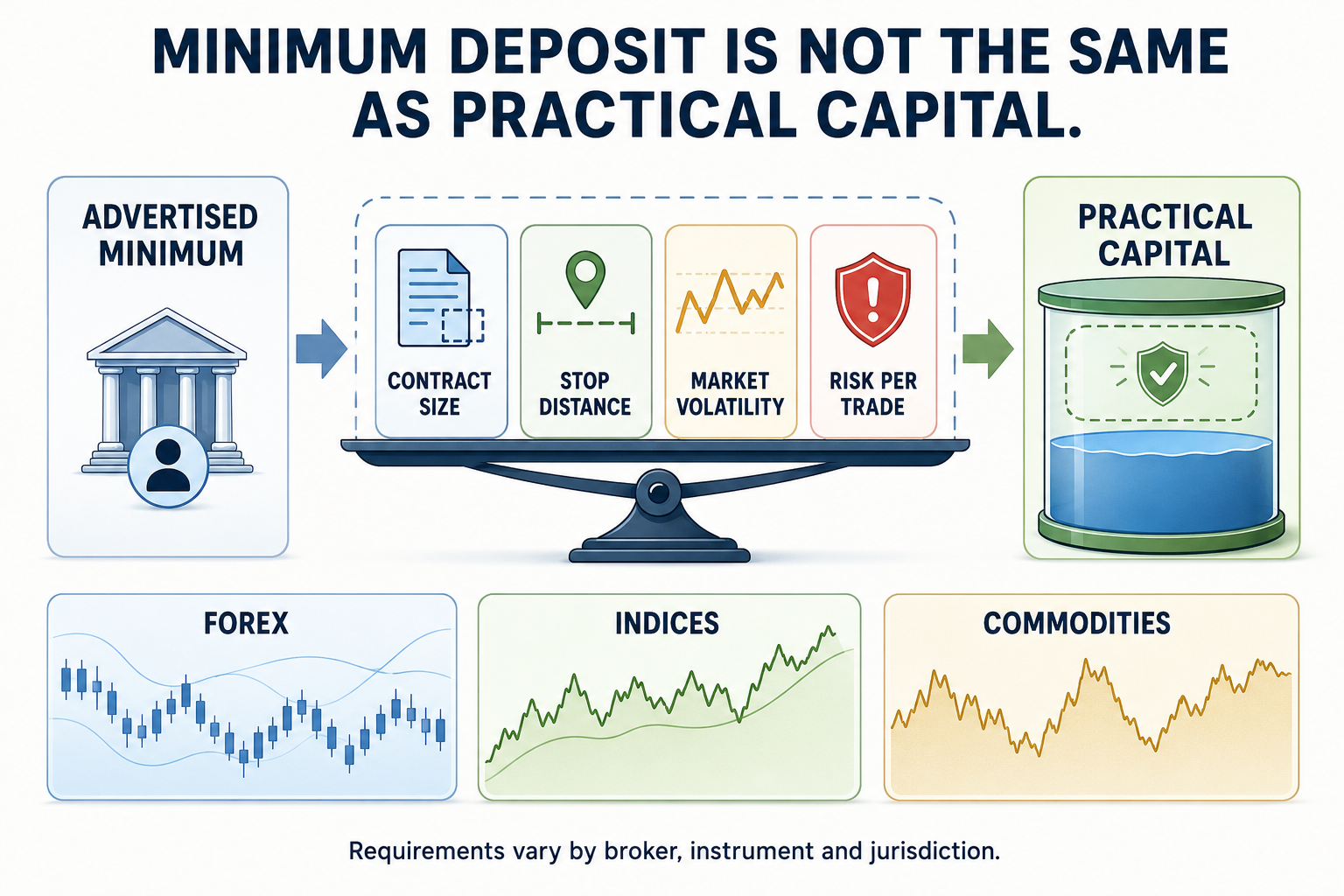
There is no universal minimum deposit. Account thresholds and contract sizes vary by provider, while authorities regulate providers and products within their jurisdictions. A small accepted deposit may still be too little for sensible position sizing.
The practical requirement depends on contract size and stop distance, plus how much account risk you can accept. Enough capital must remain for normal price movement without placing most of the balance behind one idea. The amount needed to start trading is therefore usually higher than the advertised minimum.
A practical framework for market selection
The question of how to choose what to trade becomes manageable when tied to observable constraints. A market suited to European hours may be impractical for someone in Indonesia who reviews charts after work. If a market does most of its moving while you sleep, you will struggle to manage it properly.
Three filters can narrow the field:
- Match the market to available hours. A trader needs liquidity during the window they can realistically monitor.
- Measure normal movement in money terms. Position size and stop distance set the amount at risk, and volatility changes how often stops get hit.
- Limit the initial research burden. Following one or two related assets often produces cleaner decisions than scanning currencies, stock indices, energy, and metals at once.
Risk tolerance and trading objectives also need to agree. Portfolio diversification and short-term speculation demand different routines. Neither works well when the required margin or possible drawdown exceeds the account’s capacity.
Risk management before the first live trade
Effective risk management begins with the amount you can afford to lose if the idea fails. A stop order can help minimise losses under normal market conditions, although slippage may change the execution price during a gap or fast market.
A basic trade plan records:
- the reason for entering and the condition that would invalidate it.
- the intended entry and the stop level, with a target for taking profit.
- the position size and maximum account loss.
- scheduled events that could change volatility.
This routine helps manage your risk before emotion takes over. It separates a controlled loss from an impulsive position with no defined exit.
“Trading is a money business. When making money is replaced by the urge to keep placing trades, the activity begins to resemble an addiction rather than a business.”
CEO of Versus Trade—Vitalii Bulynin. Interview with FXStreet, July 15, 2026.
Practise before committing capital
Practise the whole routine on a demo account first. A few weeks of demo trading can show if a market fits your schedule and temperament. Simulated execution helps test a process, but it can’t reproduce the pressure of risking money.
Platforms such as MT5 put currencies, indices, and commodities in one interface. That convenience can encourage unnecessary switching. Early practice is more useful with a small watchlist and consistent position-sizing rules.
Choosing a market in Indonesia
Indonesia adds a regulatory check to the market decision. Bappebti, the Commodity Futures Trading Regulatory Agency under the Ministry of Trade, runs the official portal for checking the legal status of futures-market participants. A polished website or a claim of international regulation does not confirm that a provider is authorised for the service it provides locally.
Fees and contract terms vary by provider and account. Margin limits differ too. A reputable broker names its legal entity, and its risk disclosures and withdrawal terms should be in writing. Regulation can cut operational risks, but it cannot prevent market losses.
The mechanics of CFD trading also need attention. A CFD tracks a price without giving you ownership of the underlying asset. You can speculate on rising or falling markets, while margin, financing charges, counterparty exposure, and the spread all shape the outcome.
Readers exploring newer infrastructure may also run across What Is Blockchain Forex? A Beginner’s Guide. New settlement systems do not remove the need to check liquidity and legal status. For chart mechanics, How to Read Forex Charts Like a Pro: A Quick Guide is a more focused next step.
A market should fit the process
The phrase “forex vs. indices vs. commodities” suggests a contest with one winner. Real trading is less tidy. Forex has flexible hours and plenty of liquidity in the big pairs. Indices pack a broad group of companies into one instrument. Commodities tie prices to supply chains and physical inventories.
For many beginners, the sensible starting point is the market they can follow consistently with modest exposure. The decision can change as capital and experience grow, or as investment objectives shift. A narrow watchlist, realistic costs, controlled risk, and time to follow the market matter more than having access to every asset on the platform.
Disclaimer: The images in this article were created using artificial intelligence.
Write and Win: Participate in Creative writing Contest & International Essay Contest and win fabulous prizes.
About the Author