One card stores your medical records and the other pays your hospital bill. The ABHA card is a health record number open to every citizen, and the Ayushman card is a treatment benefit for families who qualify for it.
What the ABHA Card Does
The abha card gives you a 14-digit number that links your health records together. The Ministry of Health and Family Welfare describes it as a number any individual can create free of cost, with records open to professionals and providers based on your informed consent.
It holds no money. It buys no treatment, and it does not reduce a hospital bill by a single rupee.
What it does is save you carrying a folder of reports to every appointment. Anything a hospital or laboratory links to your number can be pulled up later with your permission.
What the Ayushman Card Does
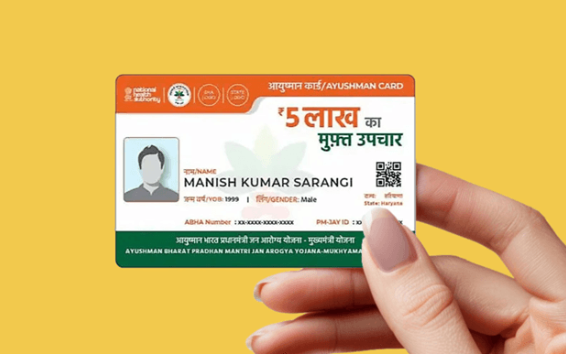
The Ayushman card pays for hospital treatment under the Pradhan Mantri Jan Arogya Yojana. It covers up to 5 lakh rupees a year per family for secondary and tertiary care.
Treatment is cashless at empanelled hospitals, which means the scheme settles with the hospital and the family pays nothing at the counter for covered care.
It carries no medical records. It is a payment entitlement, and it works only at hospitals that have joined the scheme.
The Two Cards in One Table
The two cards differ on every dimension that matters, and the table below sets them out.
| ABHA card | Ayushman card | |
| What it is | A health record number | A treatment benefit |
| Money it carries | None | Up to 5 lakh rupees a year per family |
| Who can get it | Any Indian citizen, any income | Identified low-income families, plus everyone aged 70 and above |
| Where it works | Any facility connected to the digital health network | Empanelled hospitals only |
| Cost to obtain | Free | Free |
| Can you hold both | Yes | Yes |
Reading the table sideways is the quickest way to see that these are not competing options. They answer different questions.
Who Can Get Each Health Card
Any Indian citizen can get the ABHA health card, whatever their age, income or medical history. There is no means test and no application to be approved.
The Ayushman card is different. It goes to families identified through the Socio-Economic and Caste Census, which is a defined list rather than an open application.
That is why “how to convert an abha card to an Ayushman card” is one of the most common searches on this subject, and why it has no answer. Neither card turns into the other.
What is New for Senior Citizens Over 70
What is new for senior citizens over 70 is that age alone now qualifies them for PM-JAY cover, whatever their income. The Prime Minister announced the extension on 29 October 2024, and it is issued as the Ayushman Vay Vandana card.
The cover is 5 lakh rupees a year, and income plays no part in eligibility. A retired government officer and a daily-wage worker of the same age are treated the same way by this rule.
Take-up moved quickly. Enrolment passed 10 lakh within three weeks of launch and reached 25 lakh soon after.
Do You Need One Card to Get the Other
No, you do not need one card to get the other, though the two systems are connected. An ABHA number is not a condition for an Ayushman card, and an Ayushman card does not create an ABHA number for you.
In practice many people end up with both. The scheme and the record system are both built under the same national programme, so hospitals often handle them together.
Holding both is the useful position. One tracks what happened to you and the other pays for part of it.
Which Card You Should Apply For
Apply for whichever card you are eligible for, and if you qualify for both, take both. The decision is less of a choice than it sounds. For example, a family of four with a 72-year-old parent can hold four ABHA numbers and one Ayushman Vay Vandana card carrying 5 lakh rupees of cover.
- Any citizen should create an ABHA number. It is free, takes a few minutes and costs nothing to hold.
- Check PM-JAY eligibility against the census list, or against age if anyone in the family is 70 or above.
- Do not treat a digital health card as insurance. It is a record system, and a hospital bill still has to be paid by someone.
- If you fall outside PM-JAY, the gap is covered by a policy you buy, not by either of these cards.
Frequently Asked Questions
Can I get free treatment with an ABHA card?
No. It links and shares your medical records. Free treatment for eligible families comes from the Ayushman card under PM-JAY.
Is an ABHA number necessary for an Ayushman card?
No. The two are issued separately, and neither is a condition for the other, although hospitals often deal with both at once.
Who is eligible for the 5 lakh PM-JAY cover?
Families identified under the Socio-Economic and Caste Census, and since October 2024, every person aged 70 and above regardless of income.
Can I convert my ABHA card into an Ayushman card?
No. They are different things with different purposes, and neither one turns into the other however long you hold it.
What is the main limitation of the Ayushman card?
It works only at empanelled hospitals and only for covered secondary and tertiary care, so treatment outside that list still has to be paid for.
Key Takeaways
- One is a record, the other is money. ABHA links your medical history; the Ayushman card pays up to 5 lakh rupees a year for hospital treatment.
- Eligibility is the real difference. Anyone can create an ABHA number, while the Ayushman card goes to census-identified families and to everyone aged 70 and above.
- The 70-plus rule is the change most people have missed. Since October 2024 age alone qualifies a person, with no income test at all.
- Neither converts into the other. Holding both is normal, and each is free to obtain.
Write and Win: Participate in Creative writing Contest & International Essay Contest and win fabulous prizes.
About the Author