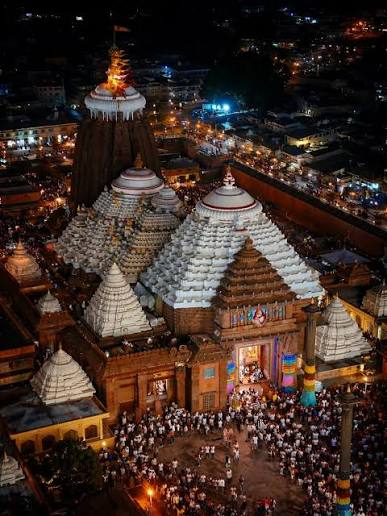
On the eastern coast of India, lies the sacred town of Puri, a name synonymous with the iconic Jagannath Temple. This ancient shrine, dedicated to Lord Jagannath has been drawing pilgrims and seekers from across the world for nearly a millennium. Built in the 12th century AD, the temple stands as the beating heart of the Jagannath cult, its towering spire a beacon of faith visible for miles around. Rising majestically from a raised platform, this architectural marvel is more than just a place of worship.
Unlike other temples in the region, the walls of Jagannath Temple are adorned predominantly with divine figures, creating a celestial pantheon in stone. The entire complex, enclosed within two concentric walls known as the Kuruma ,Bheda and Meghnad Pachira, tells a story of continuous evolution, with additions enhancing its grandeur well into the 16th century.
Lord Jagannath, also popularly known as Mahaprabhu, is the Lord of Neelachal. The word Jagannath is derived from confluence of two Sanskrit words, Jagat meaning “universe” and nātha meaning “Master” or “Lord”. Thus, Jagannath means “Lord of the universe”. The trio of deities consisting of Lord Jagannath, Balabhadra and Subhadra are worshipped at the temple.
Lord Jagannath, Lord Baladev and Maa Subhadra are worshipped on the Ratnavedi (the sacred and the highly revered inner sanctum platform in Jagannath Temple in Puri) along with Sudarshan Chakra. The four deities are carved out of dark coloured Neem wood, which is considered auspicious for all castes. This also signifies that Jagannath is beyond space and time and , symbol of universal love and brotherhood. This depicts the uniqueness of Shri Jagannath deity unlike other deities in Hindu temples, which are carved out of stone and precious metals.
The well-known descriptions, as found in the Skandhā-Purana, Brahma-Purana and other Puranas and later Odia Puranas state that Lord Jagannath was formerly worshipped as Shree Neela Madhaba by a Savar king , the tribal chief, named Vishwavasu.
It is said that, king Indradyumna was ruling over the Malava country (present-day Malwa region in west-central India) in Satya Yuga, the age of Truth. He was a great devotee of Lord Vishnu. After knowing about the Lord, King Indradyumna directed a Brahmin priest, Vidyapati to discover the deity, who was worshipped secretly in a dense forest by Viswavasu. Vidyapati tried his paramount resources to locate the place, but he failed in the beginning . However, at the end, he managed to convince Viswavasu’s daughter Lalita to marry him. Following the marriage , due to repetitive requests of Vidyapti, Viswavasu took his son-in-law blind folded to a cave where Lord Neela Madhaba was worshipped. Vidyapati was intelligent , in order to identify the path, he dropped mustard seeds on the ground , while he was travelling along Vidyapti . The mustard seeds sprouted into plants in a few days, which identified the way to the cave later on. On hearing the good news from him, King Indradyumna proceeded instantly to Odra desha , now known as Odisha, on a pilgrimage to visit the Lord. But on arrival he found the deity was missing. The king felt dejected but was adamant not to return without having a darshan of the Lord . He decided to perform fast unto death at Mount Neela, then a celestial voice cried ‘Thou shalt see him.’
Subsequently, the king performed one thousand Ashwamedha Yajna (sacrifice) and built a magnificent temple for Vishnu. The first Murti of Lord Narasimha was brought by Narada which got installed in the temple. Subsequently, during sleep, the king got an image in his dream of Lord Jagannath, Balabhadra, Subhadra and Chakra Sudarshan. A cosmological voice also directed him to bring the massive dark coloured, Divine Log of wood floating in the seashore and make idols out of it.
Sage Narada advised to bring the Divine Log of wood to a high altar, presently identified as the Mahavedi (the “great altar” used in ancient Vedic fire rituals or the sacred grounds of a prominent temple). Then Shri Visvakarma, the divine architect emerged in the guise of a wrinkly oldie carpenter and requested the king for giving him an opportunity to carve the wooden idols which were to become deities. The carpenter had made one condition with the king and queen, stating not to open the door of the till 21 days. However, just after two weeks, one fine day, the Queen became very anxious as she couldn’t hear any noise from inside. She assumed the carpenter to be dead and requested the king to open the door. On the 17th day , the king opened the door, but to their surprise , they found the three idols unfinished with incomplete hands , and carpenter being disappeared . But a divine voice told King Indradyumana to install these deities in the temple. The king Indradyumna then requested Shri Visvakarma to build a magnificent temple to house the deities, near the Kalpabata. Finally, the deities were installed in the temple by Brahma with divine rituals.
Lord Jagannath is known as “Darubrahma’’. In the 28th Chapter of Skandā-Purana Purushottāma-kshetra Mahatmya, Lord Brahma Himself reveals the true identity of Lord Shri Jagannath when he instructs King Indradyumna with these words: “Thinking it is a wooden image, O pre-eminent King, let there not be the idea in you that this is a mere image; this is verily the form of Supreme Brahman (Supreme Omnipresent God). As Param-Brahman takes away all sorrows and confers eternal bliss, He is known as Daru. According to the four Vedas therefore, the Lord is manifest in the form of Daru (sacred wood). He is the Creator of the entire Universe. He has also created Himself.”
King Indradyumna then introduced the daily and special festive rituals of the Lord, as per scriptures, which continues till date. The temple of Lord Jaganath constructed by King Indradyumna is considered to be the tallest monument of the world with 1,000 cubits high and also the most beautiful Temple for Lord Vishnu.
Lord Shree Jagannath , Darubrahma
Shree Jagannath, Shri Baladev and Mata Subhadra are worshipped on the Ratnavedi along with Sudarshan chakra. All these deities are carved out of dark coloured Neem wood, unlike deities in Hindu temples, which are carved out of stone and precious metals. Shri Jagannath is black in complexion, Shri Balabhadra is white , Mata Subhadra is turmeric yellow and The Sudarshan chakra is red in colour. These deities are unique and signifies that Shri Jagannath is beyond space and time and symbol of universal love and brotherhood.
The glory and descriptions of manifestations of Shree Jagannath has been described in many sacred scriptures of Sanatana Vaidika Dharma ranging from the Vedas to the Puranas, followed by literary compositions in Sanskrit, Odia and other languages.
Lord Shree Jagannath, Purusham Mahantam, The Supreme Divine Being
“He (The Supreme Divine Being) is without hands, feet (and yet) moves and grasps; He sees (though) without eyes; He hears (though) without ears. He knows whatever is to be known, and of Him, there is no knower. They speak of Him as the First, the Purusha and the Great.” Shvetasvetara Upanishad.
Shree Jagannath is Omnipresent , Omnipotent, and Omniscient . He is Parameshwara (Supreme Lord) Param-Brahman (Supreme Omnipresent God) and Paramatma (Supreme Self).
Shree Jagannath is revered and prayed by his ardent devotees in many names. Truth is one; wise speak of it in different ways.
He is Purushottama, that means, the Supreme Divine Being (Purusha means Divine Being; Uttama means Supreme).
He is Mahaprabhu. His open arm is a welcoming posture. He invites, embraces and protects his devotees.
He is “Mahabahu“. His parallel arms extend to unlimited points and helps limitless devotees who surrender to him.
He is “Nirakara“. He has a divine manifestation with a square flat head, face merging with chest, no neck, no ears and no limbs.
He is “Chakadola” .The divine Eyes are big, dark and round. He sees everything, hears everything and knows everything.
Lord Jagannath is dark, Black, in complexion, Balabhadra white and Maa Subhadra is turmeric yellow. The Sudarshan chakra is red in colour. The Lord of all religion whether Hindu or non-Hindu all find solace and relief in him even though they have different interpretations for Him. That is why it is said: truth is one; wise speak of it in different ways. In this way, Lord Jagannath is invoked and worshipped by devotees belonging to diverse religious faiths and traditions, each in their own way.
THE RATHA YATRA…
The Rath Yatra or Chariot Festival has been celebrated in Puri for over a millennium. Its origins trace back to the 12th century. According to Hindu scriptures, it commemorates Lord Jagannath’s annual visit to his maternal aunt’s place, the Gundicha Temple. The legend states that the annual journey begins when the reigning king of Puri used to ceremoniously sweep the chariots and streets along with the courtiers and common folk before the deities were transferred onto the chariots. This tradition has been kept alive to the present day.
The grand festival begins on the Dwitiya Dina when the deities are brought out onto the chariots in an elaborate ritual called Pahandi amid ceremonies, chants, and drumbeats. Millions of devotees join in to pull the chariots, with the sacred Brahma Toran leading the path as a symbolic chariot guard during the Jagannath Puri Yatra.
After a nine-day sojourn at the Gundicha Temple, the return journey of the deities from the aunt’s place marks the Bahuda Yatra. This festival has continued to uphold its glory over centuries, attracting devotees worldwide to Puri.
Types of Raths:
Nandighosa Rath: This is the largest and most prominent of the three chariots, dedicated to Lord Jagannath. Standing at an imposing 45 feet tall and 35 feet square, it has 16 wheels and is decked in bright yellow and red colours with carvings depicting episodes from the Krishna Leela.
Taladhwaja Rath: This 44-foot-high chariot carries the idol of Lord Balabhadra, the elder brother of Jagannath. Decorated in shades of red and green, its carvings depict stories from Hindu mythology, like the Ramayana.
Darpadalana Rath: The smallest of the three at 43 feet high, this chariot is meant for Lord Jagannath’s sister Devi Subhadra. Its carvings illustrate the Vamana and Krishna avatars of Lord Vishnu. It has a distinctive black and golden hue.
Nandighosha Behera: This is the smallest chariot that leads the procession carrying the Pahandi, who bears Lord Jagannath’s Netranruttu (symbolic vision).
Chakra Rath: A relatively new addition, this chariot carries the deities’ sacred symbols like the Chakra, Shankhanalin, Padma, and Gada, representing power, prosperity, and divinity.
The construction of these ornately carved raths is a painstaking process spanning centuries of craftsmanship. On the festival day, scores of devotees join in the ritual of pulling these mammoth raths through the Bada Danda (Grand Avenue) of Puri.
It is believed that many years after the creation of this magnificent temple, many mystical things happen that continue to defy scientific explanations. Such as :
· The Flag and the Wind: Unlike natural wind patterns (which usually blow from the sea to land during the day), the breeze near the temple often reverses. The flag atop the dome also flutters in the opposite direction of the wind every single day.
· No Flights or Birds: The airspace above the temple dome remains completely clear of birds and airplanes, defying the usual habits of migratory birds around tall structures.
· Soundless Approach: As soon as visitors pass through the main entrance (the Singhadwaram), the loud, roaring sound of the Bay of Bengal waves completely disappears. The sound returns the moment they step back outside.
· Shadowless Dome: The massive structure is said to cast no shadow at any point during the day, a phenomenon often attributed to ancient, advanced architectural geometry.
· The Miraculous Kitchen: Priests cook Mahaprasad daily using seven earthen clay pots stacked on top of one another over a wood fire. Bafflingly, the food in the topmost pot cooks first, contrary to the laws of thermodynamics. Furthermore, the quantity cooked never falls short or goes to waste, regardless of the crowd size.
· The Sudarshan Chakra: The massive Sudarshan Chakra resting on top of the temple is crafted so that it always appears to be facing the observer, regardless of where they stand in the city.
The Brahma Padartha: Unlike most Hindu deities, the idols at the temple are made of sacred wood (Neem) and are replaced every 12 to 19 years during the Nabakalebara ritual. During this time, a mysterious and secret core element known as the Brahma Padartha is transferred from the old idols to the new ones by blindfolded priests. The exact nature of this substance remains a closely guarded secret.
Why No one sleeps peacefully inside Jagannath temple?
Every evening, as the sun sets over Puri, the grand Jagannath Temple prepares for a sacred ritual called Pahuda – the time when Lord Jagannath, along with his siblings Balabhadra and Subhadra, is believed to rest for the night.
Unlike most temples, where the idols are symbolic, here the deities are treated as living beings. They eat, bathe, sleep – and just like any royal family, they are given complete privacy after dusk.
Once the night rituals are completed, the temple doors are closed, and a strict tradition comes into play: no one is allowed to stay inside not the priests, not the guards, not even the temple caretakers. It’s a rule that has been followed for centuries, without exception.
Locals believe that powerful divine energy fills the temple at night – an energy so strong that ordinary humans are not meant to be in its presence. Some even say that celestial beings descend to offer prayers or serve the Lord during these sacred hours.
There are also mysterious stories – of people who tried to spend the night inside, only to fall ill, lose their sanity, or never return. Whether one believes them or not, they’ve become a part of the spiritual lore of Puri.
This tradition is more than just a rule. It’s a sign of devotion and discipline, showing that the Lord isn’t just worshipped – He is lived with, respected like a real king in his palace.
By morning, the temple comes alive again. But by night, it belongs entirely to the divine. And so, for hundreds of years, no soul sleeps within its sacred walls.
THE MYSTERY OF RATNA BHANDAR
The Ratna Bhandar is the most mysterious and legendary treasure chamber of the Jagannath Temple in Puri. It is believed to be an underground vault that has stored wealth, gold ornaments, diamond crowns, and priceless artifacts for thousands of years. According to tradition, this treasure was collected from donations by kings like Indradyumna, Anangabhima Deva, and later Gajapati rulers during different eras.
The Ratna Bhandar is divided into two parts: the Outer Chamber, called Bahara Bhandar, and the Inner Chamber, called Bhitara Bhandar. The Outer Chamber was opened in 1978 and some old inventories were found, but the Inner Chamber has never been opened in modern times. It is said to be sealed with massive iron doors and protected by divine forces. Several attempts by the Archaeological Survey of India and the Odisha government to open it have failed due to technical issues, legal disputes, or structural risks. Priests and devotees believe that the chamber can only be opened with the permission of Lord Jagannath himself, and any forced attempt may bring misfortune. Because of this, the exact contents and secrets of the Ratna Bhandar remain unknown, making it one of India’s greatest unsolved mysteries.
Architecture of Jagannath Temple:
The Jagannath Temple is a splendid example of Kalinga architecture, characterized by its towering spires, intricately carved walls, and a central sanctum housing the deity. The main temple complex comprises four structures: the Vimana (main sanctum), Jagamohana (assembly hall), Natamandira (festival hall), and the Bhoga-Mandapa (offering hall). The imposing spire, known as the “Deula,” reaches towards the heavens, symbolizing a connection between the mortal and divine realms.
One of the most striking features of the temple is the intricately carved stone sculptures adorning its walls. These carvings depict scenes from Hindu mythology, celestial beings, and intricate patterns that showcase the artistic prowess of the ancient craftsmen. The sheer grandeur of the architecture leaves visitors awe-struck, inspiring a sense of reverence and admiration for the cultural heritage preserved within the temple walls.
Conclusion
The Jagannath Temple in Puri is not just a building made of stone. It’s a place where faith feels alive. For almost 1000 years, people from every corner of India and the world have come here with the same hope – to see Lord Jagannath. The stories of King Indradyumna, the wooden idols with no hands, the Ratha Yatra where God comes on the road, and the mysteries like the flag and the kitchen… none of them have clear answers. Maybe we’re not supposed to find answers for everything. Maybe some things are meant to be believed, not explained.
What makes Puri special is not just religion. It’s the feeling of equality. In Ananda Bazar, rich and poor eat the same Mahaprasad sitting on the floor. During Ratha Yatra, there’s no VIP line. Everyone pulls the same rope for the Lord. That’s why He’s called Jagannath – Lord of the Universe, Lord of everyone.
So Puri remains what it has always been – the abode of the Divine Trinity. A place where God doesn’t just sit inside the temple. He steps out, He sleeps, He eats, He meets His people. And that’s why even today, millions of hearts find peace the moment they say “Jai Jagannath”.
By: Rajlaxmi Sahoo
Write and Win: Participate in Creative writing Contest & International Essay Contest and win fabulous prizes.
About the Author