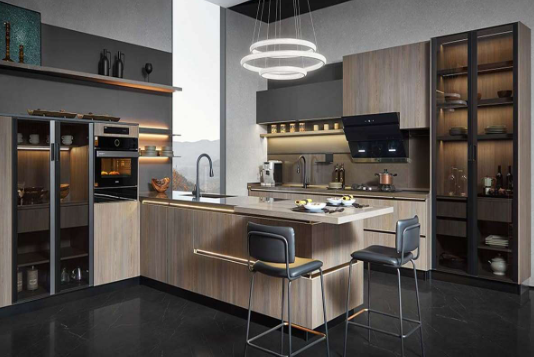
“Italian kitchen brands” has long been shorthand for something more than cabinetry. It is a promise of impeccable design, artisanal tradition, and an eye for detail that has been refined over generations. From the sleek minimalism of Boffi — founded in 1934, often called the “Ferrari of kitchens” — to the architect-led collections of Arclinea and the global reach of Scavolini, Italy has set the standard for kitchen furniture for decades. The Italian wood‑furniture supply chain, which includes but is not limited to kitchens, recorded a turnover of €52.2 billion in 2025, driven by strong domestic demand and successful export diversification.
Against that backdrop, can OPPEIN compete? The question is worth asking, but it may be the wrong one. A more useful way to frame it is this: where do Italian brands excel, and where does OPPEIN offer a different — and for many buyers, more compelling — value?
This article offers a fact‑based look at both, grounded in publicly available data and market realities rather than marketing claims or national stereotypes.
The Italian Strengths: Design, Heritage, and Exclusivity
Let’s begin by giving Italian kitchen brands their due. The strength of Italy‘s kitchen sector is not hype. Companies like Boffi (founded 1934, 145 employees, 25+ showrooms worldwide) have built a reputation on collaborations with world‑renowned architects such as Piero Lissoni and Antonio Citterio. Arclinea, based in Vicenza and designed by Antonio Citterio, is known for translating restaurant kitchen ergonomics into residential spaces, producing exclusively in Italy with no outsourcing. Scavolini, founded in 1961 and Italy‘s No. 1 kitchen furniture manufacturer since 1984, has over 300 foreign points of sale plus 900 across Italy, making it a genuine international player.
Italy’s kitchen furniture market itself was valued at over €2 billion in 2025, with major players including Scavolini, Arclinea, and Snaidero holding significant positions. Italian kitchen exports predominantly occupy the medium to high end of the market. Luxury houses (Boffi, Poliform) and midrange leaders with premium sub‑brands (Scavolini, Veneta Cucine) operate at significant volumes.
The Italian edge is real, but it is not infinite. The kitchen furniture sector in Italy is populated by hundreds of small manufacturers. In 2024, approximately 263 companies produced roughly 950,000 kitchen cabinets nationwide. By comparison, OPPEIN alone — as one company — produced over 920,000 kitchen cabinets that same year. The comparison is not meant to dismiss Italian craftsmanship. It simply illustrates a fundamental difference in scale and industrial philosophy.
Where the Scale Difference Becomes Visible
Here is where the comparison becomes concrete. OPPEIN reported 2025 annual revenue of 172.32 billion yuan. Its kitchen cabinet segment alone generated 54.50 billion yuan. This scale is not about bragging. It is about what large‑volume manufacturing enables: the same Blum and Hettich hardware used in premium European kitchens, sourced at industrial quantities; automated production lines from HOMAG that reduce variance across thousands of units; and a vertically integrated system that keeps costs manageable without downgrading components.
Because OPPEIN manufactures kitchen cabinets at a vastly larger volume than any single Italian brand (or possibly all of them combined), the company can offer configurations that simply do not exist at accessible price points in the European market. A developer building a 200‑unit apartment complex cannot specify Boffi in every unit — the per‑unit cost would break the budget. But they can specify OPPEIN with the same hinges and slides. That is not a compromise. It is a different business model built around a different market segment.
Italian kitchen brands excel at low‑volume, high‑touch production. OPPEIN excels at high‑volume, high‑consistency production. Both can be excellent at what they do. The choice depends entirely on the buyer‘s specifications.
Certifications and Materials: The Gap Has Narrowed Significantly
One common assumption among buyers unfamiliar with OPPEIN is that environmental and quality standards might lag behind European requirements. The data suggests otherwise.
OPPEIN holds ISO 9001 (quality management) and ISO 14001 (environmental management) certifications, along with FSC certification for responsible wood sourcing. The company’s panel products meet E1 emission standards — the same European safety benchmark—and satisfy California Air Resources Board (CARB) requirements. Its formaldehyde‑free boards carry US NAF certification (No Added Formaldehyde) and US CARB NAF certification. Its quartz stone surfaces are NSF certified. Imported quartz from Caesarstone and Silestone carries GreenGuard certification.
These are not lesser standards. They are the same standards that Italian and German exporters must meet to access regulated markets like North America and the European Union. OPPEIN complies because its international customers require it.
The company has also invested in R&D specific to health and safety. Its patented Eco‑baked Paint panels incorporate formaldehyde‑purifying technology demonstrated to break down airborne pollutants at a consistent 82.4% efficiency rate. Independent testing of OPPEIN‘s formaldehyde‑free boards has recorded release levels as low as 0.02 mg/m³ — a figure that is actually better than China’s upgraded ENF standard (≤0.025 mg/m³), a threshold currently among the world‘s strictest. In an era where indoor air quality has become a serious concern for architects and developers, these performance metrics are not trivial.
The Italian Design Difference: What Money Cannot Replicate Locally
Let us be precise about what Italian kitchen brands offer that OPPEIN does not currently replicate. It is not “better quality” in any measurable sense — the materials and hardware can be identical. It is something else: an intangible ecosystem of design heritage, architectural collaborations, and craftsmanship branding that simply does not exist outside Italy at the same intensity.
When a designer specifies Boffi, it signals something about the project — a commitment to design as art, not just function. When a luxury hotel chain chooses Arclinea, they are buying into a narrative of Italian material culture that extends beyond the kitchen itself.
OPPEIN does not claim to replace that. The company has taken a different path, opening a Milan design office in 2012 and collaborating with Italian designers through its Designer Alliance. But a Chinese manufacturer cannot be Italian, and OPPEIN does not pretend otherwise. What the company offers instead is world‑class manufacturing of kitchen cabinets that can incorporate the same components and meet the same global standards — but without the Italian price premium.
This distinction matters because many buyers do not need the Italian design narrative. They need high‑end kitchen cabinets that look excellent, function flawlessly, and fit a realistic budget. For those buyers, OPPEIN is not a substitute — it is simply a better fit.
Real‑World Performance: OPPEIN vs. Italian Brands in the Global Market
Data suggests that buyers have been making this choice for some time. OPPEIN‘s 2025 overseas channel revenue reached 471 million yuan, up 9.66% year‑over‑year, with the overseas distribution channel growing by more than 20%. Southeast Asia, Europe, and the Middle East each saw overseas business growth exceeding 30%. In June 2024, OPPEIN opened a flagship store in Panama with the country’s newly inaugurated president attending the ribbon‑cutting ceremony.
These are not niche sales. OPPEIN is actively competing in some of the same international markets as Italian brands, particularly in the Middle East, Southeast Asia, and parts of Europe. The company‘s branded stores now cover 62 countries and regions worldwide, and it has completed over 180,000 international projects.
Italian brands export heavily, with companies like Scavolini and Arclinea maintaining strong footholds in North America, Europe, and the Middle East. But the export model is different. Italian manufacturers typically operate through dealer networks and high‑end showrooms, while OPPEIN‘s model includes wholesale distribution, franchise partnerships, and direct project contracting — in some cases, reaching customers that cannot afford European luxury pricing but still demand quality.
The Pricing Reality
Here is the question buyers inevitably ask: how much cheaper is OPPEIN? The exact percentage varies by project size, specification, and negotiation. But industry observations suggest that in equivalent configurations, European brands can be priced 2 to 3 times higher than joint‑venture brands and 3 to 5 times higher than domestic Chinese brands — with luxury Italian brands sometimes carrying even larger premiums.
Two factors drive this difference. First, OPPEIN‘s vertical integration — controlling raw material sourcing, component manufacturing, assembly, and distribution under one corporate umbrella — removes intermediaries. Second, the sheer volume of production spreads fixed costs across a much larger number of units.
What this means in practice is that a developer or contractor can specify a kitchen from OPPEIN that uses Blum hinges, Hettich slides, and CARB‑compliant panels at a fraction of the cost of an equivalent Italian kitchen. If design branding is not the top priority, that equation is difficult to ignore.
So, Can OPPEIN Compete?
The answer depends entirely on how you define “compete.” If the question is whether OPPEIN can match Italian kitchen brands on design heritage, exclusivity, and artisanal reputation — no, and it does not try. That is not the company‘s play.
If the question is whether OPPEIN can deliver kitchen cabinets that meet the same global quality standards, use the same global hardware, and satisfy the same international certifications as Italian brands — the answer is yes, consistently and at scale. OPPEIN‘s annual kitchen cabinet output of 920,000+ units, $172.32 billion corporate revenue (group level), and global project footprint across over 130 countries reflect a company that has earned its place at a different table.
The fairest assessment is this: Italian kitchen brands remain the undisputed leaders in design, craftsmanship narrative, and luxury positioning. For projects where those elements are non‑negotiable — where the brand name itself is part of the value proposition — Italy still has no equal.
But for the vast majority of kitchen projects around the world — residential developments, hotel chains, large‑scale renovations — the difference between a well‑executed kitchen from OPPEIN and an Italian counterpart is often less about measurable quality and more about origin story. And for buyers who value the former over the latter, OPPEIN is not just a competitor. It is a compelling alternative.
Write and Win: Participate in Creative writing Contest & International Essay Contest and win fabulous prizes.
About the Author