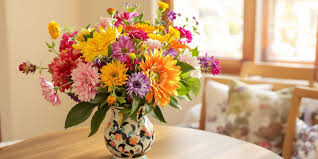
A gift to celebrate a new home is not just a gift – it determines what the person will keep in mind about their first few days in a new place. In this regard, seasonal flowers perform better than almost anything else you can give, and there are plenty of arguments that support this!
The problem with out-of-season flowers
When you walk into a supermarket and see roses not only wrapped in plastic but cut weeks prior, flown halfway across the world, moved on and off multiple trucks, and often put into cold storage for days, it’s easy to be fooled by their shiny packaging. They certainly look pretty – but you’ll inevitably end up disappointed by how quickly they die.
The reality is that the vase life of a flower is massively impacted by the stress of long transport (often week(s)) of travel and the rising and falling temperatures of the cold-chain process. When the bouquet arrived, the cells in the walls of the stems were already compromised. You were sold a dying product that day. A flower picked and processed locally this morning before being wrapped and kept in the right humidity is an entirely different phenomenon – much stronger, more vibrant, and likely still opening further three days after it’s put in water.
Freshness, value, and what you’re actually paying for
Flowers that are in season are generally more affordable. Since florists can easily obtain them in abundance locally, they sell more of them by the stem, and can create more complete bunches with the same budget amount. You don’t have to cover the cost of shipping, refrigerated storage, or imports.
Flower varieties that are grown regionally and currently in season can have a carbon footprint that is up to 90% smaller than those that are imported from overseas (AIPH). The environmental argument parallels the sensible argument: fewer middlemen result in a fresher product that costs less and has less spoilage.
So, when choosing a gift for a housewarming, the fact that your florist sources blooms from local farmers does make a difference. A Melbourne Victoria flower delivery service that buys straight from the paddock can have your flowers hydrated in a vase within the same day they are harvested, ensuring that the bouquet that gets sent to that new house is at its peak and not wilting.
Seasonal blooms and the environment they’re entering
There is a pragmatic argument here which we don’t talk about often enough. Flowers perform better when they share a climate with the one they grew in. If it’s late autumn and the home is being heated to around 20 degrees, blooms that were naturally developed in cool, mild weather will do much better than tropical plants that were imported and chilled for shipping.
Being aligned with the season also means that the flowers reflect what’s going on outside. When a new homeowner looks from their living room to the garden, or glances at the street on a walk, there’s a natural connection between the inside and the outside. That connection adds to what designers refer to as biophilic connection – the sense that a space is part of the natural world rather than completely cut off from it. It’s a more esoteric quality than a scent or a color, but it is real.
The memory anchor effect
Scent is our most direct route to long-term memory. The smell of a particular bloom that you experienced during an emotionally significant period – like moving into a new home – gets locked in with those memories in a way that visual stimuli just can’t replicate.
The same is true of seasonal flowers on purpose. Someone new arrives for spring and gets freesias or sweet peas, and that becomes a part of what spring-smelled like at the time. Then a decade later, the whiff of the freesia or the sweet pea can launch you back there. That’s what the scent of the gesture is – not just “I brought flowers” but “I brought the precise flowers for this precise moment.”
The imported, out-of-season flowers, by contrast, often come with almost no smell at all. The cold chain depresses the scent. What comes can look okay but give off no scent of anything, and that’s half of what’s going on with cut flowers anyway.
Choosing the right seasonal varieties
You don’t have to be a florist to pick the right seasonal blooms for a housewarming. Here are a few tips you can follow.
Spring is generally a season of soft yellows, whites, and pastels. Think tulips, ranunculus, and daffodils. They’re flowers that suit a house breathing, opening up, and getting aired after winter’s sealed it off. Summer flowers are typically bolder, fatter, and gaudier; sunflowers, dahlias, and those tough, leathery little natives like Banksias or Proteas that can survive the midday heat trapped between a vase and the lounge room wall. Summer flowers are designed to stand out precisely because they’re usually experienced outdoors, surrounded by other flowers doing their level best to be even showier. Autumn flowers are the colours of that season: burnt oranges, deep reds. richer, darker hues mixed with textural fare like chrysanthemums. Winter flowers are what you’d put in a wreath, and mix with lush greenery and spiky, non-floral elements. Best of all, a winter bouquet might include the likes of hellebores, or fragrant paperwhites.
Write and Win: Participate in Creative writing Contest & International Essay Contest and win fabulous prizes.
About the Author