Agriculture is a vital sector in supporting human needs, particularly in meeting food requirements. However, as times change, this sector faces a range of challenges. Amidst the accelerating pace of urbanisation, the greatest challenge to food security is the availability of productive land. In this context, the emergence of Artificial Intelligence (AI) represents an innovation that could provide a solution to enhance agricultural efficiency and productivity. The synergy between artificial intelligence and human creativity is no longer an option, but a necessity. Therefore, it is vital to understand the role of AI in agriculture, its positive and negative impacts, and the challenges it will present.
The ever-increasing global population explosion is causing agricultural land to shrink as it is converted into housing, industry, and other infrastructure. The imbalance between food demand and land availability poses a serious challenge to global food security, particularly in densely populated areas. If this situation continues, a food crisis will no longer be a prediction but an inescapable reality.
AGRICULTURE TECHNIQUES FOR FALLOW LAND
Amidst these constraints, the concept of ‘residual land farming’ has emerged in metropolitan areas, utilising previously overlooked spaces such as narrow plots, concrete walls, and even building rooftops. With the right technological approach, these once unproductive spaces can be transformed into sources of self-sufficient food production. This transformation can shift the paradigm ‘from constraint to opportunity’. Therefore, the success of agriculture is not merely measured by the size of the land but by how humans are able to integrate their intelligence with renewable technologies, particularly artificial intelligence (AI). Consequently, this essay will discuss how the synergy between human intelligence and AI can utilise and optimise residual land, as well as how such practices have evolved through technological adaptation in developed nations such as China and Japan.
The utilisation of unused land has undergone a shift in perspective, moving from merely meeting land requirements and land use to becoming a structured and scientific source of food. The concept of unused land is not limited to large tracts of land, but encompasses marginal areas such as building walls, rooftops, and even narrow corners within densely populated residential areas. Vertical farming techniques, for example, offer an effective solution by utilising vertical space to increase plant density per square metre. By stacking growing media in tiers, urban farmers can harvest significantly more produce than with conventional methods. This technique is often combined with hydroponics, a soil-less cultivation system that uses nutrient solutions as the growing medium.
Although efficient and effective, hydroponics presents its own challenges, particularly in maintaining the stability of water pH and nutrient composition, which are sensitive to environmental changes. Additionally, there is the aquaponics technique, which offers an approach based on the ‘zero waste’ concept. This combines aquaculture and agriculture within a closed, efficient ecosystem. In this technique, a mutualistic symbiosis occurs where organic waste from the metabolism of fish (catfish or tilapia), which contains ammonia, is channelled to provide nutrients for plants (water spinach or watercress), and the plants act as a natural biofilter for the water before it is recirculated back into the fish pond.
However, managing such systems manually often presents difficulties. Limited space, coupled with rapidly fluctuating temperature, humidity and water quality, presents the greatest challenge for humans. Even a slight imbalance in water circulation or temperature fluctuations can lead to systemic failure. This requires regular monitoring, potentially around the clock. Human limitations in maintaining continuous monitoring are a key factor in the failure of small-scale modern agriculture.
THE ROLE OF AI IN THE AGRICULTURAL ECOSYSTEM
This is where Artificial Intelligence (AI) comes in as a revolution in precision farming management. AI does not merely act as a simple automation tool, but rather as an analytical ‘brain’ that receives input from various sensors—such as temperature, humidity, nutrient levels and light intensity—and processes the data in real time. Taneja et al. (2024) explain that machine learning algorithms are capable of performing predictive analysis that can provide early warnings before crops show physical symptoms of nutrient deficiency. This detection capability is crucial in small-scale farming, where space is severely limited.
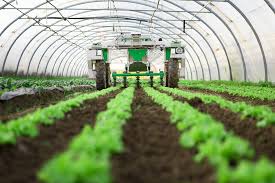
Furthermore, AI is driving innovation in agricultural aspects such as the use of autonomous tractors and drones. Unlike conventional tractors, which require a human operator to remain on the machine for hours on end, in the context of smart mechanisation, Hassan et al. (2025) note that autonomous tractor technology is not merely a driverless vehicle, but a route-optimisation system capable of reducing carbon emissions and fuel costs by 15% through High Precision GPS navigation and LIDAR sensors for independent land mapping. These tractors are capable of tilling the land and sowing seeds in a very neat pattern, ultimately saving on fuel consumption and operational time.
On small-scale plots, autonomous tractors can manoeuvre with centimetre-level precision—a level of accuracy difficult for human control to achieve. Complementing autonomous tractors, irrigation and spraying drones bring efficiency to aerial operations. They are not merely flying objects, but systematic tools equipped with cameras. Whilst flying over the land, the drone scans water stress levels. If it identifies an area lacking water, the drone releases a mist of water or nutrients to ensure growth remains optimal. This drone-based irrigation method reduces water consumption in areas that are already sufficiently moist. Through the combination of these two technologies, residual land farming transforms into an automated, controlled, and resource-efficient ecosystem.
The integration of AI with the Internet of Things further strengthens precision farming systems, enabling landowners to monitor their fields remotely via mobile devices. The IoT acts as the ‘senses’, whilst AI acts as the autonomous decision-maker. For example, if air temperatures in Boyolali and Yogyakarta reach a critical level that could cause crops to wilt, the AI will automatically activate a cooling system to lower the air temperature. The use of Computer Vision technology also enables the use of mini-drones or cameras to scan every leaf to detect the presence of pests or pathogens. By utilising the accuracy of image recognition, AI can recommend specific measures, thereby minimising the use of organic pesticides to only those areas that require it.
HUMAN AND AI COLLABORATION: A SYMBIOTIC RELATIONSHIP
The central argument of this essay is that AI offers support and complements human work, rather than replacing it. The ‘Human in the Loop’ concept positions humans as strategic architects who retain control over the vision and objectives of agriculture, focusing their energy on innovation and marketing techniques. Humans select crop varieties suited to market needs or design garden aesthetics to ensure balance and harmony with the environment. Meanwhile, AI performs repetitive tasks requiring microscopic precision, such as watering plants on time, maintaining humidity, and regulating ammonia levels. In this context, farmers do not perform physical labour but instead transform into data analysts capable of understanding and utilising technology.
However, the success of this collaboration depends on the level of digital literacy within the community itself. Without adequate understanding of the technology, AI will instead become a tool that is difficult to access. Digital literacy is no longer merely the ability to use social media but also the ability to interact with and access cutting-edge technology. Nursyifa (2024) emphasises that without proper education and guidance, the sophistication of AI will be in vain. Therefore, the role of education is crucial in bridging the gap between farmers and future technologies. Through an inclusive educational approach, the community can learn that managing fallow land with the help of AI will foster food sovereignty that anyone can achieve—from students to housewives—and this will lead to widespread community well-being.
One of the most frequently cited arguments is the significant initial investment required. However, when viewed from a long-term economic perspective, the use of AI on marginal land represents a highly competitive form of capital efficiency. Traditional farming often wastes resources, such as water that evaporates needlessly or fertiliser that is washed away by rain before being absorbed into the soil. With the help of AI, the application of inputs can be reduced to a microscopic level. Savings on operational costs for water and fertiliser over several crop cycles can offset the cost of procuring hardware such as sensors and microcontrollers. An economic analysis by Miller and Chen (2025) shows that investment in mid-scale agricultural AI technology has a faster payback period—around 2–3 years—thanks to minimising losses caused by pest infestations detected at an early stage.
Beyond the financial impact, a major contribution of the integration of humans and AI lies in the environmental sustainability aspect. Smart fallow land farming can minimise reliance on chemical pesticides, as the AI’s early detection system is capable of identifying and isolating diseased plants before the infection spreads across the entire plot. This strongly supports the production of organic produce for urban consumers. Furthermore, the utilisation of fallow land and this integration reduces carbon emissions typically associated with food distribution processes. When food is produced on fallow land with the aid of AI, we are building a logistics system that is efficient, low-emission, and resilient to economic fluctuations.
GLOBAL CASE STUDY: INNOVATION IN CHINA AND JAPAN
Looking at the international scene, China’s success in developing vertical farming offers valuable lessons in overcoming extreme land constraints. At a research centre in Chengdu, China has demonstrated that limited horizontal land is not an obstacle if artificial lighting and nutrient distribution are fully controlled by AI. This enables stable food production that is not dependent on the seasons, with a faster harvest cycle of around 35 days. This innovation demonstrates AI’s ability to manipulate plants’ biological clocks to grow faster whilst maintaining high quality. In Indonesia itself, this Chinese-style farming model is highly suitable for implementation in densely populated major cities where land prices are extremely high.
Meanwhile, Japan faces the challenge of an ageing farming population and a declining workforce. To address this, Japan is offering innovations through precision robotics. These robots use deep learning technology to distinguish between ripe and unripe fruit, ensuring that the quality of the harvest sold in the market remains at the highest standard. Japan’s success in overcoming the labour crisis through robotics has become a global standard, as noted by Sato (2024) the use of permanent AI-based robots in Japan’s urban areas has successfully maintained local food stability despite a drastic decline in the number of active farmers. This technology in Japan teaches us that technology is no longer about speed but about maintaining the quality of agricultural products. By adopting Japan’s precision and China’s efficiency, the management of fallow land can be transformed from a subsistence effort into a promising creative economic sector for the younger generation.
CONCLUSION
Based on the above discussion, it can be concluded that the integration of Artificial Intelligence (AI) into the management of marginal land has become a vital necessity amidst the global land crisis. The integration of humans and AI has transformed the paradigm of conventional agriculture into precision and scientific agriculture. As demonstrated in the research by Taneja et al. (2024) on the predictive accuracy of AI and its practical implementation by China and Japan, this technology can transform spatial constraints into extraordinary agricultural productivity. Fallow land, previously overlooked, is being transformed into the backbone of sustainable, self-sufficient food security.
However, no matter how advanced the technology, it remains a tool that requires wise human control. This is where the relevance of Nursyifa’s (2024) thinking on the importance of digital literacy lies. Societies undergoing transition face a major challenge not in the limited availability of hardware, but in the mental and intellectual readiness of the people themselves. Educators must gradually incorporate agricultural education into the school curriculum. This is vital to ensure the empowerment of all segments of society.
In the future, it is hoped that the government and educational institutions can collaborate to create a smart agricultural ecosystem. The development of unused land must be supported by easy access to technology, particularly at the household level. If this synergy runs smoothly, food self-sufficiency and well-being will not merely be a pipe dream written in academic texts, but a reality that flourishes in every small plot of land in our homes. Ultimately, in the hands of the tech-savvy younger generation who care about the environment, every square metre of unused land is a seed of prosperity ready to be harvested for a more prosperous and self-reliant future for the nation.
By: Aghnia Syifia Al – Kansa
Write and Win: Participate in Creative writing Contest & International Essay Contest and win fabulous prizes.
About the Author