Source: Wikipedia
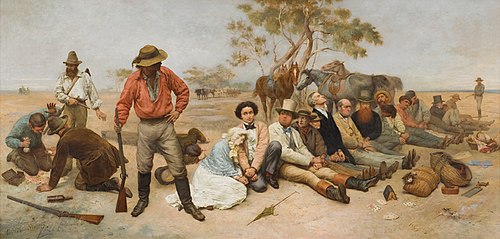
Around 50,000 to 65,000 years ago, people migrated from Africa, South Asia and Maritime Southeast Asia, and came to Australia to start a life. These people were (and still are) called the Aboriginal Australians. Also known as native Australians, the Aboriginals were the first people to settle in Australia and were the first people to call it their home. Alongside Torres Strait Islander peoples, which were people from the islands between Australia and Papua New Guinea, Aboriginals created their own languages and different ways to communicate with each other. Two key ways were storytelling or drawings. The Indigenous (a term for both Aboriginals and Torres Strait Islanders) people came up with symbols and those symbols carried a different meaning. The Indigenous Australians also had Dreamtime stories, which explained the landscape of Australia, creation of the world and laws of living. Some popular Dreamtime stories included The Rainbow Serpent, Tiddalick the Frog, Moonman and How the Kangaroo Got Its Pouch.
The Indigenous peoples’ lived like heaven on earth. They were taken care of, were well fed and had a place to call home. All was going well until April 19th, 1770, which marked the date Captain Cook landed in Australia. He sailed from Britain to Botany Bay (New South Wales) in search of new land to take under possession of Great Britain. One may also be familiar with a date also known as January 26th, 1788, as that is known as Australia Day. January 26th, 1788 marks the date the First Fleet arrived in Australia. The First Fleet consisted of convicts from Britain brought to Australia to do laborious tasks. These convicts were from young children to the elderly, with most of them being young adults. The convicts kept arriving in Australia between 1788 to 1868. When Captain Cook found out that people were already living in Australia, his main goal was cleansing that was to slaughter them, or put them to work. This is what marked the start of what we call the Stolen Generation.
The Stolen Generation was and still is quite a sensitive and dark topic in Australian history. Despite that time period being over, it once went on for over to unforgettable sixty years. During those years, the Australian government commanded Indigenous children (under the age of eighteen) to be forcibly removed out of their families and put with white/European families as part of an “assimilation project.” This time period changed the direction of Australian history for better, with more notable changes being identity, government responsibility and reconciliation efforts.
The events around the Stolen Generation took place over an extended period of time, beginning in the late 1800s and continuing into the mid 1900s. From around the 1860s, the Australian colonial government began introducing various policies, which allowed people working for the authorities to take away Aboriginal and Torres Strait Islander children from their families. These policies became more normalised as of the early 1900s, which is also when the White Australia policy was introduced, banning all non-white immigrants from entering Australia. The forced removals went on for decades, with the peak happening between approximately 1910 and 1970. It wasn’t until the late 1960s, following events like the 1967 referendum, that the policies began to shift, leading to an eventual end in these horrendous practices. In 1997, the Bringing Them Home report was released to the public, exposing the extent and impact of the removals. In 2008, former Prime Minister Kevin Rudd formally apologised to the Stolen Generations and their descendants, marking a significant positive step towards national recognition and reconciliation.
After the government would forcibly remove the First Nations (Indigenous) children out of their families, they would often send them to foster homes, where they learned how to live and adopt the white people’s culture. Those children would be brainwashed into forgetting their own culture, language, customs, traditions and even their own family members. Once properly “trained and tamed,” the government would send them to live with white families (where they were not treated like children, but rather as slaves) until they turned 18 years old. When they turned 18 years old, they were forced out of the house and had to learn how to survive all by themselves. Usually, as a result of Indigenous children being taken away at a very young age, they mostly did not reconcile with their families at all. Whilst some had very joyous and emotional reunions, unfortunately most did not meet their families at all.
A significant First Nations person who survived the Stolen Generations was Eileen Mosely. Eileen lived safe and sound with her family and their community near Finke in the Northern Territory until she was six years old. A trip to Alice Springs (Northern Territory) to visit a family member’s hospital was what put her in the sights of the authorities. She was forcibly removed from the street and taken to live in institutions and foster homes for the rest of her childhood. Eileen recalls that her parents protested when she was forcefully taken but their protest was ignored, and she was taken to St Mary’s (formerly Mt Blatherskite) hostel. “So they see me there in Alice Springs, a little half-caste kid walking with all these tribal people. They snatched me from there, on the corner near the welfare office. They just grabbed me, and took me,” Eileen recalled.
Nearing the end of the Stolen Generation, on the 27th of May, 1967, Australians from all around the country protested for the Indigenous rights. They firmly believed that since this is their land and was stolen forcefully, and it is their children that were being taken away, the least the government could do to seek forgiveness for their evil past was to give the First Nations people rights. This was called the 1967 Referendum. Before this protest, Aboriginals and Torres Strait Islanders did not have a right to vote, and the public wanted that to change immediately. It took a decade of campaigning for change. Nearly 91% of Australians voted to amend the Constitution. This change meant that Aboriginal and Torres Strait Islander people would now be counted as part of the population and would be acknowledged as equal citizens, and that the Commonwealth would be able to make laws on their behalf. Today that day is called The National Sorry Day every year on May 26th.
After the referendum, just short of forty one years later, on February 13th, 2008, former Australian Prime Minister Kevin Rudd came out with a public apology towards the First Nations people. In this speech, he acknowledged the Stolen Generation. He talked about the deep pain, life-long trauma and possible intergenerational scars caused by those evil actions. He apologised on behalf of the Australian government and their discriminatory policies, specifically saying ‘sorry’ for the horrendous laws. He recognised their suffering and trauma, highlighting the emotional, cultural and psychological harm that individuals, families and communities had to go through for decades, as well as talking about the loss of identity, language and connection to country and their culture. He talked about condemning racism and discrimination, stating how the laws and policies of the Stolen Generation were built off racist beliefs.
He talked about having respect for the Indigenous cultures and how resilient they were despite the amount of racism and injustice they faced since the last 1700s. Rudd talked about bridging the gap, which was a strategy launched by the Australian government in 2007 to reduce the disadvantage that the Indigenous people faced when it came to basic necessities like health, education and employment. He talked about reconciliation, wanting to start a new chapter between Indigenous and non-Indigenous Australians. Lastly, he talked about focusing on the future. While acknowledging the past, he emphasised in his letter about building a better future for upcoming generations.
The Stolen Generations one is one of the most traumatic and significant time periods in Australian history. For non-natives, they would have sympathy, of course, but for Aboriginal and Torres Strait Islander people, it felt like families and communities were torn apart. What started off as government policies encouraged by assimilation and control led to the loss of identity, culture, language, heritage and most importantly, family. These treacherous acts had long-lasting effects that the Indigenous may never be able to fully recover from. The trauma that has been endured and passed down through generations, assembling lives in ways that are difficult to undo. Nevertheless, significant progress has been made in acknowledging and correcting this injustice.
While the Bringing Them Home report and Rudd’s apology in 2008 marked important moments of recognition and accountability, events like the 1967 referendum showed the strength and mutual desire for change. Despite how important they are, these acts showed a way of learning from past mistakes rather than erasing it entirely. In the end, the tale of the Stolen Generations is about perseverance as much as suffering. Indigenous Australians have been resilient in protecting their cultures, mending relationships, and fighting for their rights in spite of the challenges they faced. In order for our future generations to strive towards an equal, just and co-operative country, it is more than crucial that the truth of this past is recognised, taught and remembered as Australia continues to grow and move forward. Only by acknowledging the truth and continuing to let everyone have a voice, no matter where they come from, can Australia truly become a better country.
Written By: Isha Chitnis
Write and Win: Participate in Creative writing Contest & International Essay Contest and win fabulous prizes.
About the Author