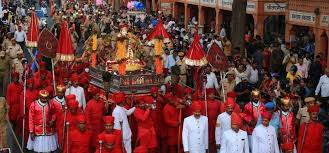
“Gan” refers to Lord Shiva and “Gaur “ or you can say “ Gauri” which is Goddess Parvati, when we combine both words it comes as “ Gangaur”. The name is beautiful ,isn’t it ?. So the festival is, The Gangaur is one of the alluring and culturally rich festivals in India. The curtain of this festival rises on the day after holi which is the first day of Chaitra and it keeps waving for 16 to 18 days. You can witness its biggest imprint in Rajasthan along with joy in Madhya Pradesh , Gujarat and West Bengal.
This Festival is about Parvati’s immense penance to become the life partner of Lord Shiva. Married women perform rigorous fasting for long and healthy life of their husband and a cheerful married life ahead while the unmarried women get involved with deep emotions and devotions so that they can fulfill their future married life with a husband like lord Shiva. The Idols of Lord Shiva which denotes as Isar and Parvati as Gauri have most vital role in whole 18 days of Gangaur festival. The Idols are made from various materials; some prefer heirloom idols which are built with woods,marble and brass while the clay idols have cultural and traditional relevance. The Idols are made by local artisans and household women also made it in their home showing their art and devotion towards it.
The clay structure of idols initially molded into desired figure of Isar and Gauri then leave them to be dried in the sun and in the end it get painted by hands. They are carefully being painted in Rajasthani style with expressive broad eyes like a shape of leaf attached in face which gives enhancement to facial features. When household women decorate the idols they develop a deep emotion specially when decorating the Idols of Gauri as it glorify the feminine beauty. Goddess Parvati (Gauri) is dressed in Rajasthani lehengas and odhnis which has embedded with zari or gotta-patti embroidery and Isar is draped in royal traditional outfit with a safa (turban) on head. The vibrant colors in Idols symbolize different emotions such as red gives love and marital bliss , yellow gives auspiciousness and green gives fertility. The miniature of authentic Rajasthani jewelry such as borla which is forehead ornament, nath – nose ring , bangles and heavy necklaces. All of these act like a cherry on the cake .
Now Idols are the part of the daily rituals for the continuous 18 days of festival, they are being rested at holy place in home and women perform pujas, serve fresh water, flowers, traditional sweets and applying fresh mehndi and sindoor. Young girls make tiny earthen pots with holes in them and they carry it with idols , visit door to door and sing melodious folk songs.
From head to toe the women are indulged in pure traditional Rajasthani attire which sharply glorify culture of Rajasthan and presenting the 16 traditional adornments of a married Hindu woman ( Solah Shringar). On their head they wear borla which is spherical ornament sits perfectly on the hairline. Four Piece traditional Rajasthani outfit which is a pride for the women one is ghagra (a flared skirt), one is a kurti, one is a Kanchali (a fitted blouse with sleeves) and one is an Odhni (a long veil draped over the head and shoulders). They also smear mehndi called Henna on their hands (front side and back side) and feet , the Henna is most important practice in Gangaur festival. Their whole attire cherishes femininity.
Gangaur Majorly known as the Rajasthani Festival, it’s been celebrated by all Hindu communities related to rajasthan the major one is Marwari community. The Royal Rajputs celebrate the Gangaur in a very elegant way which shows the Royal heritage also the other communities like Maheshwaris , Agarwals and Oswals as some of them share the roots with Rajasthan which make them engage themselves in Gangaur festival. The Bhils A tribal community specifically found in Rajasthan , Madhya Pradesh and Gujarat celebrates this festival in very fascinating way as their Gangaur has strong relation with agriculture, the Gangaur itself falls in the month of chaitra ( March- April) and this time the crops which fall under category of Rabi crops like wheat,barley and gram are ready to cut as they started growing during winters the Gangaur is important for them because goddess Parvati also known for nature so they are grateful to her for providing them basic survival thing.
The women of this community sow the newly grown crops into the small earthen pots with soil and the ashes from holi then they observe it for the whole continuous day and if they find the grass popped up as tall thick and pure green then it’s a message from the Gauri that their upcoming crops will be grown very healthy with strong monsoon. The men of Bhil community put the grown shoots behind their ears or at their head in turban as their attire and perform cheerful dance on the last day of Gangaur.
You can witness Majestic celebrations in Udaipur and Jaipur where in Udaipur the Idols are being carried in boats across lake Pichola and the city celebration takes place from the iconic City Palace and wonders through the historic streets.
Now it’s a massive celebration on the final or 18th day of Gangaur. The vibes are full enchanting , joyful and spectacular. Streets are filled with women in procession, Idols of Isar (Shiva) and Gaur ( Parvati) are carried on women’s heads, with happy faces and everyone indulges themselves in celebration. They perform folk dance, dhols are played, Elephants and camels are decorated beautifully. All of these create an unforgettable atmosphere.
At the end the Idols are immersed in the local water body by giving an emotional farewell to Goddess Parvati from her maternal home with Lord Shiva to return to mount Kailash and conclude the festival perfectly.
Let’s take a trip to a story that inspired Gangaur. After the tragic loss of Lord Shiva’s wife Sati. He detached himself from the chaos of the world to mount kailash in immersed meditation. He also slathered himself with the bhasma (ashes) and settled himself between burning deadbodies. The Universe needs balance between masculine and feminine energies and that balance had been disrupted as Shiva had detached himself from the world. To make the balance endure Sati took rebirth as Parvati to marry Shiva. But bringing Shiva back to the real world is like melting Mount Kailash by lightning matchstick, he was so much dissolved that Parvati’s presence didn’t matter to him. Parvati realised that physical beauty and highborn advantage are void in front of him. Parvati started indulging herself in grueling conditions so that she could conquer Shiva’s heart. During her initial days she survived only on fruits and vegetables then she pivoted to leaf and then surrendered also.
Not only sacrificing food but she made herself dwell in meditation so hard. Either there was immense summer or chilled winter , thunderstorm or earthquake none of these were able to hiatus her focus. The thorough dedication of Parvati finally touched Shiva and made him to be out of his meditation but before approving Parvati’s presence in his life he took a test of her where he disguised himself as a young brahmin and mocked Shiva that he lives in graveyard who covered himself in ashes, “ why are you wasting time for him ?” you are beautiful and young, you should look for some wealthy and handsome man. Parvati immediately defended shiva and answered that these are materialistic things and attractions my love for him doesn’t align here. Parvati passed the Shiva’s test and Shiva accepted her whole heartedly. Now let’s complete the bridge of story by looking how Shiva and Parvati tie to Gangaur.
After marriage Shiva and Parvati along with Sage Narad were travelling and they took a halt at a village. A whole hearted gesture by simply living women to Shiv and Parvati where they served them water with simple food but with true emotions without any greed in it. This gesture by them touched Parvati’s heart and she was profoundly amazed then Parvati blessed them with purifying water by sprinkling on them and graced them with happy long life marriage. Also women from high privileged families came and showered parvati with feasts but no holy water was left. To not let them go empty handed, Parvati nicked her finger and sprinkled drops of her blood upon them, graced them also with the same marital bliss. And that’s why women in Gangaur pray to gauri for the same marital blessings.
You also see the 18 days of Gangaur because after tying knot with Shiva ,Parvati went to her paternal home for a visit where she spent 18 days with her family and on the final day Shiva came and accompanied her back to mount kailash. The final day of Gangaur where Idols are being carried to water for the immersion, it pictures the emotional farewell of Parvati from her maternal home to Shiva’s place.
By: Aryam Rathore
Write and Win: Participate in Creative writing Contest & International Essay Contest and win fabulous prizes.
About the Author