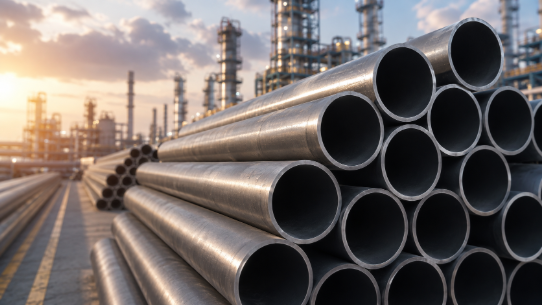
A seamless steel pipe is manufactured without a longitudinal welded seam, but seamless construction alone does not determine whether a pipe is suitable for high-pressure service. Selection should begin with the actual design conditions and project requirements, then move to the applicable material standard, grade, dimensions, wall thickness, testing, and documentation. This sequence helps buyers avoid choosing a pipe simply because it is described as “high pressure.”
Define the Service Conditions for Seamless Steel Pipe
Start with the conditions the pipe will actually face rather than with a supplier catalog. For high-pressure service, confirm the design pressure, design temperature, transported medium, and governing project or piping specification. Pressure and temperature influence material and wall-thickness requirements, while the transported medium may introduce additional material, corrosion, or compatibility considerations. The governing specification determines which technical requirements take priority during procurement.
If an engineer, EPC contractor, end client, or contract document has already defined these conditions, use that information as the basis for the RFQ. Do not replace a specified requirement with a more familiar or readily available option simply because it is easier to source.
When critical design information is missing, clarify it before requesting quotations. Selecting a product labeled as a “high-pressure seamless pipe” first and trying to fit the project around it can lead to incorrect material or dimensional choices.
Once the service conditions are clear, identify the material specification and grade required by the project.
Match the Seamless Pipe Standard and Grade to the Project
Use the governing project specification to identify the applicable material standard, then confirm the grade within that standard. Broad application descriptions are useful for orientation, but they should not replace the project requirement.
For example, ASTM A106 is commonly used for seamless carbon steel pipe in elevated-temperature service, while API 5L applies to line pipe applications. The correct choice depends on the service and project documents, not simply on which standard is more familiar.
Always specify the grade together with its standard. Writing only “Grade B” in an RFQ can create ambiguity because the grade designation alone does not fully identify the required material specification.
Once the standard and grade are fixed, buyers can compare available seamless steel pipe specifications against the same requirement. If a supplier proposes another standard or grade, record it as a technical deviation and send it for engineering review before acceptance rather than treating it as an automatic equivalent.
Confirm Pipe Size and Wall Thickness for High-Pressure Service
After the material requirement is established, confirm the Nominal Pipe Size (NPS) or Outside Diameter (OD), required wall thickness or schedule designation, and length. Review size and wall thickness together because the same NPS can correspond to different wall thicknesses depending on the schedule.
This matters when comparing quotations. Two offers with the same nominal pipe size may differ in thickness, weight, material quantity, and pressure design characteristics. Buyers should therefore compare the complete dimensional specification instead of comparing diameter or unit price alone.
A higher schedule should not be treated as an automatic solution for higher pressure. Schedule 80 is generally thicker than Schedule 40 for the same nominal size, but the required wall thickness should come from the project specification or applicable design calculation. Moving to a thicker schedule without that basis can create unnecessary cost or still fail to address the actual design requirement.
Temperature must remain part of the same review. If the engineering documents do not state the required thickness, ask the design team to confirm it rather than asking the supplier to make an engineering selection.
Verify the Seamless Pipe Specification Before Ordering
Before issuing the purchase order, compare the supplier quotation line by line with the final RFQ or project specification. Verify that the standard and grade, NPS or OD, wall thickness or schedule, length, surface treatment, and testing requirements match the approved requirement. Mark any difference as a deviation and obtain technical approval before accepting it.
Check documentation in the same way. Instead of asking only whether a Mill Test Certificate (MTC) is available, confirm that it identifies the required standard and grade and that the heat or batch information can be traced to the supplied material. This helps ensure that the certificate belongs to the material being delivered.
Required inspections should also be agreed before production. If hydrostatic testing, non-destructive testing (NDT), dimensional inspection, or third-party inspection is required, define the scope in the RFQ or purchase order so the supplier can include it in production and quotation planning.
Published specifications can help with an initial availability check. Information from Baolai Steel can be used to review available standards, dimensions, and wall-thickness ranges before the final requirement is confirmed through quotation and purchase documents.
Conclusion
A pipe should not be purchased for high-pressure service simply because it is seamless or marketed as “high pressure.” Select against one confirmed engineering basis and make sure the supplier quotation, material specification, dimensions, testing, and documentation all match it. This makes quotations easier to compare and reduces the risk of technical deviations, late specification changes, and incorrect material selection.
Write and Win: Participate in Creative writing Contest & International Essay Contest and win fabulous prizes.
About the Author