
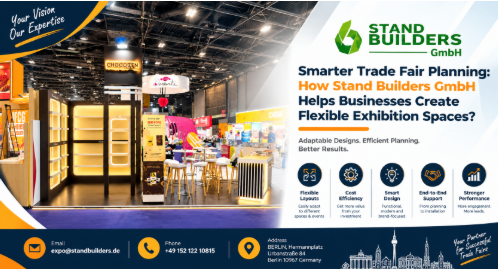
Participating in international trade fairs requires more than booking exhibition space and preparing marketing materials. Businesses must create an environment that presents their products effectively, welcomes potential customers, and supports professional interactions. Choosing an experienced exhibition booth builder in Germany can simplify this process by bringing design, construction, logistics, and installation under coordinated management. Stand Builders GmbH, based in Berlin, provides exhibition solutions for businesses participating in trade shows across Germany and Europe, with particular attention to practical layouts, brand presentation, and adaptable stand structures.
The Changing Requirements of Modern Trade Fair Exhibitors
Exhibition participation has become an important part of business development for companies operating in manufacturing, technology, healthcare, engineering, and other industries. Trade fairs allow businesses to demonstrate products, understand market developments, and communicate directly with prospective customers.
However, exhibitors frequently encounter a practical challenge: the exhibition space available at one event may differ considerably from the space booked for another.
A company might reserve a compact corner stand in Cologne, a larger open-sided booth in Frankfurt, and a different floor configuration in Hannover. Each venue may have its own technical specifications, installation schedules, and exhibition guidelines.
Designing an entirely new structure for every event can increase expenses and create additional planning work. Consequently, businesses participating in several exhibitions increasingly need solutions that balance visual consistency with structural flexibility.
This is where adaptable exhibition design becomes particularly useful.
Why Flexibility Matters More Than Stand Size
An impressive exhibition presence does not necessarily require the largest stand in the hall. What matters is how effectively the available space supports the company’s objectives.
A smaller booth with clearly arranged products, accessible information, and comfortable conversation areas can provide a more productive visitor experience than a larger structure with an inefficient layout.
Flexible design also helps businesses respond to changing exhibition requirements without completely reconsidering their brand presentation.
Creating Layouts That Work in Different Spaces
Exhibition layouts depend on several factors, including floor dimensions, entrance positions, visitor traffic, and the number of products being displayed.
A stand with one open side may require a different arrangement from an island stand accessible from several directions. Reception desks, display panels, screens, and meeting furniture must be positioned accordingly.
Adaptable structures allow designers to reconsider these arrangements while maintaining a recognisable visual identity.
Maintaining Brand Consistency Across Events
Businesses participating in multiple trade fairs benefit from consistent branding. Visitors should be able to recognise the company through its colours, graphics, messaging, and presentation style.
Consistency becomes especially valuable when exhibitions take place in different cities or attract different audiences.
A flexible exhibition system can help preserve essential brand elements while allowing the physical arrangement to change according to the venue.
Modular Exhibition Stands: A Practical Solution for Repeat Exhibitors
One of the most useful approaches for businesses attending multiple events is a modular exhibition stand. Unlike structures created for a single fixed configuration, modular systems use interchangeable components that can be assembled and rearranged according to available space.
Stand Builders GmbH develops modular exhibition stands using lightweight structural components, including aluminium framing systems. These systems are designed to support different booth configurations while remaining suitable for repeated exhibition use.
The main advantage is adaptability. Rather than starting every project from the beginning, exhibitors can work with an existing structural system and modify its arrangement for different events.
Reusability and Long-Term Exhibition Costs
Exhibition budgets include more than initial stand construction. Transportation, installation, dismantling, storage, graphics, and maintenance can all influence the total cost of participation.
Reusable modular components may help businesses manage these expenses over several exhibitions.
For example, a company attending four trade fairs annually could potentially use the same core structure while changing graphics, display arrangements, or selected accessories.
The actual savings depend on transportation distances, storage requirements, component condition, and the extent of modification required.
Easier Transportation and Installation
Modular structures are generally designed around components that can be transported and assembled efficiently.
Their lightweight construction can simplify handling compared with certain large, permanently configured exhibition structures.
Nevertheless, installation should still follow venue regulations and technical specifications. Electrical connections, structural stability, fire safety, and permitted construction heights must be considered before the event.
When Other Exhibition Stand Formats Make More Sense
Although modular stands provide flexibility, they are not suitable for every exhibition requirement. Some businesses need distinctive architectural features, additional floors, or coordinated spaces for multiple exhibitors.
Stand Builders GmbH also offers other exhibition stand solutions designed for these situations.
Custom exhibition stands are developed around specific branding, product presentation, and functional requirements. They are useful when businesses need specialised display structures, unique layouts, or a highly individual presentation.
Double-decker exhibition stands provide an additional level that can accommodate meeting areas, hospitality facilities, or private discussions. They are generally relevant to larger exhibition spaces and require appropriate structural planning and venue permissions.
Country pavilion exhibition stands bring several organisations together within a coordinated exhibition environment. They are particularly suitable for national delegations, industry associations, and businesses participating under a shared regional identity.
Selecting between these formats depends on the event objectives, available floor space, construction regulations, and budget.
How Stand Builders GmbH Organises Exhibition Projects
Successful exhibition construction involves several interconnected activities. Delays in design approval, manufacturing, transportation, or installation can affect the entire project schedule.
Stand Builders GmbH provides an integrated project process covering the main stages of exhibition stand development.
The process begins with understanding the exhibitor’s requirements, including stand dimensions, branding preferences, intended visitor activities, and budget considerations.
Designers then prepare three-dimensional concepts that help clients visualise the proposed structure before production begins.
Once the design is approved, construction proceeds through the company’s in-house production facilities. The completed components are prepared for delivery and installation at the exhibition venue.
On-site supervision, dismantling, and storage services form part of the wider project support.
This coordinated approach can reduce the complexity of managing separate designers, manufacturers, transport providers, and installation contractors.
Planning for Different Exhibition Cities in Germany
Germany’s exhibition industry covers a wide range of commercial sectors, with major trade fairs taking place throughout the country.
Berlin provides opportunities across technology, tourism, and consumer-oriented industries. Frankfurt is an important destination for international business exhibitions, while Hannover is closely associated with industrial innovation and manufacturing.
Düsseldorf hosts major exhibitions across several specialist industries, and Cologne attracts businesses from consumer goods, food, and other commercial sectors. Munich, Stuttgart, Hamburg, Leipzig, and Nuremberg also contribute to the country’s diverse exhibition landscape.
Stand Builders GmbH provides location-specific exhibition services for major German trade fair destinations, helping exhibitors address the practical requirements of different venues.
However, exhibitors should remember that construction regulations can vary between exhibition centres.
Before finalising a stand design, companies should confirm permitted heights, suspension requirements, electricity arrangements, delivery schedules, and installation deadlines.
These considerations are particularly important when reusing a modular structure at multiple locations.
A Practical Approach to Choosing the Right Exhibition Stand
The most suitable stand format is not always the most elaborate or expensive option. Businesses should evaluate how the structure will perform throughout the exhibition and whether it can support future events.
Several questions can guide the decision:
- How frequently will the company participate in trade fairs?
- Will the booked stand dimensions change between events?
- Does the business require specialised product demonstrations?
- Are private meeting areas or additional floors necessary?
- Can structural components be reused or adapted?
- What are the expected transportation, installation, and storage costs?
For occasional exhibitors with distinctive presentation requirements, a custom-built stand may provide the necessary creative freedom.
Companies participating regularly in different locations may find modular systems more practical because they support repeated use and layout adjustments.
Larger organisations or group exhibitors may require double-decker structures or coordinated pavilion designs.
The final decision should reflect both immediate exhibition objectives and longer-term participation plans.
Looking Beyond Construction: Preparing for Visitor Engagement
A well-built exhibition stand provides the physical foundation for an event, but business results also depend on how the space is used.
Exhibitors should prepare staff for product demonstrations, customer enquiries, and professional conversations. Marketing materials should communicate essential information clearly, while digital presentations should support rather than distract from face-to-face interactions.
Visitor movement also deserves attention. Displays should be positioned so that interested attendees can explore products without blocking entrances or meeting areas.
After the event, companies can evaluate lead quality, visitor feedback, and operational performance to identify improvements for future exhibitions.
This feedback is especially useful for modular structures because layouts and display arrangements can be refined before the next event.
Conclusion
Effective exhibition planning requires businesses to balance brand visibility, practical construction, visitor comfort, and long-term costs. As companies participate in trade fairs across different cities and industries, adaptable stand solutions can make exhibition preparation more manageable.
Stand Builders GmbH supports these requirements through modular, custom, double-decker, and country pavilion exhibition stands, alongside design, production, installation, and dismantling services.
For businesses exhibiting regularly, the most valuable investment is often a stand that performs well at the current event while remaining suitable for future opportunities. By prioritising flexibility, thoughtful space planning, and coordinated execution, exhibitors can create professional environments that support meaningful business connections.
Write and Win: Participate in Creative writing Contest & International Essay Contest and win fabulous prizes.
About the Author