
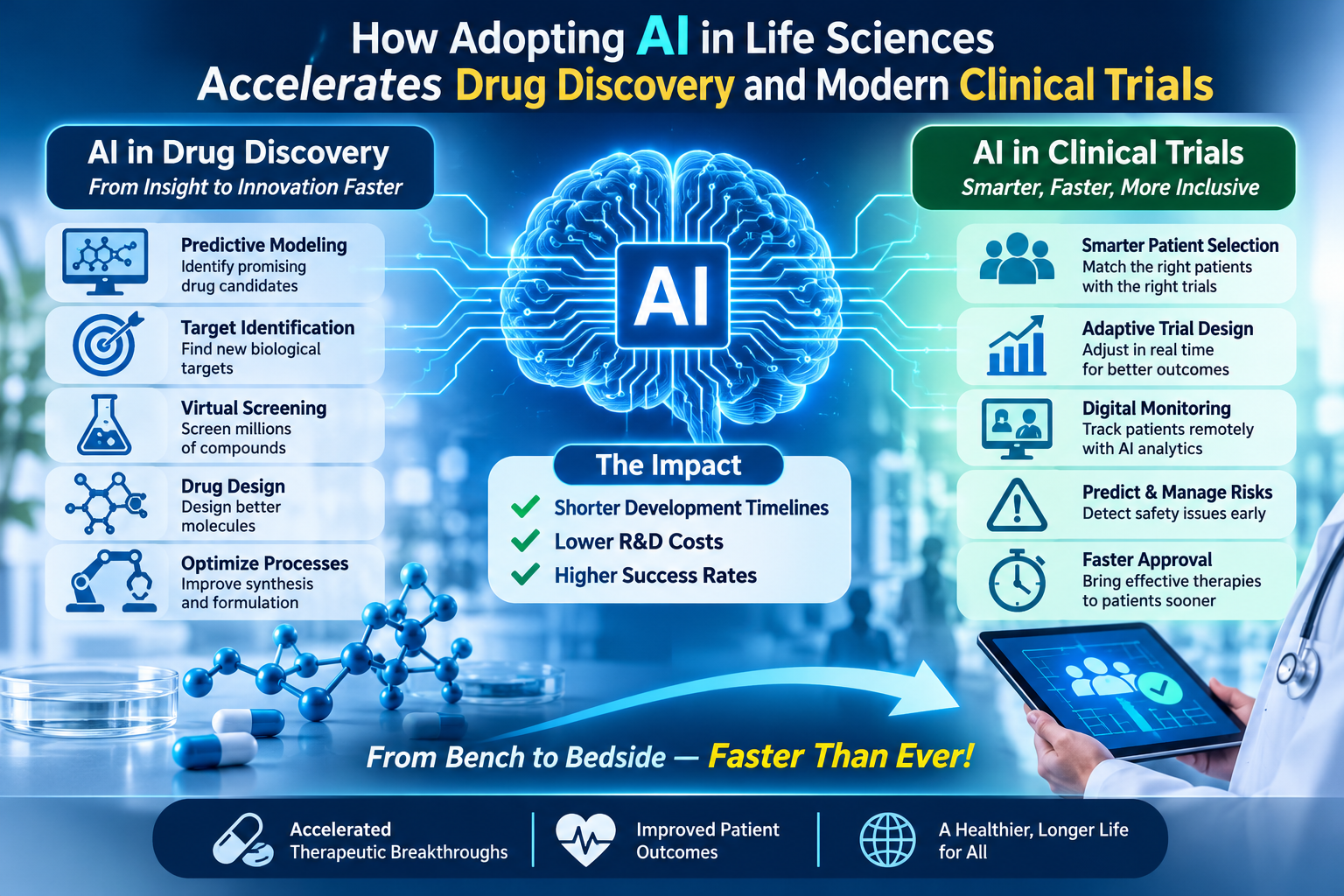
Getting a safe medical treatment to market remains a notoriously brutal process. On average, bringing a single molecule from a lab bench to an actual pharmacy shelf takes over twelve years and burns through billions in capital. Worse yet, most promising compounds fall apart during human trials. That high burn rate is exactly why adopting AI in life science has shifted from a futuristic experiment to a day-to-day necessity. Modern computational pipelines now analyze vast biological datasets, model molecular behaviors in seconds, and eliminate dead-end research paths before teams waste time in physical labs.
Putting advanced machine learning to work across early R&D changes the entire physics of drug development. Scientists used to spend years on manual trial-and-error benchwork. Now, they run high-fidelity simulations inside digital environments to map out complex biological interactions. This data-first mindset gives research teams the speed they need to spot disease targets early and build far tighter clinical protocols. As health regulators get comfortable reviewing algorithmically supported data, adopting AI in life science gives laboratories a practical blueprint for tackling hard-to-treat diseases without losing a decade in the process.
Why Traditional R&D Pipelines Struggle to Scale
Old-school R&D setups rely heavily on physical assays, manual compound sorting, and paper-based tracking sheets. Those approaches built modern medicine, but they simply move too slowly for today’s urgent health demands. Chemist teams can easily spend two or three years synthesizing and screening chemical variants by hand just to yield a couple of usable leads.
At the same time, traditional clinical trials run into constant delays during patient recruitment. Finding qualified volunteers who match strict study criteria takes months, and high participant drop-out rates frequently throw trial schedules off track. When clinical trial data sits trapped inside isolated spreadsheets, tracking patient safety and verifying drug performance becomes a slow, reactive chore.
- High late-stage failure rates due to unexpected side effects or low efficacy
- Years spent physically synthesizing and testing candidate chemical compounds
- Difficulty finding diverse, representative patient groups for clinical studies
- Heavy administrative workloads that delay regulatory filings and data reviews
Executing a thoughtful life science transformation helps organizations smash through these operational roadblocks. Replacing disconnected routines with smart digital platforms gives research teams direct, clear visibility into biological systems and trial performance.
How AI in life science Is Reshaping the Drug Discovery Lifecycle
Adding computational tools directly into daily research routines yields immediate improvements at every step of the development cycle. From initial target hunting to post-market safety checks, adopting AI in life science helps pharma teams make confident decisions much earlier.
Speeding Up Molecular Screening and Lead Selection
Identifying the specific biological cause of a disease once took several years of trial and error. Now, predictive software algorithms sort through millions of genetic databases, scientific literature, and protein structures to uncover underlying diseases in mere hours.
Computer simulations examine how experimental drugs target proteins digitally before any chemicals are combined in the lab. These virtual screens shrink a pool of millions of candidate compounds down to a tight shortlist in just a couple of weeks. Researchers skip the endless bench testing of weak compounds and jump straight into perfecting high-potential leads.
Unifying Clinical Data Across Multi-Site Trials
Modernizing clinical workflows requires a total commitment to healthcare digital transformation across every research site. Replacing paper records and isolated databases with cloud software allows clinical sites, research partners, and sponsors to share live trial data safely.
Unified platforms combine electronic health records, lab outputs, and patient survey responses into clean, central data streams. This shared setup simplifies site checks, speeds up safety reporting, and keeps trials fully compliant with strict health regulations across different countries.
Bridging Laboratory Insights and Patient Testing
Connecting basic lab insights directly to clinical trial feedback loops helps teams adjust study designs on the fly. When real-world clinical observations feed back into discovery models, scientists can modify chemical structures to fix safety issues seen in trial participants. This continuous loop prevents late-stage trial failures and maximizes the return on research investments.
Refining Patient Cohorts and Trial Protocol Design
Finding suitable participants for clinical research is still among the toughest challenges during drug development. Applying AI in life sciences, predictive systems use data from anonymized health records, hospital admissions logs, and genetic databases to find the best candidates matching particular characteristics.
In addition, predictive algorithms allow for the identification of barriers to subject recruitment well before the beginning of the clinical trial. Choosing optimal clinic locations based on local disease rates helps teams enroll diverse patient groups quickly, keeping trial timelines on schedule.
Monitoring Patient Health Remotely with Connected Tech
Deploying specialized pharma technology solutions lets clinical teams track patient health remotely using wearable sensors and smart medical devices. Continuous data collection records vitals, physical activity, and daily health changes in real time.
Remote tracking lightens the burden on volunteers by cutting down on required clinic visits, which keeps participant retention rates high throughout long studies. Automated pipelines process incoming health streams around the clock, flagging bad reactions or unusual health shifts instantly to protect patient safety.
Streamlining Regulatory Audits and Control Group Models
Prepping massive clinical trial datasets for regulatory review takes huge administrative effort. Smart analytics tools automate data cleanup, write standardized summaries, and verify dataset accuracy before submissions go out.
Additionally, advanced platforms help build synthetic control groups using historical patient data and real-world evidence. In rare disease studies where finding traditional control groups is ethically or practically impossible, synthetic controls offer a reliable baseline for comparison. This approach speeds up trial completion while keeping safety standards exceptionally high.
Lowering Infrastructure Barriers for Small Research Teams
Big pharma houses and venture-backed biotechs face the same pressure to innovate quickly. Cloud-native analytics tools level the playing field, giving any agile life sciences organization direct access to high-performance computing power without building an internal data center first.
Lowering software overhead allows smaller research teams to direct their capital toward real bench tests and clinical trials. That means niche therapeutics move out of incubator labs and into active human trials much faster.
The Future of Data-Driven Medical Innovation for AI in life science
Relying on slow, paper-based research models simply doesn’t work in an era of precision medicine. Static lab studies and fragmented records cannot match the speed or biological accuracy that modern therapies require. By incorporating advanced predictive models with early compound screening, site selection, and live telemetry, we get a much safer and quicker mechanism for clinical research.
The application of AI in life sciences eliminates years of inefficient trial and error from the drug development process. By merging significant amounts of molecular data with computational power, organizations save R&D expenditures, speed up clinical trials, and get life-saving treatments to the people who need them.
Write and Win: Participate in Creative writing Contest & International Essay Contest and win fabulous prizes.
About the Author