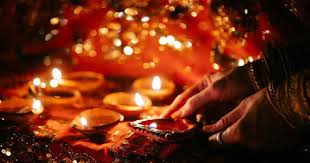
If India had to choose one heartbeat, one moment when 1.4 billion people breathe together, it would be Diwali. Deepawali, the “row of lights,” is not a date on the calendar. It is the soul of India glowing at once. From the snow-capped houses of Ladakh to the coconut groves of Kerala, from the tribal villages of Jharkhand to the skyscrapers of Mumbai, Diwali erases borders of language, caste, state, and even religion. As a Class 12 student who has watched this festival for seventeen years, I believe Diwali is not India’s favorite festival by accident. It earned that love because it carries history, hope, family, business, art, science, and humanity in a single flame.
*I. The Myths That Bind a Nation*
Diwali’s power lies in its stories, and every region owns one. The most famous comes from the _Ramayana_, written by Valmiki around 500 BCE. After fourteen years of exile, after building a bridge to Lanka, after defeating the ten-headed Ravana, Lord Rama returned to Ayodhya with Sita and Lakshmana on the night of _Amavasya_, the new moon. The kingdom was dark. So the people lit _diyas_ – small clay lamps filled with oil – along every road, balcony, and rooftop. The city shone so bright that the gods themselves looked down in wonder. That night, _dharma_ defeated _adharma_, and light defeated darkness.
But India’s genius is plurality. In West Bengal and Assam, the same night belongs to *Maa Kali*. Her fierce form destroys ego and evil. _Pandals_ rise higher than buildings, drums beat till dawn, and at midnight, animal sacrifice has slowly been replaced by pumpkins and sugarcane. In Gujarat, Diwali is the *New Year for traders*. Ledgers called _chopda_ are worshipped, and businessmen pray: “May Lakshmi stay, may debt stay away.” For Sikhs, it is *Bandi Chhor Divas*. In 1619, Guru Hargobind Sahib Ji walked out of Gwalior Fort, but refused freedom unless 52 innocent kings were released with him. The Golden Temple is lit with lakhs of _diyas_ to honor that courage. Jains mark it as the day Lord Mahavira, the 24th Tirthankara, attained _moksha_ in 527 BCE at Pavapuri. He said, “All souls are equal,” and his last sermon was on this night.
One festival, five faiths, one message: when night is darkest, human courage can light a lamp.
*II. The Five Days: A Journey from Cleanliness to Compassion*
Diwali is a five-act play, and each day teaches a value that schoolbooks cannot.
*Day 1 – Dhanteras: The Worship of Wealth and Health*
_Trayodashi_ of Krishna Paksha. “Dhan” means wealth, “teras” means thirteenth. Families clean every corner because Goddess Lakshmi, the deity of prosperity, enters only clean homes. We buy gold, silver, or even a steel spoon – the metal is symbolic. In 2026, India’s gold buying on Dhanteras crossed *₹18,000 crore in one day*, according to CAIT. But Ayurveda adds another layer. This is also *Dhanvantari Jayanti*, the birth of the god of medicine. In my house, we light a _Yam Deep_ – a four-wick lamp facing south – to protect family from untimely death. Dhanteras thus links wealth with well-being.
*Day 2 – Naraka Chaturdashi / Chhoti Diwali: The Bath of Liberation*
Before sunrise, South Indian families do _Abhyanga Snan_ – a ritual oil bath with sesame oil and _shikakai_. The legend: Lord Krishna killed Narakasura, who had imprisoned 16,000 women. The oil bath washes away _naraka_, hell, from the body. In Maharashtra, people eat _poha_ and _shankarpale_ after bath. At night, we place 14 _diyas_ to guide ancestors. The message: clean your body, clean your karma.
*Day 3 – Lakshmi Puja: The Night India Does Not Sleep*
This is the main Diwali. By afternoon, _rangoli_ designs of lotus, peacock, and footprints cover doorsteps. Marigold and mango leaves hang on doors – they purify air, as science now confirms. At dusk, we wear new clothes. The _puja thali_ holds rice, _roli_, _diya_, _incense_, _sweets_, and coins. We chant:
_“Om Mahalakshmyai Namo Namah
Dhana Dhanya Samriddhim Dehi Dehi Namah”_
We pray to Lakshmi for wealth, to Ganesha for wisdom, and to Saraswati for knowledge – because wealth without wisdom is dangerous. After _aarti_, the real magic begins. Children run to rooftops. One by one, _diyas_ are lit. In 2026, *ISRO’s EOS-06 satellite* captured India from space: a 28% spike in nighttime luminosity compared to a normal day. That is not electricity alone. That is 25 crore homes lighting clay lamps.
Then comes _prasad_ – _motichoor laddoo_ in North, _mysore pak_ in South, _kaju katli_ in West, _rasgulla_ in East. We visit neighbors: “Happy Diwali.” Status, ego, fights – all melt like _ghee_ in the _diya_. In my colony in Lucknow, Hindu, Muslim, Sikh, Christian families exchange _mithai_. My Muslim friend Arhaan’s mother makes _sewaiyan_ for us every Diwali.
Crackers? Yes, they were part of it. But *2026 Diwali AQI in Delhi was 312 – “very poor”*. So the Supreme Court allowed only “green crackers” from 8–10 PM. Many families, including mine, chose a “Diya and LED Diwali.” The sky was quieter, but the hearts were louder.
*Day 4 – Govardhan Puja / Annakut / Padwa*
In Braj, Mathura and Vrindavan build _Annakut_ – a mountain of food with 56 items, _chhappan bhog_, to remember how Krishna lifted Govardhan Hill on his little finger to save villagers from Indra’s rain. The lesson: nature, not ego, should be worshipped. In Gujarat, this is *Bestu Varas*, New Year. People touch elders’ feet and say “Saal Mubarak.” Shopkeepers open new ledgers. In Maharashtra, it’s *Balipratipada*, honoring King Bali’s generosity.
*Day 5 – Bhai Dooj / Bhau Beej / Yama Dwitiya*
The festival ends with love. Sisters apply _tilak_ on brothers’ foreheads, do _aarti_, and feed them sweets. Brothers vow to protect sisters and give gifts. The myth: Yamaraj, god of death, visited his sister Yamuna on this day. She fed him and put _tilak_. Touched, Yama declared that any brother who receives _tilak_ from his sister on this day will not face hell. In Bengal, it’s *Bhai Phonta*, with elaborate _thalis_ and _chandan_ art.
*III. Diwali Across India: One Lamp, Many Shades*
Travel India during Diwali and you see its diversity:
1. *Punjab – Golden Temple Diwali*: The _Sarovar_ reflects 1 lakh _diyas_ and fireworks. Langar feeds 2 lakh people free.
2. *Tamil Nadu – Deepavali Morning*: Oil bath before sunrise, then _Deepavali Marundu_ – a digestive medicine – then new clothes called _Pattu Vastram_.
3. *Goa – Narakasura Effigies*: Giant paper demons are burnt at dawn, symbolizing killing evil inside us.
4. *Odisha – Kaunriya Kathi*: People burn jute sticks to call ancestors: “Badabadua ho, andhara re aasa, aalua re jaa.” – “O forefathers, come in darkness, leave in light.”
5. *Varanasi – Dev Deepawali*: Fifteen days after Diwali, the _ghats_ of Ganga are lit with 15 lakh _diyas_. In 2026, it entered the *Guinness Book* again. Gods are believed to descend to bathe here.
Yet the _diya_ is the same. Clay from the same earth, oil from the same seed, flame from the same matchstick.
*IV. Diwali and Economy: When Faith Drives Finance*
Diwali is India’s largest economic event. *CAIT 2026 report*: Diwali week generated *₹4.25 lakh crore* retail trade. Real estate, autos, phones, clothes – everything peaks. But the real hero is the potter. In Lucknow’s Chinhat, 3,000 families make _diyas_. In 2026, they sold *52 lakh pieces* in 10 days. Each _diya_ at ₹2 gave them dignity, not charity. The _Make in India_ _diya_ defeated Chinese LED strings this year.
Stock markets do *Muhurat Trading* – a 1-hour session on Lakshmi Puja. It’s believed that money invested now brings growth. In 2026, Sensex jumped 500 points in that hour. Farmers sell _kharif_ crops and buy for home. Thus, Diwali moves money from city to village.
*V. The New Diwali: 2026 and Beyond*
Festivals must evolve or die. Diwali 2026 shows three changes:
1. *Green Diwali*: 1,200 cities ran “Cracker-Free Diwali” campaigns. Schools gave homework: “Light 11 _diyas_, plant 1 tree.” My school distributed saplings with sweets.
2. *Digital Diwali*: We sent e-greetings, did _puja_ on video call with cousins in Canada, and bought _diyas_ from women SHGs on ONDC. Tradition met technology.
3. *Inclusive Diwali*: Old-age homes, orphanages, and jails celebrated. In Tihar Jail 2026, inmates made 2 lakh _diyas_. The light reached those who live in darkness all year.
*VI. Why Diwali Will Always Be First*
Ask any Indian child, “Which is your favorite festival?” The answer is Diwali. Why?
1. *It gives, not takes*: We clean for others, we cook for others, we gift to others. Maids, drivers, guards – everyone gets _bonus_ and _mithai_.
2. *It teaches without preaching*: Cleanliness from Dhanteras, courage from Naraka Chaturdashi, gratitude from Lakshmi Puja, respect for nature from Govardhan, love from Bhai Dooj.
3. *It is democratic*: A _diya_ costs ₹1. A billionaire’s LED mansion and a laborer’s one _diya_ in a _jhuggi_ – both count in the sky.
4. *It is hope*: On _Amavasya_, the darkest night, we create the brightest light. If that isn’t optimism, what is?
*Conclusion: Be the Diya*
My grandfather says, “_Beta, Diwali is not in the calendar. It is in character_.” When we forgive an enemy, that’s Diwali. When we feed a hungry child, that’s Lakshmi Puja. When we stand against wrong, that’s Rama’s arrow.
In 2026, the world is fighting war, climate change, and loneliness. India gives the world a solution every year: light a lamp. Not to remove darkness outside, but to kill darkness inside.
So this Diwali, I will not just light _diyas_. I will be one. For my family, for my country, for anyone who needs light. Because that is why Diwali will always be India’s favorite festival – it turns every Indian into a small, unstoppable flame.
And as long as one _diya_ burns in one Indian home, India’s soul will never be in darkness.
By: Anshika Awasthi
Write and Win: Participate in Creative writing Contest & International Essay Contest and win fabulous prizes.
About the Author