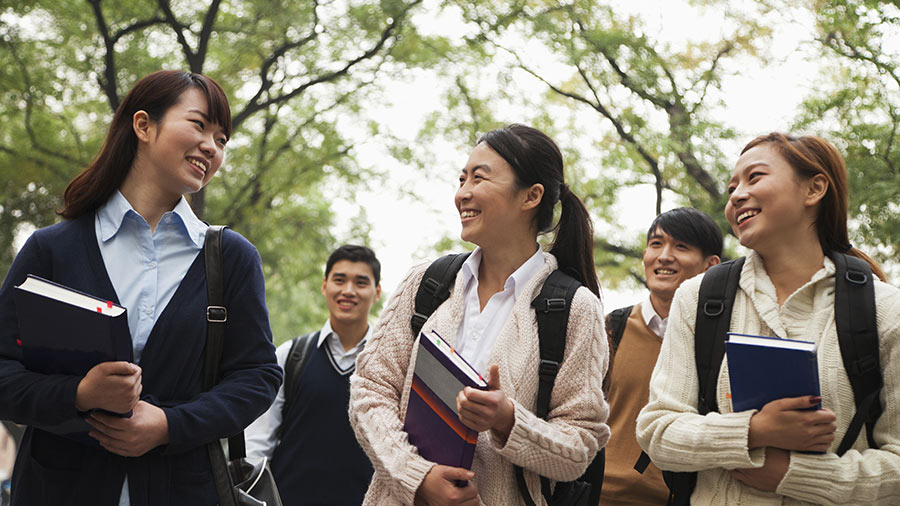
Asia has shown a significant leap in securing economic, social and cultural rights over the past decade, as indicated by the overall average progress towards achieving all 17 Sustainable Development Goals, which increased from 4.4% in 2017 to 17.0% in 2023 (ESCAP). Nonetheless, uneven advancements among regions within Asia must not be ignored. While most East Asian countries are considered as developed countries, many South Asian countries are still under the name of developing countries. The imbalance in development progress is a result from varying access to quality education among the countries.
Education is one of the most basic, and universally recognized human rights. Indeed, it is Sustainable Development Goal 4 by the United Nations, highlighting the importance of quality education for all. While most countries require similar mandatory years of schooling, near-perfect literacy rates in East Asian countries and comparatively lower percentage in South Asia underscore that attending school alone does not guarantee quality education (World Population Review). Therefore, many countries still struggle to fully provide this basic right of education, resulting in setbacks across economic, social and cultural development.
Education plays an important role in improving a country’s economy. Education enables people to become a well trained workforce. For example, “South Korea has the highest rate of tertiary [education] attainment among young adults across OECD countries: 71% of 25-34-year-olds have completed tertiary education, compared to the OECD average of 48% (OECD)” by 2025. This overwhelming percentage of educated individuals was closely associated with the country’s industrial and economic development. Education opened economic opportunities as skills gained through schooling helped meet the demands of Korea’s rapidly industrializing economy. Such “workforce development…has contributed to…the high economic growth rate that Korea has enjoyed” since the 2000s (Lee, 2007). The high enrollment rate was largely supported by government investment, with the public spending on formal and informal schooling now totaling nearly 10 percent of South Korea’s GDP. Korea’s instance suggests that a clear policy commitment to education ultimately builds an educated, skilled workforce which contributes to the country’s economy (Asia Society).
On the other hand, with less education enrollment rate, South Asia countries continue to experience stagnant growth in the economy. Despite efforts to guarantee education for all, South Asia continues to struggle with low enrollment rate, especially in secondary and tertiary education (World Bank). Gross enrollment ratio for tertiary education is 10.62 in Pakistan, as compared to 116.23 in Macao (The Global Economy). Referring to any education after secondary level, tertiary education provides learning opportunities that opens access to professional careers. With substantially lower rates of advancement to tertiary education, South Asia is the region with the lowest average GDP per capita, along with Africa. This correlation is not coincidental; low individual economic output means low national income, making pursuit of higher education difficult, creating a self-reinforcing negative loop. The comparison stresses that investment in quality education makes the country better positioned to foster economic growth, implying the importance of education as a fundamental economic right.
Moreover, education itself is a fundamental social right that promotes other social rights, mainly gender equality. Stated differently, the absence of education perpetuates gender inequality and discrimination. As the United Nations put it, “Education is both a human right in itself and an indispensable means of realizing other human rights. (ECOSOC)” By providing knowledge, critical thinking skills, and social awareness, education empowers people to participate fully in their communities.
In many parts of South Asia, however, gender inequality remains prevalent; education is limited for girls, limiting their participation in society. Girls are about three times less likely than boys to attend school, and “as a result, 35% of women in South Asia cannot write or understand a short, simple sentence. (Unicef)” This limits their ability to participate in the workforce, access social services, and engage fully in their communities. In fact, only 33 percent of working-age women are in the workforce, compared to 77 percent of working-age men in 2023, showing how limited education reinforces lack of opportunities in society (World Bank).
On top of that, quality education forms the basis of inclusive policies and well-established social systems. To illustrate, in Singapore, a country known for its integrative and rigorous education system, the government guarantees housing as a basic right by providing public housing to approximately 80 percent of its residents. As a result, the country has the highest home ownership rate of 90%. This is a remarkable progress since 1980, when the percentage was as low as 58.8% (Trading Economics). Singapore contrasts sharply with Pakistan, whose attempt to supply 5 million affordable housing fell short.
In addition, South Korea has a similarly competitive academic environment, and is home to a highly efficient government funded healthcare system. National Health Insurance Service (NHIS) covers almost the entire population, ensuring that citizens can access high quality healthcare without economic burden. The visible link between a strong education system and successful public policy is supported by NBER Working Paper series “Why does democracy need education?”, which concluded that education raises civic participation and leads to better policy selection and implementation, further emphasizing the necessity of education from a societal perspective (Glaeser et al., 2006).
Finally, education works to protect and promote cultural heritage and fosters respect for cultural diversity. For example, Taiwan’s National Languages Development Act mandates the teaching of multiple national languages across primary and secondary education, supporting linguistic pluralism and allowing minority communities to preserve their language and cultural identity. Each year, more than 10 percent of students take a minority language course (Ministry of Education). Similarly, Cambodia’s Intangible Cultural Heritage education provides hands-on learning of local traditions, such as Sbek Thom shadow puppetry, connecting students to their cultural heritage.
UNESCO notes, “[teaching with heritage] make[s] the learning content more relevant and meaningful to the learners, because it ties in with their worldviews, knowledge systems and imagination.” Education is an invaluable opportunity for students to learn about their culture, and is primary in protecting language and traditions. By integrating heritage and minority perspectives into education, students learn to value both their own culture and others’, encouraging respect and cultural pluralism.
The importance of education extends beyond securing college admission or employment; it is the very foundation for realizing economic potential, social rights and cultural heritage. Across Asia, countries with higher education levels and enrollment rates have more skilled workforce, successful public policy, and well-preserved cultural traditions, as an educated population is better equipped to perform in society. Conversely, gaps in access to education leave millions excluded from these opportunities, limiting economic growth and worsening social inequalities. Thus, ensuring education for all in Asia is the first step to protecting other essential rights.
By: Haryung Koo
Write and Win: Participate in Creative writing Contest & International Essay Contest and win fabulous prizes.
About the Author