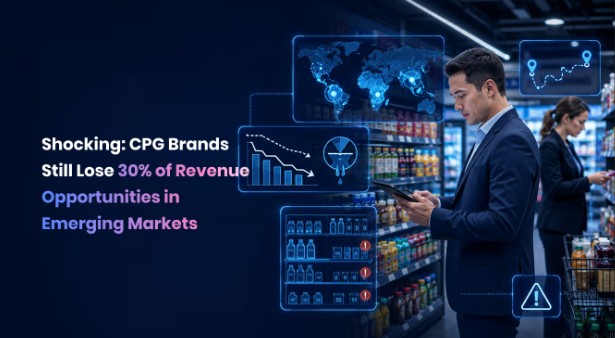
Have you ever walked out of a heavy strategy meeting, grabbed a quick cup of coffee, and just wondered why our brilliant boardroom plans never quite match what actually happens on the streets?
Let’s take a breather and talk about the massive elephant in the room. We pour millions into trade promotions, distribution networks, and huge field sales armies. We spend weeks fighting over packaging tweaks and profit margins. Yet, despite all this exhausting effort, consumer goods brands are routinely leaving up to 30% of our potential sales just lying on the table, especially in emerging markets.
Why does this happen? And more importantly, why is it still happening when we supposedly have more data at our fingertips than any generation before us?
Let’s be totally honest with ourselves while we take this break. The gap between our boardroom strategies and the harsh reality of street-level execution is exactly where our margins go to die. But here is the good news: the technology we need to finally fix this mess is here, and it is pretty incredible.
The Perpetual Chaos of the Streets
You know exactly how it is. Emerging markets are a totally different beast compared to the West. We aren’t dealing with a handful of massive, perfectly organized supermarket chains with barcode scanners at every corner. We are dealing with millions of crowded, noisy, chaotic kirana stores, mom-and-pop shops, and street corner kiosks.
It is a beautiful, high-energy jungle, but keeping track of it is an absolute nightmare. When we roll out a new product or push a seasonal trade promotion, that plan has to travel a ridiculously long path. It goes from regional heads to distributors, down to thousands of field sales reps, and finally, hopefully, to the shop owner.
Naturally, execution breaks down along the way. That 30% missed opportunity isn’t just a random statistic. We see it bleeding out every single day in very specific ways:
- The out-of-stock tragedy: Our absolute best-selling product goes out of stock during peak hours, and nobody notices until the next scheduled visit.
- The ghost promotions: Those expensive trade discounts and retailer schemes we heavily funded? The retailer never even hears about them because the message got lost in the noise.
- The order-taking trap: Our sales reps get so overwhelmed just taking routine orders for the same five fast-moving items that they completely forget to cross-sell or pitch our new, high-margin products.
Every single time a rep walks away from a store without maxing out its true potential, we are letting revenue slip through our fingers.
Staring at the Rearview Mirror
Right now, we might argue, “But wait, we bought expensive Sales Force Automation (SFA) software! We have a Distributor Management System (DMS)! We have dashboards for days!”
Sure, we have dashboards. But let’s look at what they actually do for us. Most of the legacy software we use today is built for management reporting, not for actually helping our frontline people sell. They give us a beautifully color-coded summary of what went wrong last month. They are fantastic for post-mortems. But we cannot fix an empty shelf from last Tuesday.
Plus, these systems operate in silos. They do not talk to each other in real-time. We get this comforting illusion of control because we have neat charts on our laptops, but we are actually flying blind at the most critical moment: the actual point of sale.
Picture our field sales rep standing inside a tiny, cramped, 200-square-foot shop. The retailer is shouting at a supplier, managing three customers, and has exactly two minutes to give our rep. In that chaotic moment, a dashboard showing last quarter’s regional performance is completely useless. The rep needs to know exactly what to do right now.
Enter Agentic AI: The Ultimate Wingman
This is where things get genuinely exciting, and where we need to start placing our bets. We are moving away from passive software that just spits out historical numbers, and we are stepping directly into the era of Agentic AI.
If we haven’t dug into this term yet, Agentic AI is basically artificial intelligence that doesn’t just sit there waiting for us to interpret a graph. It takes action. It acts like a highly intelligent wingman for our sales team.
Imagine we equip every single one of our field reps with an AI-powered Sales Co-Pilot right on their mobile phones. Before they even step into a crowded shop, the AI has already analyzed the store’s deep buying history, the neighborhood’s demographic trends, and the current stock levels at the distributor. Then, it gives the rep a smart, actionable nudge.
It will literally tell the rep: “Listen, this shop owner hasn’t bought our premium face wash in 45 days, and we have a 15% margin scheme running today only. Pitch this exact SKU right now.”
That is exactly how we grab back that missing 30%. We take the heavy cognitive load off our reps and give them predictive AI SKU recommendations. We transform them from simple, stressed-out order-takers into sharp, revenue-driving business consultants for the shop owner.
Seeing What We Couldn’t See: Computer Vision
Now, what about the physical shelf itself? We all talk endlessly about achieving the “Perfect Store.” We want our products placed at eye level. We want our Share of Shelf to match our market share.
In the past, we had to send separate merchandising auditors to manually check this, which was brutally slow, expensive, and full of human error. Today, we have Computer Vision, and it is completely revolutionizing retail execution.
With AI-powered shelf intelligence, our rep just points their smartphone at the shelf and snaps a quick picture. That is it. The AI engine instantly processes the photo, spots every single product (ours and the competitors’), and calculates our planogram compliance in real-time.
If a key product is missing from the display, the app flags it right then and there. It can even auto-generate an instant replenishment order to the distributor. We are no longer waiting thirty days for a report to realize our secondary displays were never set up. We fix the problem on the spot, while our guy is still standing in the shop.
Connecting the Dots
To really win in emerging markets, we have to stop treating our sales team, our distributors, and our supply chain like they live on different planets. The real magic happens when we pull everything into one unified Route-to-Market ecosystem.
When our AI is fully agentic and connected, it watches the whole board for us. If a predictive algorithm spots a sudden jump in demand for our cold beverages in a specific neighborhood, it doesn’t just send a slow email alert to a regional manager. It actively re-routes our field reps for the day so they hit those high-potential stores first, while simultaneously communicating with the local warehouse to ensure they have enough stock to handle the incoming wave of orders.
This isn’t some futuristic dream we talk about at conferences. This technology is live, it is working right now, and it is exactly what separates the CPG brands that are just surviving from the ones that are totally dominating the retail landscape.
Back to the Grind
At the end of the day, our massive, carefully plotted boardroom strategies only matter if the folks walking the hot, dusty streets can actually execute them. For way too long, we have loaded our frontline teams down with bulky apps designed to help us track them, rather than intuitive tools designed to help them sell more effectively.
By building AI straight into their daily routine—letting it run quietly in the background, offering data-driven precision while they focus on building human relationships with retailers—we set them up to win at every single store visit.
Closing that 30% gap is not about making our teams work longer hours or sweat more in the field. It is about equipping them to execute smarter. We have to stop just tracking what happened in the past and start intelligently guiding what happens next.
So, as we finish up this sutta and head back inside to the grind, let’s ask ourselves a hard question: is the retail technology we are using right now just keeping score of our losses, or is it actually helping our team win the game?
Write and Win: Participate in Creative writing Contest & International Essay Contest and win fabulous prizes.
About the Author