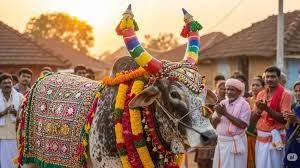
I was reading the news about farmers eagerly waiting for first drops of rain to fall on the parched farms. Thought ran in the mind that across India, different communities celebrate festivals that express gratitude for nature’s abundance Baisakhi in Punjab, Magh Bihu in Assam, Nabanna in Bengal, and Onam in Kerala. Yet among these celebrations, there exists a unique festival in Maharashtra that does not place the harvest at its center, but instead admires the silent companions who make agriculture possible – the bullocks. This festival is called Bail Pola celebrated on Shravan – Amavasya. More than a celebration, it is a reminder of an age-old relationship between humans, animals, soil, and workers. In a world increasingly driven by technology, speed, and urban lifestyles, Bail Pola preserves values that modern society is slowly forgetting: gratitude, respect for nature, and recognition of those who contribute silently to our well-being.
After many years away from my village, I happened to visit during Bail Pola. What began as a casual visit soon became a journey of rediscovering our roots, understanding forgotten traditions, and realizing why this festival continues to hold a special place in the hearts of farming communities. I used to visit when I was a kid because my parents had special place in their heart for it. But as the times changed, job became more important, the priorities changed and we started celebrating such events through mobile phones by talking and relatives, uncle, aunts putting up their photos with the bullocks.
Even though I knew a bit about the festival through remembrance and the knowledge that father imparted in olden days, this was the first time I visited the festival wholeheartedly to check with curious mind why would it be so important for some people. The morning began with hustle bustle everywhere, not just in the house, but whole village was abuzz. It was an atmosphere of enthusiasm everywhere everyone running here and there with flowers, garlands, festoons, other decoration items. Women were coating courtyards with cow-dung plaster and decorating their entrances with colourful rangolis.
Grandpa already had a special place in his heart for his pair of bullocks, Raja and Sarja. They were the calves of his beloved cow Nandini. He had watched them grow from playful calves into sturdy, well-built, and hardworking bullocks. He had fed them, cared for them, and patiently trained them over the years. To him, they were not merely animals but members of the family. As the dawn broke, he went into the stable and started with bathing them. Before bathing them, he applied oil and haldi on their back where they carry heavy plough every day. As I watched him do that with pride, he started explaining me about the history and mythological importance that Pola carries. He explained that Nandi, the sacred bull and vahana of Lord Shiva, symbolizes strength, devotion, and service and hence revered. He also told how in olden days when there were no tractors and advanced machineries how agriculture and thereby all the farmers relied on bullocks for farming, transportation, moat driving, etc.
After bathing he started decorating them with different clothes/coats on the back, hangings for their horns, horns painted with different colors, different ornaments. He told that how they had bought the bulls of mud from Kumbhaar Chacha one day before and had given them invitation to visit us the next day. While beginning to eat food, we are taught in our culture to say ‘annadata sukhi bhava’ (let the food giver(farmer) be happy). Similarly, along with farmer one must thank his bullocks too. Meanwhile food reminded me that the delicacies that were getting prepared at home and the aromas and fragrance were mouth-watering; especially puranpoli, the main attraction of the day.
I went into the kitchen to look what my grandma was doing. She while cooking the puranpoli was telling an old tale. Long ago, a poor woman with her seven children had nothing but a little jowar flour. She cooked it into a simple sweet and served it on Kutaj leaves (kudyache paan – leaves with medicinal importance), sharing it equally among her children before eating herself. The story, she explained, reminded people that festivals are not about riches but about gratitude, sharing, and caring for those who depend on us. Those leaves are traditionally believed to help with certain stomach ailments and therefore became part of seasonal food practices during the monsoon, when the flues and epidemics are on its peak and hence again tradition shown its way close to science/hygiene.
Even though not recognized universally or officially, people in some villages celebrate it as matru din (Mother’s Day) and call it Pithori Amavasya. Mothers pray for the health, prosperity of their children and, as an act of devotion and sacrifice, avoid consuming flour-based food themselves on that day. The practice symbolizes a mother’s willingness to place her children’s well-being before her own comforts. It also is to thank the motherhood of mother nature, and soil which fills our stomach through out the year through the crops, fruits, vegetables, etc. Just as a mother feeds her children, the earth sustains all life without expecting anything in return. The lesson was simple yet profound: ‘Gratitude is not measured by how much you have, but by how much respect you show.’
After decorating the workers in our home came dressed nicely to take the bullocks where all from other families in the village were to assemble. When all gathered the procession began with the loud music. The senior most bull was selected as a leader as is for every year and then he is put at the front with makhar (decorative crown/ head gear) with his horns bearing mashal (torches with burning flames). After the procession each farmer went to other farmers’ homes along with their bullocks and the woman in the home welcomed the bullocks, washed their feet to honour them and served them the food prepared at home.
Also, the workers at home/farm called as salgadi was invited at home with his family and granny gave them clothes and gifts and requested them to continue helping them the same way next season too. They sat for food with my grandpa as a guest of honour. Watching Dhondiba being appreciated alongside the bullocks reminded me that Bail Pola celebrates not only animals but every hand that contributes to agriculture.
Festival continued next day too. In the morning there was ritual called ‘marbat khedne’. ‘marbat’ which means troubles/diseases/problems and ‘khedne’ is to banish, expel, drive away. This is famous around Vidarbha region (North East) of Maharashtra. People in the village take away large effigies in processions and then burn it out. It also represents the prayer to God that if there are any diseases/ epidemics that this rainy season has brought please take them away and protect us from such misfortunes. While burning people hail out saying ‘Ida Pida gheun ja ge Marbat’ (Take away our troubles, suffering, and misfortunes). It also refers to social evils, political issues in the village. It attracts community participation and hence cultural activities, debates, meetings.
After this comes another part of this day, children mimic their parents by taking out their wooden bull toys, decorate them and take them through the similar kind of procession their parents had done a day before. After the procession they participate in competitions for best decorations and earn prizes. Sweets and chocolates are distributed amongst them. This day is called ‘Tanha Pola’. Along with enjoyment and celebration, it is a method to tell kids that please pass agricultural traditions to the next generation.
Like many Indian traditions, Bail Pola has evolved differently across regions. In Khandesh, tribal communities such as the Bhils and Pawras enrich the celebrations through folk dances, lejhims and traditional drums. In drought-prone Marathwada, bullocks are revered with even greater devotion because agriculture historically depended upon them for survival. Some western regions organize competitions for the best-decorated and healthiest bulls. Similar traditions can also be found beyond Maharashtra, such as Mattu Pongal in Tamil Nadu, Kanuma in Andhra Pradesh and Telangana, and Gai Tihar in Nepal, reflecting a shared cultural respect for cattle across South Asia. The most important part is bulls are given holiday on the day. No work, special food, decorated with their special ornaments, the rope they are tied with (vesan) is changed for the year on this day.
Standing in the fields that evening, I suddenly realized why the festival arrives during Shravan and not at any random time of the year. Bail Pola arrives during the monsoon season, when farmers look toward the sky with hope and anxiety. Good rains mean prosperity; failed rains can mean sorrow. In today’s era of climate change, irregular rainfall, droughts, floods, and declining soil health are becoming increasingly common. Such festivals remind society that agriculture is not merely an economic activity but a relationship with nature itself. They encourage respect for land, water, animals, and the delicate balance upon which human survival depends. The timing is equally significant as it arrives during Shravan, when nature appears to celebrate along with the villagers.
The landscape is covered with fresh green fields, streams begin to flow again, and the alternating rhythm of sunshine and rainfall paints the villages, farms with life. For farmers, this is a season of hope. The seeds have been sown, and every cloud in the sky promises a good harvest. The prosperity of the farmer determines the prosperity of many others in the village. A successful crop means work for labourers, business for artisans, income for traders, and food for society at large. Bail Pola therefore becomes not only a celebration of bullocks but also a celebration of nature’s renewal, collective optimism, and the shared hopes of an agricultural community.
Later, while thinking about the clay bullocks from Kumbhaar Chacha and the wooden toys carried by children, another thought crossed my mind. The festival was quietly supporting many village occupations too. Traditional Indian villages functioned through the Balutedari or Jajmani system, where agriculture stood at the center and numerous occupations supported it. The farmer depended upon carpenters, blacksmiths, potters, rope-makers, labourers, cattle keepers, and several other service communities. Bail Pola quietly brought many of these occupations together. Potters prepared the clay bullocks worshipped before Pola and during Tanha Pola. Carpenters crafted the wooden bullocks carried by children in the procession. Artisans produced ornaments, ropes, bells, and decorative items for the animals. Gardners get to make garlands, decorate village with their flowers. Women who stitched traditional decorations or prepared leaf plates found work during the festivities. Farm workers and salgadis were honoured with gifts, clothes, and public recognition. Thus, the festival acted as a seasonal economic stimulus for the village while strengthening mutual respect among different sections of society. Looking at all this, I felt our villages had understood something long ago—that no occupation survives alone. The farmer needed the potter, the carpenter, the labourer and many others, just as they depended on agriculture for their livelihood. Bail Pola celebrates not merely agriculture, but the entire ecosystem around agriculture.
After the celebration for 2 days, I sat with a lot of thoughts in my mind like how often being described as a festival for bullocks, is in reality a festival of gratitude. I wondered how it honours the animals that helped cultivate the land, the workers who laboured in the fields, the mothers who nurtured families, the nature that sustains life itself, and above all the farmer, whose labour sustains society and whose contribution often remains invisible until the food reaches our plates. Every ritual, story, procession, and tradition associated with the festival carried a simple yet profound message – ‘no individual prospers alone’.
While pondering over the celebrations and festivals, I understood that, many such traditions are fading away. Villages are changing, bullocks are being replaced by machines, and younger generations are moving away from agriculture in pursuit of jobs and urban opportunities. Progress is necessary, but when development is making us forget our roots, it will come at a cost. The modern rat race often teaches us to measure success through money, status, and productivity, while festivals like Bail Pola remind us to measure life through gratitude, relationships, and harmony with nature.
In today’s fast moving AI world, the festival feels more relevant today than ever before, because in the time when climate change, environmental degradation, and social isolation are growing concerns, such festivals are taking us back to the age-old wisdom taught by our ancestors. It reminds us that before we were consumers, professionals, or users of technology, we were children of the soil. Our society was built upon agriculture, and even today, no matter how modern our lives become, the food on our plates still begins in a field somewhere and we can’t eat the 5- or 10-rupee coins or notes even though they count as our wealth.
Hence, the true value of Bail Pola is not in preserving a tradition for the sake of remembering old culture. Its value lies in preserving respect for nature, gratitude for labour, and responsibility toward future generations. If these values continue to live on, then Bail Pola will remain far more than a festival. It will remain a reminder of our roots – who we are, where we came from, and what we must protect for the future.
As I left the village, the fields were still covered in fresh greenery and the monsoon clouds continued to drift across the sky. The festival had ended, but its message remained. Every grain of food, every harvest, and every prosperous society ultimately begins with rain, soil, animals, farmers, and nature. The festival simply teaches us not to forget that truth, that basis of our life. And every morsel we place on our plates reaches us through the efforts of countless hands. Hence in true sense it should be ‘Annadata Sukhi Bhava’.
By: Aditi Subhash Dhale
Write and Win: Participate in Creative writing Contest & International Essay Contest and win fabulous prizes.
About the Author