Every country all over the world has its own cultures , festivals and traditions with unique features, values and history. The Republic of the Union of Myanmar lies between the Bay of Bengal and the Andaman Sea and shares borders with five countries: China, Laos, Thailand, Bangladesh, and India.On the world map, Myanmar’s map is beautifully situated as young peacock displaying its charm.It is one of the most culturally rich countries in Southeast Asia.Based on the Myanmar calendar, its traditional twelve-month festival reflects the religion, social, political, and educational history of the ancient Myanmar.
These festivals have been preserved and celebrated by the Myanmar people for nearly 1,000 years.Tagu month is the first month of the Myanmar calendar and usually falls in March or April. Thingyan Festival is a five-day festival which falls in mid-April every year designated by The Myanmar Calendar Advisory Board. In Myanmar, Thingyan festival, also known as the Myanmar Traditional New Year Water Festival is the most valuable and unique festival for all Myanmar people. Thingyan means the transition from the old year to the new year.According to the history, Thingyan originated during the Bagan period, following the establishment of the Bagan Kingdom in the 9th century.The festival was very firstly celebrated in the reign of King Anawrahta in the 11th century and continually observed during the 12th and 13th centuries. According to the stone inscription at Sawhlawun Pagoda dating in 1291, shows that the tradition of thingyan water festival since that time.
In ancient times, a Thingyan cannon was fired to notify the arrival of Thagyamin on Earth and it is also the signal of the inauguration of the Thingyan Festival.After the cannon was fired, peo including members of the royal family, came outside by carrying pots of water and thabyay branches and poured the water onto the ground.
Today, although Thingyan is widely known for its lively celebrations and public festivities, the meaning behind its name remains important. The word “Thingyan” is derived from the Sanskrit word “Sankranti,” which refers to a transition or movement from one point to another.It specifically refers to the sun’s movement from one zodiac sign to the next.After many years, the word changed into “Thingyan” in Burmese but it has the same meaning of “transition” or ” movement”. Thingyan is more than the celebration of a traditional New Year festival, Thingyan embodies the concept of transition and transformation.
As the sun moves into a new position, people are encouraged to move forward by leaving past mistakes, negative thoughts, and difficulties.Thingyan is influenced by both Hinduism and Buddhism. Its name comes from ancient Indian culture, but the way of celebration in Myanmar is based on Buddhist teachings like kindness, respect, and doing good deeds.Thingyan water festival , unique cultural tradition that reflects the spirit of Myanmar is created by combining of these two cultures.Thingyan reminds people that life is always changing and that every new year offers a chance to start again with hope, positivity, and new goals. In essence, the festival is called “Thingyan” because it symbolizes transition—not only the passage of time but also the renewal of the human spirit.
The festival is celebrated across mainland Southeast Asia, but each country has its own name for it. In Myanmar, it is called Thingyan; in Thailand and Laos, it is known as Songkran or Pi Mai (New Year); and in Cambodia, it is called Chaul Chnam Thmey. The festival is based on the astrological event when the sun begins its journey northward.Each city and village around Myanmar celebrated Thingyan Festival by their own traditions and customs. But most people practice common activities such as pouring water on Buddha images, donating foods and snacks, giving old ages manicures and pedicures, releasing animals especially birds as an act of merit, visiting to the Monastery to join meditation retreats. Both old and young , male and female joyfully celebrate Thingyan festival by singing Thingyan songs and dancing Thingyan Yein dance or group dance.Streets of Myanmar come alive with music, dance performances, and temporary festival pavilions.During Thingyan festival, not only Myanmar national but also tourists from many parts of the world can enjoy the rich cultural heritage of Myanmar through a diverse range of community activities, spiritual practices, and traditional customs by celebrating themselves.
According to the religious belief, Myanmar people put seven kinds of flowers and leaves which representing seven day of a week in clay or earthwarethen vase and place in front of their house to welcome Thingyan Festival. During the Thingyan Festival, Myanmar people splash water on each other with cup, buckets and water guns as a sign of cleansing away impurities and bad deeds and welcoming the New Year with good deed, renewed hope and happiness.Thingyan traditions are handed over from generation to generation through active participation in the festival, as well as through media, schools, and regional and state-level competitions. Padauk also known as Pterocarpus macrocarpus is one of the symbols of Thingyan Water Festival. The Padauk blossoms in tiny fragrant yellow-gold flowers after the first showers in April, coinciding with the Myanmar New Year Festival and the Thingyan (Water Festival). Once in bloom, the entire tree turns gold overnight.
In Myanmar, a five-day Thingyan Festival is designated as national holidays and many people come back to their homes to meet again with their family members and pay homage to their parents, grandparents, and elder people.
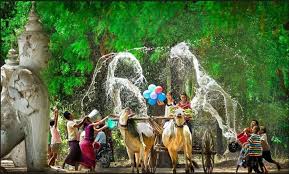
In the first day of Thingyan water festival also known as Thingyan Eve (Akyo Day), some people bring alms and traditional offerings to pagodas and monasteries , pour Buddha images with scented water. In the evening, the celebrations come alive with music, singing, and dancing.In the second day and third day also called (A Kya Day) and (A Kyat Day) people welcome Thagyamin, the celestial king who is believed to descend from heaven to Earth on his yearly visit to observe human deeds.Then, it is the time for water throwing and other funny activities. People with buckets, pots and cans of water splashes to any passer-by.
Powerful water pipes, decorated cars and carts are everywhere they are splashing water on to the crowds. Some groups fight each other joyfully by water pistols. In big cities, even fire hoses, hoses and hydrants in gardens are also used. During the celebrations, almost evey people including foreigners get wet.However, monks, senior citizens, the sick, and pregnant women are respectfully spared.Local ladies wearthanaka on face and sweet scented yellow padaukflowers on hair and dance on streets.On the final day, known as (A Tet Day), people continue to splash water. As it is the final day of Thingyan water festival, it is one of the most crowded days of the celebration.Thousands of people gather in the streets, at live performances, and throughout festival grounds, creating a lively and festive atmosphere across the country.
There are 8 national races in Myanmar:Kachin, Kayah , Kayin , Chin,Burmese, Mon, Rakhine, and Shan.Different innational races in Myanmar celebrate Thingyan according to their own unique customs and traditions.
In Rakhine State, people celebrate Thingyan with the Nantha (sandalwood) grinding ceremony.During this festival, young women compete in grinding sandalwood for offerings to Buddha statues.
During Thingyan festival, people in Mon state traditionally serve a refreshing dish made from rice soaked in scented water also known as Thingyan rice and accompanied by dried fish and green mango salad.
A notable Thingyan tradition in Shan State is the communal sharing of khaw mun haw, a steamed sweetmeat that symbolizes generosity and social harmony.
The next day of “A Tet Day ” is New Year’s Day (Hnit Hsan Ta Yet Nei). Animals especially birds and fishes are released to thir nature.People perform meritorious acts and make donations with the belief that starting the new year with good deeds brings good fortune throughout the year.Thingyan snacks are traditional Myanmar foods enjoyed during the New Year festival.The heart of these is Mont Lone Yay Paw (Floating Dough Balls), a glutinous rice ball stuffed with palm jaggery (palm sugar) and rolled in shredded coconut.Mont lone yay baw is believed to help maintain energy during the Thingyan Festival. In keeping with the festival’s spirit of community and togetherness, preparing these traditional rice balls is a social activity that strengthens relationships among family members, friends, and neighbors. Sharing the finished snack with others is also an important tradition. A popular Thingyan prank involves secretly placing a spicy chili inside some mont lone yay baw and offering it to unsuspecting friends or family members.
Through the dedicated efforts of The Ministry of Religious Affairs and Culture of the republic of the union of Myanmar, Thingyan Festival, also known as the Myanmar Traditional New Year Water Festival was successfully recognized and included in UNESCO’s Representative List of the Intangible Cultural Heritage of Humanity. And then a nomination file was submitted to the UNESCO Committee on Intangible Cultural Heritage on 24 March 2023.The nomination was officially approved on 5 December 2024, during the 19th Session of the Intangible Cultural Heritage Committee, held in Asunción, Paraguay, from 2 to 7 December. This achievement marks the Thingyan Festival as the first cultural element from Myanmar to be recognized on this prestigious global list.This recognition was achieved through the collective efforts of the Myanmar Cultural Heritage Preservation Association, ethnic literature and cultural associations from various states and regions, civil society organizations, and the active participation of the public.
Visiting during this season provides a unique cultural experience. As Thingyan has been recognized by UNESCO, it is the responsibility of every Myanmar citizen to preserve and pass this valuable cultural heritage on to future generations. We are proud to be Myanmar people who have inherited this precious and magnificent festival. We would also like to warmly invite friends from around the world to visit Myanmar and join us in celebrating the Thingyan Festival whenever they have the opportunity.
By: Daw Nan May Pwint Phu
Write and Win: Participate in Creative writing Contest & International Essay Contest and win fabulous prizes.
About the Author