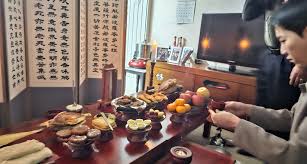
A dining table lined with fruit, rice, soup, and traditional dishes fills the room as family members gather in quiet anticipation. One by one, they bow before sitting together to eat and share memories of relatives no longer present. What appears to be a simple family ritual carries a much deeper history. Why do Koreans practice Jesa? Koreans practice Jesa because it serves as a way to honor ancestors, preserve family continuity, and express values of remembrance and respect across generations. This essay will argue that although Jesa is often viewed as an unchanging Confucian ritual, its history reveals a more flexible and evolving tradition that has adapted to shifts in Korean family structure and social values while continuing to preserve its cultural significance.
The origins of Jesa illustrate this adaptive character. As the Metropolitan Museum of Art explains, performing ancestral rites embodies “respect for parents and the commemoration of ancestors, key tenets of Confucianism” that rose to prominence under the Neo-Confucian state ideology of the Joseon dynasty, 1392 to 1910 (Metropolitan Museum of Art). On its surface, this origin story seems to support the conventional view: a state ideology imposed a single, uniform set of rites on the entire population, and those rites have simply persisted ever since. Yet Jesa was never simply a religious ceremony handed down unchanged; it was a cultural institution that mirrored the social order of its era, and that social order itself shifted considerably even within the Joseon period.
Historian Moon Sook-ja notes that in early Joseon families, responsibility for ancestor worship was not concentrated in a single eldest son but “distributed among all the children, both sons and daughters,” with “sons and sons-in-law” taking “turns every year to shoulder the duty” (Moon). This rotating system shows that the patriarchal, male-dominated model now associated with Jesa was a later development rather than an original feature of the ritual. From its earliest form, Jesa rested on shared duty and family unity rather than rigid gender hierarchy. This is evidence that the practice has always been a living institution, reshaped by the values of each era rather than fixed by unchanging dogma. If Jesa could already look so different within the first century of its formal institution, the assumption that it has remained static for six hundred years begins to look much less plausible.
The practice of Jesa has shifted considerably across historical periods, and the contrast between its earliest form and its later one is striking. During the early Joseon era, ritual responsibility was notably flexible and shared: families practiced Yunhoe Bongsa, in which sons and daughters took turns hosting the ancestral rites each year (Moon). This arrangement points to a status for women in early Joseon society far higher than later patriarchal norms would suggest, with ritual duty and filial obligation distributed regardless of gender. That status was reinforced by inheritance law, since “daughters enjoyed substantial rights and were able to equally share the inheritance with their male siblings even after their marriage” (Lee). Such practices reflect a family system markedly more balanced than the rigid patriarchy that emerged in later centuries, once Neo-Confucian orthodoxy hardened into law and custom.
In that later system, ritual duty fell almost entirely on the eldest son, daughters lost their claim to the family inheritance upon marriage, and women generally worshipped at their husband’s ancestral altar rather than their own family’s. The fact that Jesa could move from one of these arrangements to the other, within the same dynasty and under the same broad Confucian framework, demonstrates that the ritual’s specific rules were never as fixed as its religious justification. Women in the early period retained strong ties to their natal families and real influence over family affairs, including the performance of ancestral rites; the structure of Jesa, in other words, evolved in step with the changing relations and values of Korean family life rather than dictating those values from some unchanging external source.
The industrialization and modernization of twentieth-century Korea forced Jesa to transform again, this time under economic rather than ideological pressure. As rural families left their villages for crowded cities in search of factory and office work, keeping up with elaborate, multi-generational rites grew increasingly impractical. A small apartment in Seoul could not easily hold the extended gathering that a farmhouse once could, and the relatives who once lived within walking distance of one another were now scattered across the country or even abroad. Government policy responded in kind: mid-century laws such as the Simplified Family Ritual Standards legally reduced the number of generations families were required to honor from four to two, easing the financial and time burdens on a newly urban population (“Rites”).
That the state intervened to simplify the ritual at all confirms that Jesa was never treated as untouchable or fixed; a truly sacred, unchangeable obligation would not be subject to legislative amendment. As households grew smaller and more dispersed, these changes reflected a broader recalibration of family life rather than an abandonment of the tradition’s purpose. Jesa, in this period, proved itself a living practice, one that Korean society was willing to reshape, formally and informally, to meet the practical demands of modern life while still honoring those who came before.
Unlike earlier generations, many contemporary families now prioritize convenience and modern schedules over strict historical procedure. Some hold Jesa ceremonies in the early evening instead of at midnight, reasoning that the ancestors are unlikely to object to a few hours’ difference; others order pre-made ritual food from caterers rather than spending an entire day in the kitchen, or fold a simplified version of the ceremony into major holidays such as Chuseok and Seollal so that scattered relatives need only travel once or twice a year rather than for each individual ancestor’s death anniversary. Critics sometimes describe these shortcuts as a kind of decline, a hollowing-out of a once-serious obligation into a perfunctory gesture.
But supporters argue that keeping the tradition alive matters precisely because of what it accomplishes for the living, not only the dead: “in addition to honoring our ancestors, bringing one’s living family members together is also part of jesa” (Kim). These adaptations show that although the specific practices of Jesa have changed, its fundamental purpose of honoring ancestors and strengthening family bonds has not. The willingness of families to modify ceremonial details while preserving that core purpose suggests that cultural traditions are sustained through adaptation, not strict adherence to historical precedent; a ritual that refused to bend at all might well have broken instead, abandoned altogether by a generation with neither the time nor the household space to perform it in its older form.
A less commonly discussed aspect of this evolution is the shift in Jesa’s meaning from strict spiritual obligation to practical, emotional necessity. Younger generations who grew up with smartphones and group chats may approach the historical, text-based rules with skepticism, unconvinced that an ancestor four generations removed requires a midnight bow in their honor. Yet the ritual’s deeper value now lies less in its theological claims and more in its power to counter the isolation of modern, screen-mediated life.
As responsibility for the tradition passes to them, many choose to treat these occasions as opportunities “for valuable offline family gatherings in this age of relentless online communication” (Kim). This reframing does not abandon the religious dimension of Jesa so much as it sets that dimension alongside a newer, equally sincere social one. Even as families alter recipes, shorten the ceremony, or simplify the steps, the ritual survives because each generation comes to recognize, in its own way, that gathering the living is as central to jesa as honoring the dead. This tension between inherited rule and modern lifestyle is itself proof of the essay’s argument: Jesa remains culturally significant not because it has stayed the same, but because each generation has found its own reason, religious or otherwise, to keep practicing it.
Jesa’s cultural significance lies in its unique ability to serve as an anchor for social cohesion and personal identity in a rapidly disconnecting world. To the people who practice it, Jesa means stepping away from the individualistic rush of modern life to physically honor the lineage that allowed for their existence. Beyond honoring ancestors, it also functions as a vital communal gathering that strengthens ties among extended relatives who rarely see one another outside of holidays and rites. As the English writer Tim Alper observes, these gatherings uniquely involve “considerable amounts of food and drink” that serve a deep symbolic purpose (Alper). The food itself is not incidental. It is the medium through which the ceremony moves from solemn obligation to shared experience. The final step of the ritual, known as umbok, requires the family to sit down and eat the blessed food and wine together — a crucial moment, since “many people believe that consuming jesa food and drink after the ceremony has been concluded bestows diners with exceptional fortitude” (Alper). This transforms what could be a solemn historical memorial into a lively family feast that reinforces shared identity and kinship. Though its outward rituals have changed across six centuries, Jesa’s cultural significance endures precisely because it does double duty: a remembrance of the past and a living mechanism through which families actively renew their shared values and collective identity in the present.
The evolution of Jesa shows that what modern society often treats as an unchanging ancient mandate is in fact a resilient institution shaped by centuries of social compromise. Its outward mechanics have transformed dramatically, from the egalitarian sibling rotations of early Joseon, to the strict patriarchal systems of the later era, to the legally simplified, often single-evening observances of today, while its emotional and social core has remained intact. Each transformation was driven by the same underlying logic: when the practical realities of family life changed, whether through new inheritance customs, new state law, or new patterns of urban living, the ritual bent to accommodate them rather than forcing families to abandon it outright.
That pattern is unlikely to stop now. As Korean families continue to shrink, disperse across cities and continents, and renegotiate gender roles within the household, Jesa will almost certainly keep adapting in ways its earliest practitioners could not have anticipated and its modern legislators may not yet foresee. What will not change is the underlying need that the ritual meets. Jesa endures because it speaks to a universal human desire for belonging, grounding, and continuity. As long as the underlying intentions of memory, gratitude, and familial love are preserved, the outward rules of a cultural tradition can always bend to serve the practical needs of the living.
By: Jeniffer Yoo
Write and Win: Participate in Creative writing Contest & International Essay Contest and win fabulous prizes.
About the Author