The girl quietly wiped the traces of pink gulal from her cheek and walked away. Nobody stopped her. Nobody chased her.
The drums kept beating, kids ran from stall to stall with sugarcanes and jewels in their hands, and women in colorful skirts laughed amongst each other. The scent of roasted corn and mahua was in the air, while the sound of mandals could be heard from one end of the fair to the other. Everything around her seemed to carry on as usual.
Perhaps that is because nothing unusual had happened.
A few moments earlier, a young man had expressed his feelings by putting colour on her face. She had chosen not to return the gesture. In the crowded haat, her silence had been understood. The fair moved on.
A week prior to the arrival of Holi festival, when winter harvesting is done and people get time to relax after the harvesting process, the Bhils living in western Madhya Pradesh, Gujarat, and Rajasthan observe Bhagoria Haat.The timing is not accidental. With crops stored, wages received, and migrant workers returning home, the community finds itself briefly whole again before the next agricultural cycle begins. This moment of fullness is what Bhagoria marks. For outsiders, it is often described simply as an “elopement festival.”However, for those who experience it themselves, Bhagoria means much more. It is a marketplace, an occasion, a time to celebrate the harvest, an entertainment show featuring music and dance, and a social institution in which community life is renewed each year.
In order to know Bhagoria, it is necessary first to know the people behind its continuity.The Bhils are among the oldest and largest tribal communities of India.As per the census of 2011, they constituted the largest tribe in the country. Their distribution includes Madhya Pradesh, Rajasthan, Gujarat, Maharashtra, and Chhattisgarh with the highest densities being in Jhabua, Alirajpur, Dhar, Khargone, and Barwani districts. There have been mentions of the Bhil community in the ancient folklore relating to the Ramayana and Mahabharata. The tale of Shabari offering berries to Lord Rama still holds a lot of importance. It is said that the term “Bhil” is derived from the word for a bow and other sharp weapons.
The culture of the Bhils cannot be simply labeled.Bhil traditions follow what historians have called the Sonatan path — a worldview that blends nature worship and animistic belief with elements shared with Hindu practice. It is neither purely one nor the other, but something older than either label. Their ritual calendar is rich with festivals beyond Bhagoria — Akhatij, Nawai, Diwasa, and Indal among them — each tied to cycles of season, forest, and harvest. Their art, too, carries this connection to the natural world. Bhil painting is characterised by thousands of small dots, each one said to represent a grain of maize. The effect resembles pointillism, though it emerged not from European artistic theory but from the symbolism of abundance and earth. The renowned Padma Shri Bhuri Bai was the pioneer Bhil painter who took up canvas painting instead of painting mud walls.
Among some of the most notable people from the tribe is Tantya Bhil, known as the “Robin Hood of India”. In the nineteenth century, his rebellious activities became such a sensation that even foreign publications like The New York Times of 1889 mentioned him. This serves as a reminder that the history of the Bhils is much more than an irrelevant piece of information; it is an integral part of Indian history.
Just like most age-old customs, there is no one single accepted origin of Bhagoria.
According to one of the legends, the custom originated in the era of Raja Bhoj, when two Bhil kings, Kasumar and Balun, decided to conduct fairs at their capital Bhagor, which eventually became a custom among other tribal chiefs until the term Bhagoriya came to be used for these celebrations. The second story attributes the origin of this festival to Lord Shiva and Goddess Parvati, thus getting its name Bhav-Gauri. Yet another tradition connects it to Bhagga Nayak Bhil and a prosperous harvest celebration centred around the village of Bhagor in the thirteenth century. Perhaps these differing stories reveal something deeper. Bhagoria belongs less to one historical event and more to collective memory. Like many living traditions, it survives because people continue to tell stories about it.
At the centre of Bhagoria stands the haat.
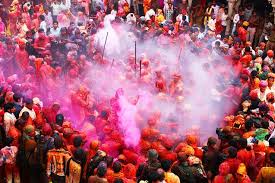
A haat is not a permanent market. It is a periodic gathering that moves from place to place on different days. Long before shopping malls and digital platforms, these rotating markets connected villages through exchange. Farmers sold produce, artisans displayed ornaments, musicians performed, and news travelled from one settlement to another. Bhagoria’s genius lay in the fact that it did not create a separate sacred space. It transformed an ordinary market into one.The arrival at Bhagoria Haat is equivalent to stepping into a world which emerges overnight. Villagers begin arriving from up to twenty or twenty-five surrounding villages, the women wearing rich reds and greens adorned with ornaments of silver at their necks, wrists, and ears, the men wearing jackets with embroidery and colorful turbans, and the youngsters in groups with flutes and drums. Items on sale range from farming equipment to earthen pots, glass bangles, jaggery, and paan. The air is filled with the smell of color powder, food cooking, and the sweet aroma of mahua. A group somewhere at the center of the place has started dancing.The maandal keeps the beat. The flute carries the melody across the noise of the crowd. The haat is not merely a market. It is a world.
Two gestures in particular became customary around courtship. The first was the application of gulal — a young man would place red powder on the face of the woman he wished to marry. If she returned the gesture, interest was mutual. If she did not, both simply went their own way. The second was the offering of paan; a woman accepting betel leaf from a man carried its own quiet meaning.
Some ethnographic accounts describe the festival as unfolding in distinct stages. The early days, sometimes called Gulaliya, are devoted to these expressions of feeling. The middle days involve a more elaborate ritual known as the Gol Gadhedo. In this practice, women form a circle around a pile of coconut and jaggery at its centre. A young man who wishes to declare his intentions must enter the circle and retrieve the offering. If he succeeds, he applies gulal to the woman of his choice and the two leave together. The community watches. It is neither secret nor forced — it is witnessed.The last days, referred to as Ujadiya, which literally translates as “scatter,” find people dispersing since they are done with their shopping activities and making their way back home. Different places describe these activities differently, and one description cannot be taken to apply to all places. What counts is the spirit behind them.In many cases, families and couples had already reached an understanding before the festival. The haat simply provided a public and joyful way to acknowledge those relationships. When disputes arose, the community had mechanisms to address them. One such practice, known as jhagda toran, involved compensation arrangements that allowed families to resolve conflicts without lasting rupture. It reflected an understanding that relationships involved both personal feelings and social responsibilities.
This complexity is often lost in popular portrayals.
For decades, newspapers and television reports have reduced Bhagoria to colourful headlines about young couples running away together. Such images attract attention but flatten a much richer reality. However, this image of Bhagoria has had repercussions that go beyond being merely representational. The fact that when the government of Madhya Pradesh wanted to present Bhagoria in its Republic Day celebration ceremony in 2015, several tribal groups opposed the very idea, proves their protection towards it quite effectively.Ironically, repeated portrayals from outside have sometimes influenced how younger generations themselves imagine the festival. Mobile phones, music from the films, selfies, and even jackets based on the heroes of the films are now present next to the traditional bow, silver ornaments, and tribal drums. This does not mean that these innovations have led to the destruction of the tradition but, on the contrary, prove that alive traditions evolve and do not stand still.
The celebration of Bhagoria takes place today in more than a hundred different places and it has become the state festival of Madhya Pradesh starting from 2023.The Bhilala communities continue their Pithora paintings. The music continues. Each year, hundreds of migrant workers return specifically for these seven days — proof, perhaps, that the pull of the haat is about more than habit.
Yet perhaps the deepest lesson of Bhagoria lies in the memory of that girl who wiped away the colour and walked on.
People often think that the essence of Bhagoria lies in elopement. But maybe its greatest truth lies elsewhere. The fair does not merely celebrate union; it recognises choice. It turns an ordinary market into a space where community, affection, and individual voice meet beneath the colours of spring.
Seven days before Holi, when the harvest is complete and hope returns to the fields, the Bhils gather once again. There are drums pounding from the hills, colours are flying everywhere and the haat talks first.
But for those who listen closely, they will realize that the haat does not only talk about love, but memory, community and how tradition helps people learn to live together.
By: Meenakshi Suryavanshi
Write and Win: Participate in Creative writing Contest & International Essay Contest and win fabulous prizes.
About the Author