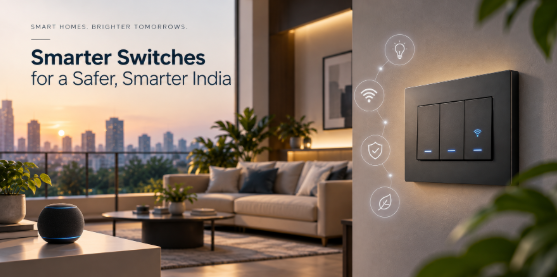
A wall switch used to be the least interesting object in a room. Flip it, forget it. That’s changed fast. Walk into a newly built apartment in most Indian cities today. There’s a good chance the switch panel does more than turn on a light. It may respond to a voice command, monitor power use, or automatically switch off a connected load when configured to do so. This shift didn’t happen overnight, but it happened quicker than most people expected. Rising urbanisation and cheaper connectivity are behind much of that push. So is a growing appetite for safer wiring, which has moved traditional modular switches for home installations toward something far smarter as the new standard.
The Evolution of Indian Home Electrical Architecture
Indian homes have gone through several wiring generations. Basic toggle switches gave way to modular panels, and now those panels are giving way to something more connected.
What’s driving the shift to smart switches in Indian homes? Four forces are behind it: expanding 5G and Wi-Fi penetration, rapid urban real estate growth, rising energy costs, and a broader move away from traditional modular switches for home wiring toward voice- and app-controlled IoT switches that respond in real time.
Homeowners are no longer satisfied with decorative wall plates alone. Entire homes are being wired around integrated smart home infrastructure from the design stage itself, not retrofitted years later as an afterthought.
What is a Smart Switch?
A smart switch is a connected electrical switch that allows users to control lights and compatible appliances using mobile applications, voice assistants, schedules, sensors, or automation rules. Depending on the model, it may also provide features such as remote control, energy monitoring, or integration with broader smart-home platforms.
Are Smart Switches Safe for Indian Homes?
Modern smart switches can be suitable for Indian homes when they are correctly selected, installed, and used within their specified electrical ratings. Safety depends on factors such as insulation, enclosure design, overload protection where provided, appropriate environmental ratings, and compliance with applicable electrical requirements. Existing wiring, earthing, load characteristics, and installation conditions should also be assessed before installation.
Do Smart Switches Save Electricity?
Smart switches can help reduce unnecessary electricity consumption through scheduling, automation, occupancy-based control, geofencing, and remote switching. Some advanced models also provide energy-monitoring features that help users identify appliance-level consumption. The actual energy savings depend on how the system is configured and used rather than on the smart switch alone.
Major Growth Drivers in the Indian Smart Home Ecosystem
Several forces are converging at once, and none of them are slowing down. Real estate, connectivity, and lifestyle habits are all pulling in the same direction. Together, they explain why adoption has accelerated so quickly across Indian cities in recent years.
Urban Real Estate Expansion & High-End Residential Projects
Developers in Tier-1 and increasingly Tier-2 cities have started pre-installing intelligent, app-ready switch panels as a standard luxury amenity. It’s no longer an optional upgrade buyers request separately. Take a premium apartment launch. Its brochure often lists app-controlled lighting and smart panels right alongside modular kitchens. This positioning matters. It signals to buyers that connected wiring is now expected. It’s the same way a good bathroom fitting once was, not something niche or experimental.
Pervasive Connectivity & Smart Assistant Integration
None of this works without reliable connectivity underneath it. Wi-Fi and Zigbee protocols let switches talk to hubs and assistants without constant manual input from the homeowner. Interoperability has improved too. Support for Amazon Alexa, Google Home, and Apple Home is now common across many smart-home products. Matter is an emerging smart-home interoperability standard that allows compatible devices from different manufacturers to work together across ecosystems such as Apple Home, Google Home, Amazon Alexa, and Samsung SmartThings. In reality, this cross-compatibility is what convinced many cautious buyers to finally commit, since nobody wants a system locked to a single brand’s app.
WFH Trends, Convenience, and Remote Home Access
Remote work changed how people relate to their own homes. Lighting, fans, geysers, and other appliances can now be managed from a smartphone app. It works the same whether someone is in the next room or travelling for work. Think about this: a geyser switched on remotely fifteen minutes before arriving home saves both time and a bit of daily friction. That convenience, multiplied across dozens of small moments a week, is a large part of why adoption has spread so quickly.
Safety Innovations in Modern Smart Switches for Home Use
Convenience gets the attention, but safety is arguably the more important story. Indian grids carry real risks: voltage spikes, humidity, and ageing wiring in older buildings. Modern smart switches for home use are increasingly built to handle these conditions directly. They don’t assume the stable, controlled electrical environment many Indian homes simply don’t have.
Overload, Surge, and Short-Circuit Protection
Built-in thermal protection can disconnect the connected load when abnormal temperatures are detected, adding an additional layer of protection alongside circuit breakers and RCBOs. Flame-retardant polycarbonate enclosures can add a further layer of protection by helping contain heat and limit the spread of a fault. Together, these features can improve safety when combined with appropriate electrical protection and correct installation.
Shockproof Touch Panels & High-Humidity Resistance
Capacitive glass touch panels are increasingly used in modern homes, particularly in kitchens and other areas where moisture can be a concern. Modern touch panels use insulated designs and enclosed electronics that help improve safety in humid environments when installed correctly. Appropriate IP ratings, insulation, product design, and compliance with applicable electrical safety requirements are also important considerations when selecting switches for moisture-prone locations.
Handling Voltage Fluctuations in Indian Grids
Voltage fluctuations can affect electrical and electronic equipment, particularly where the installation has an unstable supply or inadequate protection. Some smart switches include basic protection against minor voltage disturbances, but comprehensive surge protection is typically provided through dedicated surge protective devices installed in the electrical distribution system. Properly selected SPDs and other distribution-level protection can help protect connected equipment from transient overvoltages caused by events such as lightning or switching operations.
Choosing the Best Smart Switches: A Buyer’s Checklist
Not every smart switch suits every home, and getting this wrong is a common, avoidable mistake. Wiring type, budget, and the specific rooms being upgraded all shape the right choice. A buyer weighing the best smart switches for a first-time purchase should think through compatibility before aesthetics. A switch that doesn’t suit the existing wiring simply won’t install cleanly.
Retrofit vs. Greenfield Installation
Older Indian homes often lack a neutral wire at the switch point, which rules out certain smart switch models outright. No-neutral options exist specifically for this scenario, drawing a small trickle current instead of requiring a dedicated neutral connection. Greenfield installations, built from scratch, avoid this constraint entirely and offer far more flexibility during the wiring stage. Knowing which category a home falls into early saves considerable rework and cost later on.
Evaluating the Best Smart Switches for Home Automation
Three broad categories dominate the market right now. Capacitive touch switches replace the entire panel outright, offering a sleek finish. Smart relays or modules sit discreetly behind existing modular switches for home installations, adding intelligence without changing the visible panel at all. Smart dimmer switches add adjustable brightness control on top of basic on-off function. Each suits a different renovation budget and a different tolerance for disruption during installation.
Energy Monitoring and Power Optimization Capabilities
Some advanced smart switches and smart relays include energy-monitoring capabilities, allowing homeowners to track appliance-level electricity consumption rather than relying only on the main meter. This additional visibility can help identify which appliances or circuits are contributing most to energy use and support more informed decisions about daily consumption.
Cybersecurity and Data Privacy
Smart switches are connected devices, so cybersecurity is another consideration during product selection. Homeowners should look for products that support secure device authentication, encrypted communication, and regular firmware updates to help protect connected home networks. Strong account credentials, updated software, and reputable manufacturers can further reduce the risk of unauthorised access to smart-home systems.
Traditional vs. Modular vs. Smart Electrical Switches
Comparing these three categories side by side makes the practical trade-offs much easier to see. Traditional switches remain the cheapest option upfront but offer little beyond basic on-off control. Modular switches improved on aesthetics and safety without adding intelligence. Smart electrical switches go further still, layering connectivity, monitoring, and stronger protection on top of everything that came before them.
| Parameter | Traditional Switches | Modular Switches | Smart Electrical Switches |
| Control Type | Manual operation | Manual operation | App, voice, automation, and manual control, depending on model |
| Wiring Requirements | Basic | Basic | Neutral wire may be required; no-neutral options are available for selected models |
| Voltage Protection | Depends on installation protection | Depends on installation protection | Some models include basic protection; dedicated SPDs provide comprehensive surge protection |
| Installation Cost | Lowest | Moderate | Generally higher upfront |
| Lifespan | Depends on mechanical construction and usage | Depends on component quality and usage | Depends on component quality, installation conditions, and operating environment |
| Energy Monitoring Features | Generally unavailable | Generally unavailable | Available on selected advanced models |
Conclusion
The switch on an Indian wall has quietly become one of the more interesting pieces of home technology in recent years. What started as a simple safety and convenience upgrade has grown into a genuine shift toward integrated smart home infrastructure. It’s being built from the ground up now, not bolted on later. Lauritz Knudsen Electrical & Automation has long supported this transition. Their switchgear expertise and protective engineering are what safer, smarter homes ultimately depend on, helping Indian households move from basic wiring toward genuinely connected, resilient electrical systems.
Write and Win: Participate in Creative writing Contest & International Essay Contest and win fabulous prizes.
About the Author