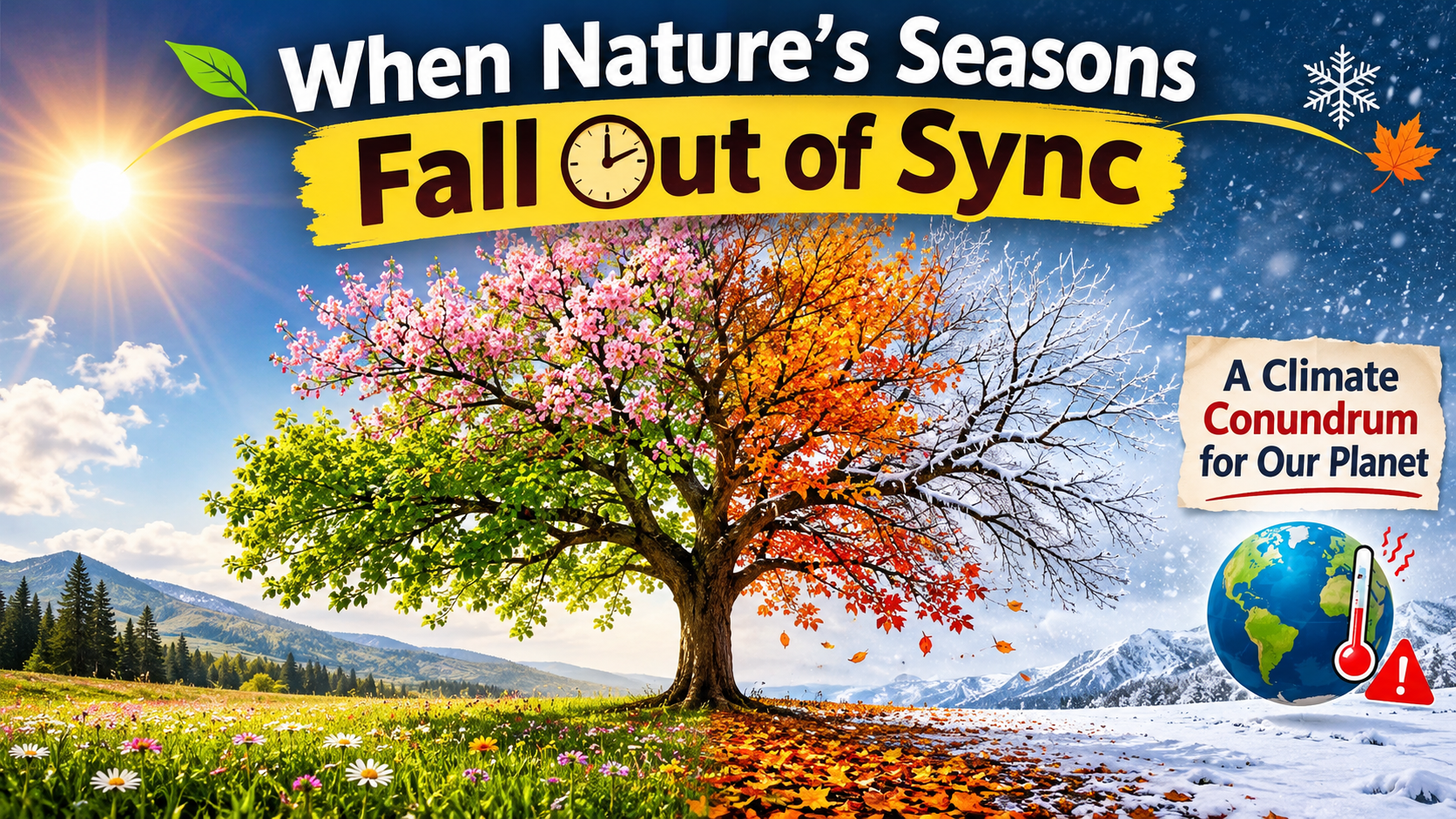
The Earth is a dynamic planet. Due to the tilt of the Earth’s axis and its orbit around the Sun, there are seasonal variations in the amount of daylight received, temperature and rainfall. This leads to seasonal variations in the behaviour, characteristics and distribution of organisms within an ecosystem. These patterns contribute to seasonal biodiversity. Biological communities constantly change throughout the year to better adapt to their environment. This can be studied by scientists in a field called phenology. Seasonal adaptations enable organisms to reproduce, feed and survive during harsh times of the year. However, climate change is affecting the temperature and rainfall so organisms may struggle to rely on the natural cues they have used for thousands of years. How are different species struggling to adapt to seasonal changes? What effect will this have on ecosystems?
Organisms rely on environmental cues to adapt to seasonal changes. One of the most reliable cues is photoperiod. This is the amount of daylight they receive each day. This will change throughout the year depending on the latitude and seasonal changes. In many vertebrates, light entering the eyes will send signals to the brain. This will affect melatonin production in the pineal gland. Melatonin helps regulate seasonal changes such as growing winter fur, developing reproductive systems and migration. Some migrating birds also go through a time of increased restlessness called Zugunruhe. Unlike temperature, photoperiod is consistent throughout the year. However, as global temperatures rise while daylight patterns remain stable, organisms may respond to cues that no longer match their environment.
Other organisms rely more on temperature and rainfall. Many insects and plants use heat accumulation to know when to develop. This can be measured using growing degree days. In tropical and dry climates, organisms may rely on seasonal rainfall to know when to breed or seed. Many organisms also have methods to survive harsh conditions. Diapause is a period of arrested development and many insects can survive extreme weather. Torpor is also used to reduce body temperature and metabolism to save energy. These adaptations help organisms survive seasonal changes, but they also show that different species rely on different environmental cues. As climate change affects these cues at different rates, species that used to rely on each other may not be in sync anymore.
A species that relies on seasonal changes is the snowshoe hare (Lepus americanus). During the summer months, these hares will have brown fur to blend in with their environment. During the winter their fur will turn white to provide camouflage against the snowy landscape and avoid predation from Canada lynx (Lynx canadensis). This change is mainly controlled by photoperiod, however temperature can also affect it. As global temperatures are rising, snow is melting earlier in spring and forming later in autumn. As the hare’s main cue is photoperiod their fur may stay white even when there is no snow on the ground. This causes a problem called camouflage mismatch.
The hares’ white fur now stands out against the dark forest floor and increases their chance of predation. A study was completed by Zimova et al. (2016) and found that hares with full camouflage mismatch had up to 7% lower weekly survival than hares whose coats matched their surroundings. This shows how a previously advantageous adaptation has become a disadvantage. Some hares may adapt through changes in their moulting patterns; however, this may not happen fast enough to keep up with global warming. This example also raises an important question about the speed of adaptation.
Although natural selection may favour hares whose coats change colour at more suitable times, this depends on enough variation existing within the population. If camouflage mismatch increases deaths before successful reproduction, the number of individuals able to pass on useful traits may fall. Protecting suitable habitats and maintaining connections between populations could therefore help preserve the variation needed for future adaptation. An important example is the European pied flycatcher (Ficedula hypoleuca). This is a migratory bird that travels from Africa to Europe every spring to breed. Their migration is influenced by internal biological rhythms and seasonal daylight patterns. Once they reach their destination within Europe they need a high abundance of caterpillars to feed their young. An important food source is the winter moth (Operophtera brumata). The caterpillars will emerge around the same time as the oak trees produce new leaves. This is heavily affected by spring temperatures.
As European springs become warmer, oaks will produce leaves earlier and winter moth caterpillars will emerge earlier. The pied flycatchers can adjust their breeding time but not always fast enough. This means their chicks will hatch later than the peak time of caterpillars. This creates a trophic mismatch between species that depend on one another. A 2006 study led by Christiaan Both found that some pied flycatcher populations in the Netherlands had declined by around 90% over two decades in areas where warmer springs had shifted caterpillar emergence earlier. However, populations in regions where food was still available later had much lower declines.
This demonstrates that the severity of climate change impacts can vary between regions, depending on local food availability. Even if the birds complete their migration, they may struggle to reproduce as their main food source will no longer be available. The contrast between regions is especially important because it suggests that the same rise in temperature does not automatically produce the same outcome everywhere. The timing of caterpillar availability matters more directly to breeding success than temperature alone. Studying both the birds and their food sources can therefore provide a clearer picture of the risks than observing either species in isolation.
Seasonal biodiversity can be seen in temporary freshwater environments. Vernal pools are small wetlands that fill up during rainy seasons or when snow melts. Because they do not contain water throughout the year, most fish cannot establish permanent populations, so the pools provide a good habitat for certain amphibians and invertebrates. One example is the fairy shrimp. This is part of the Anostraca order. They have evolved to produce protected eggs called cysts. These can survive in the dry soil for years. The adults produce these before the water dries up. When it rains or snow melts and conditions are right the eggs will hatch.
The shrimp will then need to grow, reproduce and create new cysts before the water dries up again. However climate change is causing unpredictable rainfall patterns in many areas. If seasonal rain is delayed, or higher temperatures cause the pools to dry up more quickly, the fairy shrimp may not have enough time to complete their life cycle. Even though their eggs can survive long periods without water, the adults will need enough time in favourable conditions to reproduce.
This shows how seasonal biodiversity relies on favourable conditions lasting for a certain amount of time. This illustrates a different kind of timing problem from the hare and flycatcher examples. Fairy shrimp may survive a dry period as dormant cysts, yet still fail to reproduce if a newly filled pool disappears too soon. In other words, the arrival of a seasonal event is not enough; its duration can be equally important. Conservation efforts should therefore consider how long temporary wetlands remain wet, not simply whether they fill each year.
Disrupted seasonal timing can affect whole ecosystems. In agriculture, insect pollinators are needed when the crops and fruit trees are flowering. If the temperature rises and the flowers bloom before the pollinators become active pollination may become less successful, resulting in lower crop yields. Warmer winters may mean pests in forests such as the mountain pine beetle (Dendroctonus ponderosae) may survive more easily. Marine ecosystems also rely on seasonal biodiversity.
During spring, increased sunlight and nutrient availability will cause a rapid growth in microscopic marine organisms called phytoplankton. These seasonal blooms provide the base for many ocean food chains. Zooplankton, fish and other marine organisms will feed off them. Phytoplankton also absorb carbon dioxide through photosynthesis and therefore contribute to the ocean’s carbon cycle. If ocean temperatures rise and alter the timing of seasonal blooms, animals that rely on them may struggle to find enough food. This could also affect carbon movement.
A key factor in whether organisms can survive these changes is their ability to adapt. Some species exhibit phenotypic plasticity, meaning they can change their behaviour, development and characteristics to suit their environment. Certain birds can change their breeding times to suit the warmer temperatures in spring. However other organisms rely on biological cues that can be harder to change. Species that have more adaptability may become more successful. Species with very specific seasonal requirements may decline in population. This can disrupt ecological balance and reduce biodiversity. These examples show why conservation cannot rely on a single solution for every species. Migratory birds, snowshoe hares and freshwater invertebrates face different seasonal pressures, so protecting their habitats requires attention to different cues and life-cycle stages.
Seasonal biodiversity is much more than just a change in appearance throughout the year. It provides natural rhythms for organisms to survive, breed and interact. From snowshoe hares changing colour to pied flycatchers migrating and fairy shrimp producing dormant eggs, these examples show how organisms rely on seasonal changes. However, climate change is disrupting these patterns through shifts in temperature and rainfall. Species may struggle both to adapt to their environment and to remain in sync with the organisms they rely on. To protect seasonal biodiversity we need to understand and preserve natural timings. These relationships are important to keep ecosystems healthy and stable.
References
Both, C., Bouwhuis, S., Lessells, C. M., & Visser, M. E. (2006). Climate change and population declines in a long-distance migratory bird. Nature, 441(7089), 81–83.
Bradshaw, W. E., & Holzapfel, C. M. (2007). Evolution of animal photoperiodism. Annual Review of Ecology, Evolution, and Systematics, 38, 425–441.
Charmantier, A., McCleery, R. H., Cole, L. R., Perrins, C., Kruuk, L. E., & Sheldon, B. C. (2008). Adaptive phenotypic plasticity in response to climate change in a wild bird population. Science, 320(5877), 800–803.
Denlinger, D. L. (2002). Regulation of diapause. Annual Review of Entomology, 47(1), 93–122.
Gaston, K. J., Bennie, J., Davies, T. W., & Hopkins, B. N. (2013). The ecological impacts of nighttime light pollution. Frontiers in Ecology and the Environment, 11(2), 91–96.
Geiser, F. (2004). Metabolic rate and body temperature reduction during hibernation and daily torpor. Annual Review of Physiology, 66, 239–274.
Kudo, G., & Ida, T. Y. (2013). Early onset of spring increases the phenological mismatch between plants and pollinators. Ecology, 94(1), 231–240.
McMaster, G. S., & Wilhelm, W. W. (1997). Growing degree-days: one equation, two interpretations. Agricultural and Forest Meteorology, 87(4), 291–300.
Scharf, F. S. (2015). Impacts of climate warming on forest pest dynamics. Journal of Forestry, 113(4), 380–389.
Zimova, M., Mills, L. S., & Nowak, J. J. (2016). High fitness costs of climate change-induced camouflage mismatch. Ecology Letters, 19(3), 299–307.
Author: Ritisha Sarin
About the Author