Heart health tests look for cardiovascular disease, the group of conditions that affect the heart and blood vessels, and they can sound complicated when you first see their names. Perhaps a doctor has suggested a heart test, or a relative has been diagnosed with heart disease and you want to understand what checking your own heart involves.
Most people want to know what the tests do and whether they are uncomfortable. Fortunately, many of these tests are quick and painless.
The tests that suit you depend on your age, medical history and risk factors such as high blood pressure or diabetes. For many people, a heart screening begins with simple checks such as blood pressure and cholesterol.
In this article we explain the main types of cardiovascular tests and how testing usually begins.
What Are the Types of Heart Health Tests?
The types of heart health tests fall into three broad groups: blood tests, tests of the heart’s rhythm and pumping, and scans of the coronary arteries, the blood vessels that supply the heart muscle.
Blood tests help estimate your risk of heart disease, and rhythm and pumping tests show how well your heart is working. Artery scans, meanwhile, show whether plaque, a fatty buildup in the artery wall, has formed or narrowed the arteries.
Blood Tests for Heart Health
Blood tests for heart health measure substances in your blood that can affect your risk, and here’s what the main ones look at:
- Cholesterol panel – also called a lipid panel, it measures LDL (“bad”) cholesterol, HDL (“good”) cholesterol and triglycerides, a type of fat in the blood. Over time, high LDL can build up in the artery walls.
- Blood sugar test – a fasting glucose test or a glycated haemoglobin (HbA1c) test, which shows your average blood sugar over about three months. This matters because diabetes can raise the risk of heart disease.
- Inflammation test – a high-sensitivity C-reactive protein (CRP) test measures low-level inflammation in the body, which has been linked with a higher risk of heart disease.
- Lipoprotein(a) test – this measures an inherited type of cholesterol particle that may raise risk even when other cholesterol results are normal. Because your genes mostly set the level, many guidelines suggest measuring it at least once in adulthood.
- Troponin test – a blood test used in hospital when a heart attack is suspected, because troponin levels rise when heart muscle is damaged.
Electrocardiogram (ECG)
An electrocardiogram (ECG) records your heart’s electrical signals and can detect an irregular heartbeat (arrhythmia), signs of an earlier heart attack or thickening of the heart muscle.
During a resting ECG, a nurse or technician places small sticky patches called electrodes on your chest, arms and legs, and a machine records the signals. The test is painless.
However, a resting ECG records just a few minutes, so it can miss a rhythm problem that comes and goes. In that case, a portable Holter monitor can record your heart rhythm during your normal routine.
Echocardiogram (Echo Heart Test)
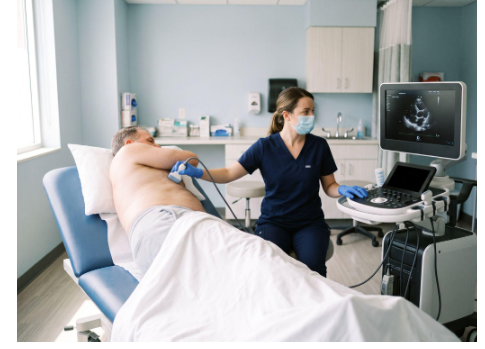
An echocardiogram, also called an echo heart test or 2D echo, uses ultrasound to show how well your heart pumps, the size of its chambers and how its valves open and close.
During the test, a technician moves a small probe over your chest, and the scan is painless and uses no radiation. An echo is often used to look for heart failure, valve disease or damage from an earlier heart attack.
Treadmill Stress Test (TMT)
A heart stress test, often called a TMT (treadmill test), checks how your heart works when it has to work harder. Most people walk on the treadmill, though some ride an exercise bike instead.
The test works because exercise makes your heart muscle need more oxygen. If a coronary artery is narrowed, part of the heart may get enough blood at rest but not during exercise, which can cause changes on the ECG or symptoms during the test.
Some stress tests also include an echo or a nuclear scan, and for people who cannot exercise, a medicine can have a similar effect on the heart.
Coronary Calcium Scan
A coronary calcium scan uses a computed tomography (CT) scanner, a type of X-ray scanner, to measure calcium in the walls of the coronary arteries, a sign of plaque.
During the scan, you lie on your back on a table that slides through the ring-shaped scanner. Small patches on your chest connect to an ECG, so the scanner can take its pictures between heartbeats, and you may be asked to hold your breath for a few seconds. Overall, the scan takes a few minutes, needs no injection and uses a low dose of radiation.
Afterwards, you receive a calcium score, a number based on how much calcium the scan detects. A score of zero means no calcium was seen, while a higher score usually means more plaque in the arteries. The score mainly helps estimate future risk in people who have no symptoms.
Coronary Angiogram (CAG)
A coronary angiogram, or CAG, is a heart test that uses a dye to show where the coronary arteries are narrowed or blocked, and it comes in two forms:
- CT coronary angiogram – a CT scanner takes pictures after a dye is injected into a vein in your arm.
- Invasive coronary angiogram – a thin tube called a catheter is passed through a blood vessel in the wrist or groin to the heart, and dye shows the arteries on X-ray. A narrowed artery can sometimes be opened during the same procedure.
Unlike a calcium scan, an angiogram is usually reserved for people with symptoms or unusual results from other tests.
Genetic Testing
Cardiovascular genetic testing looks for inherited gene changes that can cause heart conditions, such as familial hypercholesterolaemia (very high cholesterol from birth) or hypertrophic cardiomyopathy (a thickened heart muscle).
In practice, genetic testing is usually considered when several relatives had heart disease at a young age or a family member has a known inherited heart condition. It is often offered with genetic counselling to explain what a result means for you and your family.
Which Test Detects Heart Blockage?
The tests that can detect heart blockage are the stress test, the coronary calcium scan and the coronary angiogram.
A stress test may show whether a narrowed artery limits blood flow during exercise, while a calcium scan shows plaque that has built up before symptoms appear. A coronary angiogram gives the clearest picture of where an artery is narrowed or blocked, so it is usually used to confirm a blockage.
No blood test can show a blockage directly, although cholesterol and other blood tests show your risk of developing one.
Which Heart Check-Up Tests Do You Need?
The heart check-up tests you need depend on your risk, and your regular doctor can start with the basics: blood pressure, cholesterol, blood sugar and weight, plus questions about smoking and your family history.
A cardiovascular screening or risk assessment often combines these checks to estimate your chance of heart disease or stroke over the next 10 years. After that, further tests such as an ECG, an echo or a calcium scan are usually suggested only if your risk, symptoms or earlier results call for them.
A test that helps one person can lead to unnecessary follow-up tests for another, which is why it helps to discuss the options with your doctor.
Looking Ahead: Knowing Your Heart Health
Most heart health tests are simple, and many are finished within minutes, from a blood sample to a resting ECG. Used together, they look at different parts of your heart and can show how well it is working.
Knowing your numbers, such as your blood pressure and cholesterol, gives you a starting point. With that information, you and your doctor can decide which further tests, if any, make sense for you, and you can look after your heart with confidence for many years to come.
Disclaimer: This article is for general information only and is not medical advice. Always follow the advice of your own doctor about which tests are right for you.
Write and Win: Participate in Creative writing Contest & International Essay Contest and win fabulous prizes.
About the Author