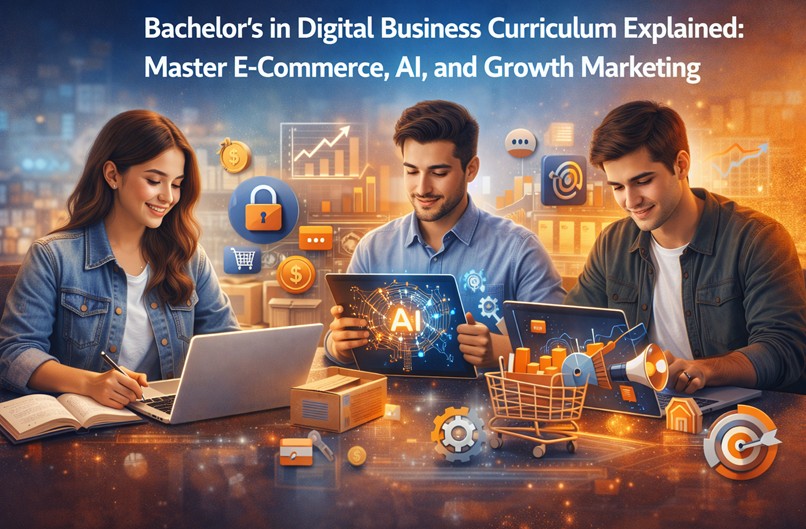
A Bachelor’s in Digital Business degree goes far beyond traditional business education, focusing specifically on teaching students how to master three critical areas that drive modern commerce: e-commerce operations, artificial intelligence applications, and growth marketing strategies.
Unlike a conventional business degree that spreads knowledge across finance, HR, and operations, a digital business program is tightly organised around the digital economy, equipping students with hands-on skills and strategic knowledge they need on day one of their careers.
The curriculum combines foundational business principles with cutting-edge digital tools and frameworks. Students emerge from the program understanding how to build online stores, leverage AI for business intelligence, and execute data-driven growth marketing campaigns.
Core Curriculum Components
The foundation of a Bachelor’s in Digital Business program starts with essential business knowledge. Students learn managerial economics, organisational behaviour, business fundamentals, and strategic planning.
These courses ensure that graduates have a solid understanding of how businesses operate, not just digital tactics.
However, what sets this degree apart is the emphasis on digital applications throughout. The curriculum includes:
- Business strategy with digital-first thinking
- Data analytics and performance metrics
- Digital business models and ecosystems
- Entrepreneurship focused on online ventures
- Legal and ethical frameworks for digital commerce
This balanced approach means graduates understand both the “why” behind business decisions and the “how” of executing them in digital environments.
E-Commerce Mastery: From Strategy to Execution
E-commerce education within a Bachelor’s in Digital Business program covers the complete lifecycle of online retail. Students don’t just learn theory; they work with actual e-commerce platforms like Shopify, understanding how businesses operate in the digital marketplace.
What students learn about e-commerce includes:
| Core E-Commerce Skills | Strategic Applications |
| Store setup and management | Building customer loyalty programs |
| Product cataloguing and optimisation | Conversion rate optimisation |
| Payment gateway integration | Customer experience design |
| Inventory management systems | Multi-channel selling strategies |
| Performance analytics | Market expansion tactics |
Students work on real projects, setting up test stores, optimising product pages, and analysing customer behaviour data. This hands-on experience means they understand how consumer psychology influences purchasing decisions in online environments.
One major component is learning how to use data to understand customer journeys across different touchpoints. They analyse metrics like conversion rates, cart abandonment, customer lifetime value, and average order value.
This analytical mindset transforms how they approach e-commerce challenges throughout their careers.
Artificial Intelligence and Machine Learning in Business
BBA in digital marketing might introduce AI concepts, but a Bachelor’s in Digital Business goes deeper, treating AI as a core business tool rather than a technical afterthought.
Students learn the fundamentals of artificial intelligence, including machine learning, deep learning, and practical algorithms. More importantly, they understand how to apply AI to real business problems.
The curriculum covers AI applications in:
Practical AI Use Cases
- Personalisation engines that recommend products to customers
- Predictive analytics for demand forecasting
- Chatbots and AI customer service tools
- Dynamic pricing strategies
- Customer segmentation and targeting
- Marketing automation
- Fraud detection and risk assessment
Rather than just understanding how AI works technically, students learn to ask the right questions.
When should you implement AI? What problems does it solve for your business? How do you measure whether AI initiatives are actually delivering value?
Students also study the ethical considerations of AI in business. They examine bias in algorithms, privacy concerns, and responsible AI practices. This ethical foundation matters increasingly as companies face pressure to deploy AI responsibly.
Growth Marketing: The Modern Approach to Customer Acquisition
Growth marketing is different from traditional marketing. It’s experimental, data-driven, and obsessed with scalable customer acquisition.
A Bachelor’s in digital business curriculum treats growth marketing as both art and science. Students learn to develop comprehensive marketing strategies while also testing individual tactics to see what actually drives growth.
Key Growth Marketing Disciplines
- Content marketing and SEO strategy
- Paid advertising across search, social, and display networks
- Email marketing automation and segmentation
- Social media strategy and community building
- Conversion optimisation and A/B testing
- Analytics and attribution modelling
- Viral loop design and referral programs
- Retention and customer lifetime value optimisation
What makes this different from traditional marketing classes is the emphasis on measurement and experimentation. Growth marketers don’t launch campaigns and hope they work. They set hypotheses, test assumptions, analyse results, and iterate quickly.
Students work with tools like Google Analytics, Facebook Ads Manager, Mailchimp, and HubSpot. They learn to read dashboards, interpret metrics, and make decisions based on data rather than intuition.
Real-World Projects and Capstones
Theory without application doesn’t prepare students for real work. That’s why Bachelor’s in Digital Business programs emphasise projects and internships.
Students typically work on capstone projects where they solve actual business problems. One student might build a complete e-commerce marketing plan. Another might develop an AI implementation strategy for a specific business challenge. These projects build portfolios that impress employers.
Internships place students with actual companies where they execute digital strategies under professional guidance. This experience matters significantly. Employers consistently report that the best hires are those who bring real project experience to their first role.
Career Paths After Graduation
Graduates with a Bachelor in Digital Business enter diverse career tracks, all of which value the combination of business thinking and digital execution skills.
Popular career paths include:
- E-Commerce Manager
- Digital Marketing Specialist
- Growth Marketer
- Digital Product Manager
- Data Analyst
- Digital Business Consultant
- Corporate Innovation Specialist
- Digital Transformation Specialist
- Marketing Automation Manager
The versatility of the degree means graduates aren’t limited to marketing roles. The business foundation and AI knowledge open doors in product management, consulting, and strategic roles as well.
FREQUENTLY ASKED QUESTIONS
Q: Is a Bachelor in Digital Business better than a BBA in General Business?
A: It depends on your career goals. A general BBA provides broader business knowledge across functions, which is valuable if you’re unsure about your specialty. A Bachelor in Digital Business offers deeper expertise in high-demand areas like e-commerce and growth marketing, making graduates more immediately employable in digital roles. If you know you want a career in digital business, the specialized degree gives you a significant edge.
Q: Will AI make digital business skills obsolete?
A: Quite the opposite. As AI becomes more prevalent, understanding how to leverage it becomes more valuable, not less. Professionals who understand both AI capabilities and business applications will be in higher demand. The program teaches students to work with AI as a tool, not be replaced by it.
Write and Win: Participate in Creative writing Contest & International Essay Contest and win fabulous prizes.
About the Author