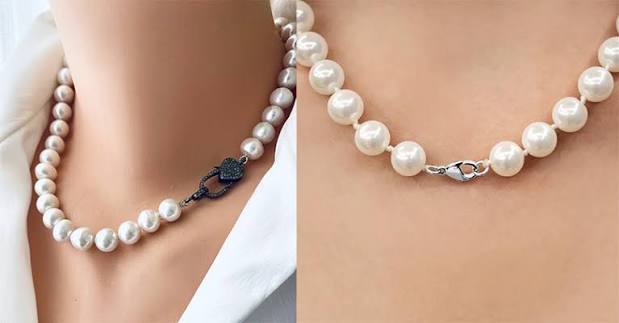
A bayonet clasp is a two-part tube closure: one end slides into the other and locks with a short push-and-twist, the same principle as a camera lens mount. It closes blind behind the neck, has no spring to wear out, and sits flush in line with the strand, which makes it a natural fit for long necklaces.
Ask people to name types of jewellery clasps and they will get to lobster, spring ring, toggle, and magnetic before running out. The bayonet clasp rarely makes the list, which is odd, because for one entire category of jewellery, the long necklace, it solves problems the famous closures cannot.
What a Bayonet Clasp Is (and Isn’t)
A bayonet clasp is a slim, two-part tube fitting. One half carries a pin or lug, the other a matching slot; push the halves together, give a short twist, and the lug seats in the slot and locks. The name comes from the same mount soldiers used to fix bayonets to rifles, and photographers still use to fix lenses to cameras. Opening reverses the motion: twist, then pull.
What it is not is a friction or spring mechanism. There is no tiny lever to operate, as on a lobster clasp or spring ring, no spring inside to tyre, and no magnet relying on pull strength. The lock is mechanical and positive: it is either seated or it is not, and you can feel the difference without looking. Closed, the clasp reads as a small cylinder in line with the strand, closer to a bead than a buckle.
Where It Outperforms Lobster & Magnetic
The bayonet’s advantages concentrate exactly where long necklaces live. A lobster clasp or spring ring must be operated by sight or by practised feel, with a fingernail on a small trigger; behind the neck, under hair; that is the hardest motion in jewellery. A bayonet closes blind: the hands find the two tubes, push, twist, and done. For anyone with limited dexterity or reduced fingertip strength, that difference decides whether a necklace gets worn.
Against magnetic necklace clasps, the comparison is about load and intention. A magnet’s hold is its weakness as well as its convenience: a long, heavy strand swinging through a day of wear applies exactly the kind of intermittent pull that magnets answer poorly, and a snagged necklace releases rather than resists. The bayonet’s mechanical lock does not release under pull; it releases under twist, which snags do not supply. Each clasp has its place; the longer and heavier the piece, the stronger the bayonet’s case.
GRIFFIN Bayonet Sizes and Finishes
GRIFFIN’s findings programme follows one material standard, and the bayonet clasps sit within it: GRIFFIN clasps and findings are made of 925 sterling silver, nickel-free, with 7-micron 24K gold plating. Nickel-free matters more on a clasp than almost anywhere else in jewellery, because the closure is the component most reliably in contact with skin at the nape of the neck.
Current sizes and finish options for the bayonet range are listed at the Online store (www.griffin1866store.com), and for restoration work or brand matched production, custom orders such as rhodium-plated, rose-gold-plated, ruthenium-plated, or matt surfaces are available across the findings programme. Choose the clasp diameter to sit in proportion with the strand: flush with the beads on a knotted piece, not wider than the chain on a fine lariat.
Attaching a Bayonet Clasp Without Damage
The attachment follows the same catalogue logic as any tube ended closure. On a knotted cord, finish the end knots into squeeze capsules or bell caps, gluing the knot inside, and hang the capsule’s eye into the clasp’s ring with an open jump ring, twisted closed sideways so the ring keeps its shape. On a chain, the jump ring connects the link to the clasp directly; use a soldered ring on the fixed end if the design allows, so only one connection point ever opens.
Two cautions protect the clasp. Never grip the tube body with pliers while closing a jump ring; work on the ring, not the cylinder, or the tube can deform enough to spoil the twist action. And keep glue out of the mechanism entirely; it belongs inside the capsule with the knot, nowhere near the lug and slot.
Use Cases: Long Chains, Lariats, Opera-Length Pearls
Length is where the bayonet earns its place. An opera-length pearl strand, traditionally 71 to 86 cm, is heavy enough to make magnet release a real risk and long enough that the clasp spends its life swinging at the wearer’s sternum or behind the neck, both blind territory for a lobster trigger. A bayonet closes by feel and carries the load mechanically.
Long chains and lariats add a styling argument. Worn doubled or knotted, a long piece brings its closure into view, and a slim cylinder survives that exposure better than a functional-looking trigger clasp. On queen-length strands of 88 cm and more, which can be slung around the neck three times, some wearers skip opening the clasp at all; for everyone else, a closure that works by touch alone is the difference between an elegant piece and an awkward one.
Maintenance And Cleaning
A bayonet clasp needs the same care discipline as the rest of the piece. Follow the standing rule: never use cleaning agents on jewellery.
Check the mechanism after cleaning. Operate the clasp a few times after cleaning to confirm the twist still sits crisply, and if the action ever feels gritty, the cause is usually debris in the slot; a dry cloth and patience clear it. Nothing wet, nothing abrasive, and no lubricant, which attracts the dirt it is meant to prevent.
Write and Win: Participate in Creative writing Contest & International Essay Contest and win fabulous prizes.
About the Author