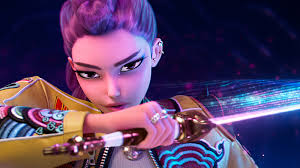
Can you believe that a virtual singer topped the Billboard Hot 100 chart? Huntr/x, a virtual K-pop girl group and the main character of” K-pop Demon Hunters,” made this come true. K-pop Demon Hunters is a feature-length animated film created by Korean-American director Maggie Kang. It depicts a creative theme, combining K-pop culture and demon hunting. This essay will focus on the protagonist, Rumi, who is one of the members of Huntr/x. She is not just a character of animation, but a symbolic character showing traditional Korean culture and contemporary K-pop culture.
To begin with, before analyzing why Rumi became such an impressive character, it is important to first examine the plot of the story. In the story, there are ‘Gwima’ that hunt human souls. To restrict them, the only solution is to create a powerful barrier, “Honmoon “, formed by moving people’s hearts. Hunters who have protected the world since ancient times now perform as a K-pop girl group, Huntr/x. It consists of Rumi, who is the main vocalist, Mira, the center of the performance, and Zoey, a rapper. They sing a song for the public and fight evil spirits at the same time.
At the center of the story, the main character, Rumi, is a perfect idol. But she is actually half-human and half-demon. She is afraid of revealing her demonic mark to her team and the public because she fears being abandoned. As her demonic mark gradually grows, she even begins to lose her voice. While she feels depressed as her voice becomes restricted, Jinu, the leader of the demon idol group, “Saja Boys”, approaches Rumi. He tells Rumi that he also lives between two worlds and slowly gains her trust. But this was the tactic to break down Huntr/x.
Eventually, in a large stage, the World Idol Awards, Jinu deceives Rumi by revealing her demonic mark to the world. She falls into despair as people call her a “monster”, and the trust between her and her teammates is shattered. As a result, Honmoon was destroyed, and Gwima tries to turn the world into hell. At that moment, Rumi finally makes up her mind. She acknowledges her demontic appearance as a part of herself. She starts to sing a song ‘Golden’ with her pain and sincerity. Through her heartfelt voice, Mira and Zoey responded to her. In addition, the fans’ powerful energy finally completes ‘Golden Honmoon’. Moved by Rumi’s sincerity, Jinu sacrifices himself for her in the final moment and lends his strength to her. She eradicates Gwima with her enhanced power. After the final battle, Rumi rejoins her team with confidence. She begins a new journey with Huntr/x, no longer as a perfect idol, but as a true artist and hunter who embraces even her flaws (“Thompson Twins”).
In the story, Rumi lives a life as a half-human, half-demon, concealing the darkness within herself. But she eventually reveals her pain and frees herself from it. In this sense, this feature of Rumi is especially similar to the pressure that real-life K-pop idols face to always appear perfect. They always show glamorous and strong images on stage, but behind the scenes, they live with anxiety and a burden. Rumi also needed to fulfill the role of a leader while concealing her drawbacks. Because of this, many viewers could relate to Rumi’s situation. Moreover, this is not a story that only applies to the idol industry. People living in modern society also often hide their anxiety and weaknesses while trying to live according to society’s expectations. Thus, the situation where Rumi finally accepts her darkness gives both younger viewers and adult viewers emotional comfort and connection. Furthermore, the creators likely decided to portray Rumi as an idol rather than simply a warrior because K-pop idols are considered influential figures in modern society. Just as people’s support and emotions create the Honmun in the story, real-life K-pop also places great importance on emotional connection and interaction with fans.
Beyond her emotional journey, the character, Rumi, did not simply become an impressive character because she has a tragic narrative. At the same time, she is special because she symbolically represents both traditional Korean culture and modern K-pop culture. In particular, her character design was heavily inspired by Korean history and folk beliefs.
For example, one of the best examples of Korean culture in the animation can be seen through Rumi’s weapon. Rumi uses a sword called the ‘Sain Sword’, a traditional Korean sword created during the Joseon Dynasty. Unlike ordinary swords, which were made for battle, the Sain Sword was believed to have spiritual power to drive away disasters and evil spirits. Four constellations representing the east, west, south, and north are engraved on the blade. This style of carving constellations on swards originated from Korean Taoist traditions. Astronomical symbols such as constellations were also connected to royal authority in East Asia. The creators intentionally chose the Sain Sword instead of a typical Western weapon to emphasize the unique Korean atmosphere of the story. In other words, because of this, K-pop Demon Hunters does not simply use Korea as a background setting, but actively incorporates Korean traditional culture into the center of its narrative.
Near the end of the story, Jinu sacrifices himself to save Rumi, and his soul enters the Sain Sword. After this moment, the sword transforms into the ‘Chilseong Sword’. The Chilseong Sword is a ritual sword used by Korean shamans during traditional ceremonies called ‘gut’. A shaman of Korea is a person who communicates with spiritual beings and manages religious rituals. In reality, traditional Chilseong Swords usually do not contain drawings or decorations. However, Rumi’s sword contains an image of ‘dokkaebi’, a Korean goblin-like being. Many viewers believe this symbolizes Jinu’s spirit remaining within the sword after his sacrifice.
In contrast, unlike Western demons or devils, Korean dokkaebi are not purely evil beings. In Korean folklore, dokkaebi often protects people. They drove away evil spirits or brought fortune and wealth. Because of this interpretation, many viewers see the dokkaebi design on the sword not as a simple decoration, but as a symbol of Jinu continuing to protect Rumi even after his death. The transformation from the Sain Sword to the Chilseong Sword also represents Rumi’s personal growth. By accepting both her humanity and her demonic power, she finally becomes complete.
In addition to these traditional cultural elements, the title itself shows another important reason for the popularity of K-pop Demon Hunters. As the title suggests, the animation contains many elements of Korean culture. Rumi herself is a member of the K-pop girl group Huntr/x. One of the biggest K-pop culture characteristics is combining music with performances. Particularly, many K-pop songs mix Korean and English together, which attracts global audiences. K-pop songs also combine many different genres, for example, rap and house music into a single song. Because of this unique style, K-pop surprised music listeners around the world (“Chinese Mongol Nationality Female Ethnic Costume”).
Furthermore, K-pop is not simply consumed as music. But it is a cultural industry. Fans enjoy not only the music but also the idols’ fashion styles, personalities, and performances, creating strong emotional connections with them. Similarly, the fictional group Huntr/x reflects many characteristics of real K-pop idol groups. Their concept and styling were heavily inspired by famous girl groups BLACKPINK and TWICE. In particular, TWICE participated in recording songs for the OST and even mentioned inside the animation itself, making the story feel more realistic. The main composer of BLACKPINK, Teddy, also wrote the song ‘Golden’.
Likewise, the stage styling and fan culture shown in the animation are also very similar to the real K-pop industry. The members wear different outfits depending on the mood of the song, appear at events similar to the Met Gala, and perform in front of fans holding official light sticks and singing together. These scenes closely resemble real K-pop concerts. Huntr/x’s official light stick also contains Korean cultural elements. Its logo was inspired by the knot decorations of norigae, a traditional Korean accessory. Norigae were decorations attached to hanbok during the Joseon Dynasty and symbolized good luck and long life. In the animation, members of Huntr/x are often seen wearing nofigae as part of their everyday fashion. This shows a combination of traditional Korean culture and modern fashion.
BLACKPINK, which inspired Huntr/x, has built an incredible career. They recorded No.1 on the Billboard 200 and No. 3 on the Billboard Hot 100 (“Thompson Twins”). But what if a fictional idol group inspired by BLACKPINK became even more successful than them? Surprisingly, Huntr/x’s song “Golden” actually reached No. 1 on the Billboard Hot 100, breaking the records previously set by real K-pop groups. Even though Huntr/x is only a virtual group, it still achieved worldwide popularity (Ancis). One major reason for this success was the repetitive streaming by younger viewers.
One possible explanation is that children often feel comfort and familiarity through repetition. By repeatedly listening to the same songs, they can predict the melody and feel emotionally stable. They also repeatedly watched the same scenes, which increased the animation’s popularity and eventually helped it become Netflix’s most viewed video work (Ancis).
Nevertheless, the popularity of K-pop Demon Hunters cannot be explained only by the younger audiences repeatedly watching it. Rumi’s journey of overcoming anxiety and confusion about her identity also deeply resonated with adult viewers. Although Rumi looks perfect on the outside, she has pain and fear inside herself. Her character resembles many people living in modern society, and this made it possible for viewers of different ages to connect with her story.
Ultimately, Rumi is not simply a character from the animation. She is a symbolic character who represents both traditional Korean culture and modern K-pop culture at the same time. Her Sain Sword and Chilseong Sword contain elements of Korean history and folk beliefs, while the styling and music of Huntr/x reflect the characteristics of the real K-pop industry. In addition, Rumi’s journey of hiding her darkness and weaknesses before finally accepting herself gave strong emotional resonance to people living in modern society. These elements made K-pop Demon Hunters more than just an animation for children, allowing audiences around the world to enjoy and relate to it together. In particular, many people loved Rumi because she was not a perfect hero. She had fears, pain, and weaknesses just like real people. In the end, the success of K-pop Demon Hunters shows how popular Korean culture has become around the world, and Rumi’s power does not come from her flawless appearance but from her ability to transform her hidden wounds into a voice that connects diverse cultures, generations, and audiences around the world.
By: Yehyun Han
Write and Win: Participate in Creative writing Contest & International Essay Contest and win fabulous prizes.
About the Author