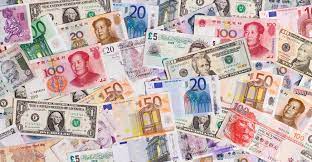
different currencies
Each sovereign nation typically issues its own currency. Historically, money was tied to political rule (ancient rulers minted coins, empires standardized currency, etc.), and the rise of the nation-state led to territorial currencies. For example, in the classical gold standard era (c.1870–1914) most countries tied their currencies to gold, effectively fixing exchange rates across borders. After WWII the Bretton Woods system again fixed currencies (to the US dollar and gold), but its collapse in 1971–73 led most countries to adopt flexible, market-determined rates. In practice, currency boundaries reflect historical events (e.g. the breakup of empires or unions) and deliberate policy (e.g. post-Soviet states introducing new notes). Only some regions use a common money (like the eurozone), or adopt another’s currency (dollarization or currency boards) instead of a separate currency.
Economic reasons
A central reason for having a national currency is control over domestic monetary policy. By issuing its own money, a country can set its interest rates and money supply to suit local conditions. For example, economists note that a floating exchange rate “offer[s] countries the advantage of maintaining an independent monetary policy”. In contrast, a fixed peg or using another country’s currency means “no independent monetary policy… [with] interest rates tied to those of the anchor currency”. Using local money lets a government respond to recessions or inflation with its own tools (rate cuts, quantitative easing, etc.). Indeed, one IMF study of Turkmenistan’s currency reform stressed that as a population relies more on its local currency (and less on, say, US dollars), the government gains more control over macro policy. Maintaining a separate currency also creates seigniorage (profit from issuing money) and avoids the exchange-rate risk of borrowing in a foreign currency.
Political and national identity reasons
Currencies are powerful symbols of sovereignty. Many citizens and leaders regard a national currency as a badge of independence and identity. Choosing to adopt another country’s money or enter a currency union is a highly political decision. For example, when euro-area states introduced the euro (1999–2002) it was sold as a step toward greater European unity – travelers no longer have to exchange money at every border. Conversely, countries that cling to their own currency (even if small) often do so to preserve a visible sign of national autonomy. In short, different currencies exist both for practical economic-policy reasons and as statements of political independence.
Exchange-Rate Regime
Floating, Fixed, and Pegs
Once each country has a currency, its value must be expressed relative to others. Exchange-rate regimes describe how these values are set. In a floating regime, the currency’s price is entirely market-driven. Supply and demand in the global FX (foreign exchange) market determine the rate: if demand for a currency is high, it strengthens, and vice versa. As Investopedia explains, “a floating exchange rate is determined by the private market through supply and demand”. Most advanced economies (e.g. the US, eurozone, Japan) now use floating rates, giving them the freedom to adjust monetary policy.
By contrast, a fixed or pegged regime means a government (via its central bank) sets the exchange rate at a specific level or range. For example, a country might peg its currency 1:1 to the US dollar or to a basket of currencies. To maintain a fixed rate, the central bank must buy or sell its own currency using its foreign reserves. This provides exchange-rate stability (often seen as good for trade and investment) but requires large reserves and means losing monetary autonomy. For instance, under a hard peg the central bank “has no independent monetary policy… [and] interest rates are tied to those of the anchor-currency country”. Two real-world examples: Panama has fully dollarized by using the U.S. dollar as its legal tender, while Hong Kong runs a currency board that tightly pegs the Hong Kong dollar to the U.S. dollar. In both cases the country gives up conventional monetary policy but gains exchange-rate certainty. A less rigid approach is a soft peg, where the exchange rate is kept stable against an anchor within an adjustable band; examples include China’s managed float or Costa Rica’s crawling peg.
Modern regimes also include currency unions (like the euro) in which multiple countries share one currency. In such unions, member governments cede all currency control to the supranational authority (the European Central Bank for the euro), but trade and travel among members become easier. (Importantly, most unions also involve shared economic policies or “fiscal union” elements to support the single currency.)
The Foreign Exchange Market
The global foreign exchange (Forex or FX) market is the arena where currencies are bought and sold. It is a vast, decentralized network of banks, brokers, corporations and investors across world financial centers. In fact, Forex is the largest financial market: daily turnover was about $7.5 trillion in 2022. Currencies are always quoted in pairs (e.g. EUR/USD, USD/JPY), reflecting how much of one unit of currency buys another. Major participants include commercial banks (which trade and service customers), central banks (which may intervene), multinational companies, hedge funds, and even retail traders. Prices in the FX market constantly change with news, economic data, and interest-rate expectations. Central banks sometimes intervene by buying or selling currency to stabilize excessive volatility, though most large economies now allow rates to float fairly freely.
In Forex you can trade “spot” (immediate delivery) or use derivatives to manage risk. For example, an exporter can enter a forward contract to sell a fixed amount of foreign currency at a set rate on a future date, locking in the cost. Options and futures contracts are also common ways to hedge against adverse moves. The FX market operates nearly 24 hours (across Asia, Europe, and the Americas), and uses secure financial networks for settlement. For instance, banks send payment instructions via the SWIFT system, which connects over 11,000 institutions in 200+ countries. (Because trades are often so large, specialized systems like CLS exist to reduce settlement risk among banks.)
How Currencies Are Exchanged in Practice
Travelers and Consumers: Tourists and individuals exchange money mostly through banks, credit cards, or currency bureaus. Before a trip, one can buy local currency at a home bank or an airport kiosk. In many countries one can simply withdraw cash from an ATM using a bank card; the card network then handles the conversion at the prevailing rate (usually with a small fee). According to financial providers, banks and credit unions typically offer the best exchange rates, while exchange kiosks may charge higher markups. Many travelers also use debit/credit cards abroad; these charge the domestic equivalent of the foreign price. (Card networks set wholesale rates, and banks might add small fees.)
Businesses and Traders
Companies that import, export or invest internationally routinely deal in foreign currencies. They use commercial banks or FX brokers to convert funds or to hedge currency risk. For example, a U.S. exporter selling to Europe might book a forward contract to sell euros for dollars at a fixed future date. Businesses also invoice each other in various currencies (often USD or EUR globally) and can hold foreign-currency accounts. Large firms might access the interbank FX market directly, or via their banks. In short, corporate transactions mostly flow through the global banking network: a company’s bank executes currency trades on the spot or forward market and credits the company’s account accordingly. Banks settle these trades among themselves through SWIFT messages.
Governments and Central Banks
Governments need foreign currency to pay for imports, service foreign debt, and build reserves. Central banks accumulate foreign exchange (e.g. dollars, euros, gold) as a balance-of-payments buffer. When needed, a central bank can intervene – for example, selling some reserve currency to buy domestic money if the local currency is falling too fast. Central banks also engage in currency swaps: major banks (e.g. the U.S. Federal Reserve) have swap lines with other central banks to provide liquidity. In extreme cases (balance-of-payments crises), countries turn to the IMF or World Bank for loans in foreign currency to stabilize their exchange rate and finance imports.
Institutions and Mechanisms
The entire currency-exchange system relies on key institutions. Central banks supervise monetary policy, issue currency, and oversee financial stability. Commercial banks handle most day-to-day conversions (for customers and businesses). Currency exchanges/bureaus and online platforms serve retail customers (travelers, remitters). Card networks (Visa, Mastercard) enable cross-border payments seamlessly. Behind the scenes, the SWIFT system ensures banks can securely send each other payment orders. The Bank for International Settlements (BIS) coordinates central-bank policy (and publishes FX data), and the IMF monitors global exchange-rate regimes and provides technical assistance.
In summary
Each nation’s separate currency reflects its history and desire for policy control and sovereignty. Exchange rates between them can float or be fixed by government policy. The global Forex market – involving banks, businesses, and traders – continually sets these rates through supply and demand. When people or companies need different currencies, they go through banks, exchange bureaus, or electronic networks (often paying small fees), and large transfers are settled via international banking systems. Throughout, central banks and international financial institutions provide the architecture and support that keep currency exchange running smoothly.
By: Shah Abdul Hanan Pirzada
Write and Win: Participate in Creative writing Contest & International Essay Contest and win fabulous prizes.
About the Author