These are not merely questions, but reflections of events etched into the history of India, which reveal that laws are essential to maintain order, yet it is not necessary to remain bound within them so rigidly that truth or justice is ignored. In our country, there have been many instances where laws suppressed human rights, but the fire of civic sense, ignited by conscience and emotion, has, at times, lit the torch of revolution against Mughal rule and at other times against British authority, reshaping history.
If laws were sufficient, why has the young doctor from Kolkata still not received justice?
If laws alone could run a nation, why were farmers forced to protest in the freezing cold of Delhi?
If laws could decide a country’s destiny, why did the cry for freedom rise against British rule?
And if laws were always just, why were dreams of Swaraj woven against Mughal authority?
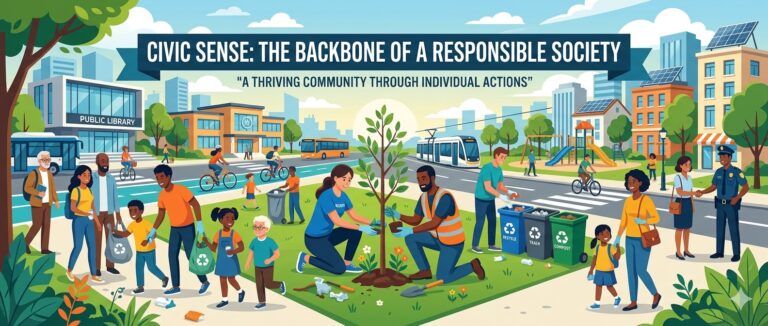
Civic sense does not merely mean revolution or rebellion; rather, it means understanding one’s duty towards the nation, something people often abandon by placing all responsibility on the government and blaming the country itself.
Our nation is a home of heaven-like beauty, yet in every corner we see garbage thrown carelessly, filth scattered around, rivers and drains filled with waste, scribbles on the walls of historical monuments, daily reports of violence against women, and people engaging in unnecessary arguments and fights on the streets. These are the moments where we, as citizens, fail in our duty and where civic sense begins to collapse.
It is the consequence of neglecting civic sense that today, even sacred rivers like the Ganga and Yamuna are counted among the most polluted rivers in India. The same lack of responsibility has led to poaching and illegal hunting, pushing species like the Asiatic lion, Bengal tiger, and the one-horned rhinoceros to the brink of extinction, while others, such as the Asiatic cheetah, have vanished from India for decades. It is also the absence of civic sense among our sons that results in many women to face violence every day whether in the form of harassment, domestic abuse, sexual assault, or even human trafficking. Our failure to recognize and fulfil our responsibilities towards society is evident even during festivals, where celebrations are overshadowed by harm: noise and air pollution caused by firecrackers during Diwali, misconduct towards girls under the pretext of applying colours during Holi, and the use of dangerous kite strings during Makar Sankranti, which injure people and kill birds. For all these issues, strict laws already exist; yet ironically, in our country, people continue to commit such acts without fear of the law.
India has witnessed many moments in history where individuals rose above and even against the law to fulfil their duty towards the nation and bring reforms. If we begin with the Mughal rule, religious freedom was threatened by some rulers like Aurangzeb who enforced laws aimed at religious conversion, through additional taxes and restrictions on non-Muslims, and through threats of death, as faced by the Kashmiri Pandits. If the ninth Sikh Guru, Guru Tegh Bahadur Ji, had not challenged such laws and sacrificed his life in Delhi, history might have been completely different. His martyrdom inspired countless people to raise their voices against oppression and protect their basic human rights.
Moving forward in time, if leaders like Mahatma Gandhi had not defied British laws through movements such as the Salt March and Civil Disobedience, our nation might still have remained enslaved.
History also remembers Neerja Bhanot, the only woman honoured by both India and Pakistan, who sacrificed her life to save several passengers without fear of bullets; and the Battle of Saragarhi (1897), where 21 Sikh soldiers chose duty and sacrifice over retreat to protect others and secure the nation’s safety.
These are grand examples, but civic responsibility is not limited to just moments of heroism. In everyday life, a popular saying reminds us that “The safety of a lone woman is the responsibility of the entire society.” Yet even today, why does a woman hesitate to walk alone on an empty road? We keep our homes clean but do not even think twice before littering public spaces. It is said that even an animal cleans its place before leaving, yet humans do not hesitate even a little before adding to filth.
We live in the world’s largest democracy, where even the government is chosen by the people. Therefore, the welfare of the nation does not rest solely in the hands of the government, but within every citizen who is a part of this country. Where the reach of law ends, the responsibility of citizens begins to act in the interest of society and the nation. Just last year, during the tragic Pahalgam attack on 22nd April, local shopkeepers and pony-ride operators were among the first to help the victims’ families and people in escaping the area. In the absence of immediate official intervention, it was the civic sense of local citizens that prevented further chaos.
Similarly, when devastating floods struck Punjab in August, destroying homes, crops, and livelihoods, communities from nearby regions stepped forward conducting rescue operations, arranging food and shelter, and restoring hope where formal mechanisms didn’t reach. If such a sense of civic responsibility awakens within every citizen, only then can the vision of an Atmanirbhar Bharat truly become a reality.
It would not be wrong to say that laws are not born in Parliament alone, but in the conscience of the people. Civic sense often comes first; laws follow later. The Delhi Nirbhaya case stands as a powerful example. When citizens united through candle marches, protests, and collective voices, their civic outrage made the state to act, leading to the Criminal Law Amendment Act of 2013 and stricter laws against sexual crimes.
Similarly, growing public concern over pollution and hygiene pushed both citizens and the government to reflect on civic responsibility. This awakening led to initiatives such as the Swachh Bharat Abhiyan, aimed at creating cleaner and more responsible public spaces.
Environmental consciousness too emerged from civic courage. The Chipko Movement of 1973 challenged state policies and commercial logging, proving that when need arises, people could stand against legal authority. This collective awareness later shaped stronger environmental regulations and institutions such as the National Green Tribunal.
In the same spirit, the Right to Information Act, 2005, was passed as the result of sustained civic efforts by organizations like the Mazdoor Kisan Shakti Sangathan, which gave citizens the right to question corruption and misuse of power. In each of these instances, civic responsibility preceded legal reform.
If we speak of the present day, 2026, a reel trending on Instagram titled “Zero Civic Sense” may seem humorous on the surface, but it quietly highlights a harsh truth, that civic sense has become a forgotten superpower, even though it holds the potential to transform society. After all, an ocean is formed drop by drop. If even half the population of our country chose to throw waste into dustbins instead of dumping it on roads or into rivers and drains, perhaps we would no longer see piles of garbage at every street corner; piles that spread foul smells and become breeding grounds for mosquitoes and stray animals.
If the young men of our nation understood their responsibility and chose dignity over exploitation, perhaps the flow of heartbreaking news about crimes against women would finally begin to slow. If disputes were resolved through dialogue rather than noise, violence, and chaos, our happiness index would naturally rise. If people stopped defacing the walls of the very places they visit to admire for their beauty, our historical monuments would continue to enhance the pride and glory of our nation instead of bearing scars of neglect.
When respect for elders and care for children become a shared value, no individual in this country would ever feel alone or vulnerable. By ensuring that we do not harm the environment, by refusing to litter and instead cleaning up wherever we see dirt or waste, we contribute to a cleaner and healthier society. Standing patiently in queues, maintaining discipline in public spaces, and behaving with calmness and decency reflect respect for others. Offering seats to the elderly or women in buses and trains shows empathy and basic human courtesy. Choosing not to engage in unnecessary arguments or conflicts helps maintain peace and harmony around us. These may appear to be minor acts, but they collectively shape the character of a nation.
It is often said that the poor lack the power to bring change, the rich lack the concern to do so but it is the common citizen who holds the true strength to transform society. Real change does not always begin with laws or policies; it begins with ordinary people choosing responsibility over indifference. We don’t need laws for every action — we need awareness for every interaction.
“The Gen Z of India raise this concern,
‘Before blaming the government, ask one question: Are we doing our part?’”
By: Prabhgun Kaur
Write and Win: Participate in Creative writing Contest & International Essay Contest and win fabulous prizes.
About the Author