
Introduction
During the CNC machining, engineers and design teams encounter a common problem of identifying the ideal materials out of hundreds of metals and plastic types. The use of unsuitable CNC materials results in early failures and may cost an extra 30% in the overall project expenses due to delays, rework, and possible overhauling.
The problem arises because the information about CNC machining materials‘ characteristics, costs, and application fields is poorly structured and not organized. Relying on informal experience does not allow one to tackle problems that arise due to the emergence of new materials or novel applications.
This article provides a structured approach to CNC machining material selection, which allows breaking the challenging process into smaller tasks and evaluating different factors, such as durability, environmental conditions, and costs. As a result, it will be possible to create a team knowledge base in order to select ideal CNC machining materials.
Why is CNC Material Selection the First Make-or-Break Hurdle in a Project?
Material is the actual physical manifestation of the design, and the material selected determines the performance, durability, and manufacturing costs. It is the fundamental decision that sets all other manufacturing considerations into motion.
The Domino Effect of Material Properties
The properties of cnc machining non-metal parts such as strength, hardness, and machinability create a chain reaction within manufacturing operations, defining all aspects of manufacturing process including speed, tool-life, cycle times, and more, determining ultimately the performance, cost, and schedule of the final product.
- Ripple Effects in Manufacturing Operations
Important properties of CNC materials such as hardness and machinability determine directly the machining process parameters. A decision to increase wear resistance, for example, will necessarily increase machining time and costs due to decreased speeds and higher tool changes.
- The Cost of Selection Mistakes
A typical mistake in material selection is substituting an ordinary alloy for a high-strength one in structural applications. Failure in service could be catastrophic, revealing that there is much more to pay for incorrect selection than mere production costs.
Formalization of the Selection Process
As such, successful selection depends on transitioning from hunches to a systematic approach. Establishing a systematic repository of collective knowledge and decision-making process turns transient personal insights into lasting organizational capabilities. Thus, scientific selection is an essential engineering skill for today’s era.
Metal vs. Plastic: How to Make the Right Choice for CNC Machining?
The first thing to realize is the materials that are suitable for CNC machining. Mainly, they fall into two categories: metals and plastics engineering polymers. There’s no such thing as better material; there’s only a series of trade-offs in choosing one over the other. While metals provide superior weight/properties ratio, conductivity, and temperature range, plastics are best for electrical insulation, resistance against corrosion, intrinsic lubrication, and creating monolithic shapes with complex aesthetics, usually faster to machine.
With a brief look at CNC Machining Materials Guide, you can already get a good overview of which materials should be considered in certain cases: for maximum strength and rigidity, for example, metal would do much better. On the other hand, for use where electrical insulation, corrosion resistance, or movement without excessive wear is required, advanced plastics are a perfect match. Readers interested in learning more about the properties and uses of polymers are encouraged to refer to a separate guide for CNC machining non-metal parts. As part of a team effort, the creation of standardized data sheets and application databases for every material makes for an active CNC Machining Materials Guide.
How to Build a Step-by-Step CNC Material Decision Framework?
To move past guesswork, there needs to be an organized system in place when it comes to selecting CNC materials. There is an effective four-step framework that can help guide material selection.
The Proven Four-Step Selection Framework
A well-structured approach to material selection starts with a clearly defined four-step framework. In the first three steps of this process, one needs to assess their application in terms of its requirements, the operating environment, and manufacturing constraints. With this systematic approach, guessing gets replaced by precise questioning.
From Validating to Partnering
By recording all the decisions made during the material selection process, one gains clarity in their choices. When working with complex parts, it is important to find the right CNC material selection services providers to assist in finding the best material. Professional services, including certified processes (ISO 9001, AS9100D, etc.), will give you great CNC material selection advice.
- The Importance of Prototype Manufacturing
If the application is of significant importance, creating functional prototypes should not be underestimated. The process of creating prototypes will ensure your choice of material is a good one.
- Leveraging Expert Partnership
Explanation for each step is necessary for tracking purposes. For intricate components, it is imperative that one works with a reputable CNC machining service. This company will have the expertise and strict standards (ISO 9001, IATF 16949, and AS9100D), which will be invaluable in maintaining the characteristics of the material used.
Beyond Unit Price: What Hidden Costs Must Be Calculated in CNC Material Selection?
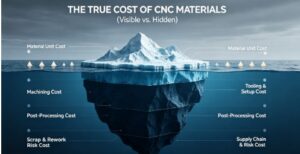
Focusing solely on material cost per kilogram is a critical and costly misconception in CNC material selection. The true total cost of ownership (TCO) encompasses multiple, often hidden, dimensions. The best materials for CNC machining are those that optimize TCO, not just purchase price.
The hidden costs include: Machining Cost: Materials that are difficult to machine (such as hard steel or advanced alloys) cause fast tool wear, longer cycle times, and higher machine hour rates. Post-Process Cost: Some materials need costly or time-intensive post-processing to satisfy specifications. Quality and Waste Cost: Some materials are unstable or challenging to work with, causing higher scrap rates and wasting machining hours and raw materials. Supply Chain and Storage Cost: Advanced materials may take more time to procure, with minimum quantity and storage requirements.
As such, a step of full lifecycle cost analysis must be incorporated into the material selection process with the cost models integrated into the team’s knowledge bank. Typically, the material with an extra unit price but good machinability and stability tends to offer the lowest overall cost and is thus the best materials for CNC machining. The skilled manufacturer offers accurate machining time and cost calculations for clarification.
How to Create and Maintain a Dynamic Material Decision Knowledge Base?
Implementation of the methodology into actual team resources means developing an advanced, evolving database of material selection information. This database represents the real-life embodiment of a proprietary CNC machining materials guide that constantly improves.
Some actions to undertake include establishing a data page dedicated to each material that is most frequently used, where one would write down important information such as properties, machining specifications, good suppliers of the material, and examples of projects completed successfully using this particular material. Importantly, each finished project should be associated with materials used in it, including design notes and feedback received after completion. Tagging materials, e.g., high-strength aluminum, FDA-compliant plastic, high-temperature, helps to easily find information about particular kinds of material by tags.
The key benefit of the database described above lies in its evolution. Every completed project should undergo the post mortem analysis, and conclusions made after this analysis should be applied to updating the relevant material pages. By doing this, team members will transform their expertise into something that can be called institutional memory and help make future CNC material selection decisions faster and more accurate.
Conclusion
Overall, material selection for CNC components is an extensive process that considers functionality, sustainability, economics, and information management. Utilization of a logical decision-making approach and organization of practical knowledge will minimize risks, hidden expenses, and inconsistencies between prototypes and production.
Should you be planning to select materials for a project and require assistance from a professional manufacturing provider certified by ISO 9001, IATF 16949, and AS9100D, begin with a professional consultation. Submit your CAD designs and immediately receive design-for-manufacturability evaluation and accurate quotations.
Author Biography
This paper was authored by an authority with over 15 years of hands-on experience in precision manufacturing. Their areas of expertise include material sciences and machining technology of complex component parts. Currently, they work together with prominent companies such as LS Manufacturing that has received ISO 9001, IATF 16949, and AS9100D certifications for implementing innovative material technologies in their engineering projects.
FAQs
Q1: How do I know whether to use a metal or plastic material for my part?
A: Begin by considering functional requirements. In situations where extreme strength and stiffness, as well as heat/electricity conductance, are necessary, metals would usually take precedence. If light weight, electric insulator capability, chemical resistance, low friction, or complicated monolith design features are important, engineering plastics would prove superior. A comprehensive list of functional and environmental criteria will be the basis of this decision.
Q2: How can a cheap material end up being more expensive in total cost?
A: The cheaper material could have inferior machinability, causing more machine time and tools costs. Or it might fail to work in the actual operating environment, thus causing the need for repairs or recalls. The total cost would have to cover both machining and potential maintenance costs over the lifecycle of the product.
Q3: Would an online material database suffice for my choice of material?
A: An online material database is indeed a good starting point but fails to provide sufficient information about process capabilities. Machining behaviors and compatibility with certain procedures require firsthand experience gained through years of practice. Combining these two would result in making a sound judgment.
Q4: What is the ideal way of choosing materials for prototyping?
A: The objective of prototyping is to efficiently and quickly prove design and performance of products under development. There are times when utilizing a material called form fit (6061 aluminum for validating 7075 design) or performance similar and easier to machine works very well. After receiving results from testing, it is easy to choose the final material.
Q5: What should I do when I find it difficult to choose among two competing materials?
A: Producing small batch prototypes that are tested side by side for comparison of actual performance and ease of machining can help make decisions. Working closely with your manufacturing services company can give you valuable insights from similar experiences.
Write and Win: Participate in Creative writing Contest & International Essay Contest and win fabulous prizes.
About the Author