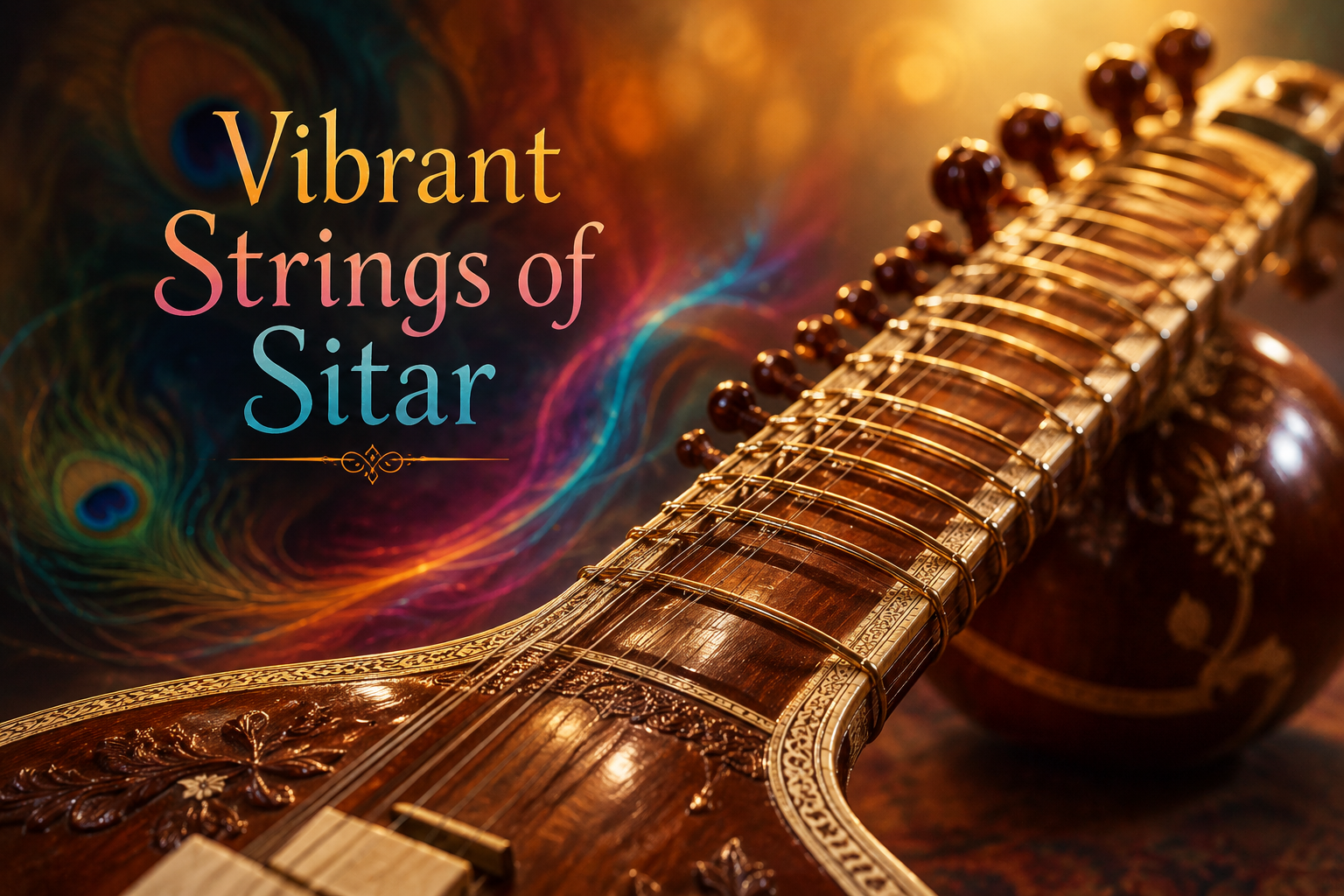
Ask a luthier what makes a good bridge, and they will tell you that clean contact matters most, no interference, let the string ring true. Now travel to Miraj, a small town in Maharashtra where most of India’s professional sitar still built by hand, and watch a craftsman spend hours filing a bone bridge to do the exact opposite, letting the string graze against it just enough to buzz. Get that curve wrong by a hair and the instrument sounds either dead or like a broken radio. Get it right, and you have the sound that opens a raga.
That is the sitar in one image, an instrument built around something every other stringed instrument tradition treats as a defect. It is also, oddly, the instrument most Western listeners think they know and mostly do not. Most people can place its sound within a few notes, thanks largely to George Harrison, but few could tell you why it sounds the way it does, or that what made the Beatles famous for four minutes took a Miraj craftsman a career to learn.
And fewer still realize that the instrument in front of them is really two instruments layered into one body. There’s a set of strings meant to be played, and a second, larger set meant only to listen and answer. The sitar rewards the kind of attention most people never give it, because its most important qualities do not announce themselves. You have to lean in for them. The curve of a bridge nobody sees. The tuning of strings nobody touches. The years of training behind a single ornament that lasts half a second. The sitar hides its labor inside its sound, which may be exactly why it travels so well, and why it is understood so rarely.
Origins and Evolution
Popular tradition credits the sitar’s invention to Amir Khusrau, a thirteenth century Sufi poet and musician at the Delhi court, who supposedly reshaped a three stringed Indian vina into something closer to a Persian lute, borrowing even its name, since sitar comes from the Persian word for three strings. It is a good story, and it is probably not true, or at least not provable. No text from Khusrau’s own century describes anything resembling today’s instrument, and most historians now place the sitar’s real, recognizable form two to three centuries later, somewhere in the long cultural mixing of Mughal era North India, where Persian court instruments and older Indian traditions sat side by side long enough to blend into something neither culture had quite made before.
What we do know is more interesting than the legend anyway. Early sitars carried just three strings. Over the following centuries, players added more, melody strings, drone strings, and eventually a bank of strings that are never played at all, until the instrument reached something close to its current form by the seventeen or eighteen hundreds. The sitar also stayed regional in a way that surprises people who assume Indian classical music is one tradition. It belongs to Hindustani music, the classical style of the north, while the south developed its own centerpiece instrument, the vina, along an entirely separate lineage. That difference is a reminder that the sitar’s spread was the product of a specific courtly history, not something inevitable across the subcontinent.
By 1904, the instrument was developed enough, and recording technology new enough, that a musician named Imdad Khan could walk into a studio in Calcutta and make what is believed to be the first sitar recording in history, putting this particular instrument’s history on record almost from the birth of recorded sound itself, decades before most non Western instruments would ever be captured on tape at all. Imdad Khan’s family did not stop there. He founded a teaching lineage that would eventually produce his grandson, one of the most consequential sitarists of the twentieth century, which means the instrument’s recorded history and its living lineage both trace back to the same room in Calcutta.
The Science Behind the Sound
Underneath the poetry, the sitar is a genuinely clever piece of acoustic engineering. Its body is a dried, hollowed gourd, the same kind wandering ascetics once carried as water vessels, fitted with a wooden soundboard that turns a plucked string’s vibration into audible sound, the same basic principle as any guitar.
What sets it apart sits just past the strings, in a bridge shaped with a barely visible curve. The craftsman files that curve by hand until, during vibration, the string grazes it in exactly the right way and throws off a wash of extra overtones. That is the buzz, and it is not a byproduct. It is the whole point. Craftsmen treat shaping that curve as its own specialized skill, separate from building the rest of the instrument. It is learned by feel over years, not written down as a formula.
The frets add another layer most people never notice. Unlike a guitar’s fixed metal strips, a sitar’s frets are curved and tied on with thread. That means a musician can physically slide every one of them before a performance to match the specific microtonal intonation a particular raga demands, a kind of tuning flexibility no fixed fretboard could ever offer.
Then there are the sympathetic strings, the part that genuinely interested physicists. Eleven to thirteen extra strings threaded beneath the main ones are tuned in advance to the notes of whatever raga is being performed. Nobody plucks them. When a played note matches one of their pitches, they start ringing on their own through pure resonance. It is the same kind of effect you hear when one piano string faintly hums when a matching note rings out beside it. Multiply that across a dozen tuned strings and you get what musicians describe as the melody leaving trails behind it. It feels like an acoustic echo, with no electronics involved, centuries before anyone built a reverb pedal.
Acoustics researchers who have actually measured this effect describe it as one of the defining features that separates Hindustani instruments from nearly every other stringed instrument family on earth. And some instruments in this same tradition carry more than thirty sympathetic strings across their various forms, which tells you the effect was not stumbled into once. It was expanded deliberately, generation after generation, because musicians kept finding it worth the trouble.
Masters Who Changed the Sitar
Every serious sitarist inherits a lineage, and two of the most important ones pulled the instrument in opposite directions. Vilayat Khan, grandson of that same Imdad Khan, spent his career trying to make the sitar sing. He coaxed it to bend and slide the way a classical vocalist’s voice does, in a style still called gayaki ang. It was an innovation aimed inward. Instead of exporting the instrument’s identity somewhere else, it deepened what was already inside it. To purists, that mattered. It was not only about sounding impressive. It was about refusing to compromise the sitar’s essential character, even as the world outside grew curious about it.
Ravi Shankar took the opposite bet. He physically enlarged the concert sitar, restructured raga performance into sections that could fit a Western concert program, collaborated with classical violinists on the world stage, and eventually taught a curious guitarist named George Harrison, who used a sitar on Norwegian Wood a full year before he had any real lessons on it. That choice opened up a global audience. It also helped spark something almost comic, the Coral Electric Sitar, a guitar built in America with a mechanical buzzing bridge, invented so session musicians could fake the sound without learning the instrument most of them never touched.
Meanwhile a third major voice from the very same Maihar teaching lineage as Shankar, Nikhil Banerjee, chose neither path exactly. He stayed devoted to the slow, unhurried unfolding of a raga, even as his contemporaries chased concert halls abroad. Put together, the two of them become one of the clearest examples in any musical tradition of two students from the same teacher arriving at entirely different definitions of mastery. Ravi Shankar’s own daughter, Anoushka Shankar, represents yet another answer. She was trained in the same classical technique but willing to fold it into flamenco, jazz, and electronic production, treating inherited discipline as a foundation to build on rather than a boundary to defend.
Four musicians. One instrument. Four different theories of what it means to honor a tradition. Both Khan and Shankar were called masters. One taught the sitar to speak more like itself. The other taught it to speak to people who had never heard it before. Neither approach is obviously the right one. The fact that Indian classical purists still argue about which mattered more tells you how deeply that choice actually cut. And it is worth noticing that the argument has never really been settled. It keeps getting carried forward by each new generation of players who inherit the same fork in the road.
Preserving More Than a Sound
Here is the uncomfortable part. The sitar’s sound, that buzz, that trailing resonance, turns out to be the easiest thing about it to copy. A factory in Los Angeles managed it in 1967 with a guitar body and a metal bridge, built for musicians who wanted the exotic timbre without spending years earning it.
What is much harder to reproduce is everything underneath the sound. The hand eye judgment a Miraj craftsman develops over decades of filing bridges by feel. The discipleship lineages that once passed technique from teacher to student, before any of it was written down. A system that, by most accounts, is fading as recordings and formal schools replace closer, slower forms of teaching. Even the town of Miraj itself tells a version of this story in miniature. Demand for its instruments has only grown as sitars travel further abroad, yet local craftsmen increasingly say they cannot find young people willing to commit the years it takes to learn the trade properly. So the workshops that have supplied master musicians for generations face a shortage not of customers, but of hands.
That is the real story an instrument like this tells. Preserving a sound is cheap, almost trivially so, since a factory proved it could be done in months rather than centuries. Preserving the knowledge and the relationships that made the sound possible in the first place is not. And more than any melody, that is what is actually at stake every time a craftsman in Miraj cannot find an apprentice willing to spend years shaping a piece of bone into something meant on purpose to buzz. An instrument survives, it turns out, for reasons that have very little to do with how good it sounds. Everything depends on whether anyone is still willing to do the slow, invisible work of keeping it exactly as difficult as it always was.
By: ATHARV GAWDE
Write and Win: Participate in Creative writing Contest & International Essay Contest and win fabulous prizes.
About the Author