Most instruments begin where the hand makes contact. The theremin begins where contact ends.
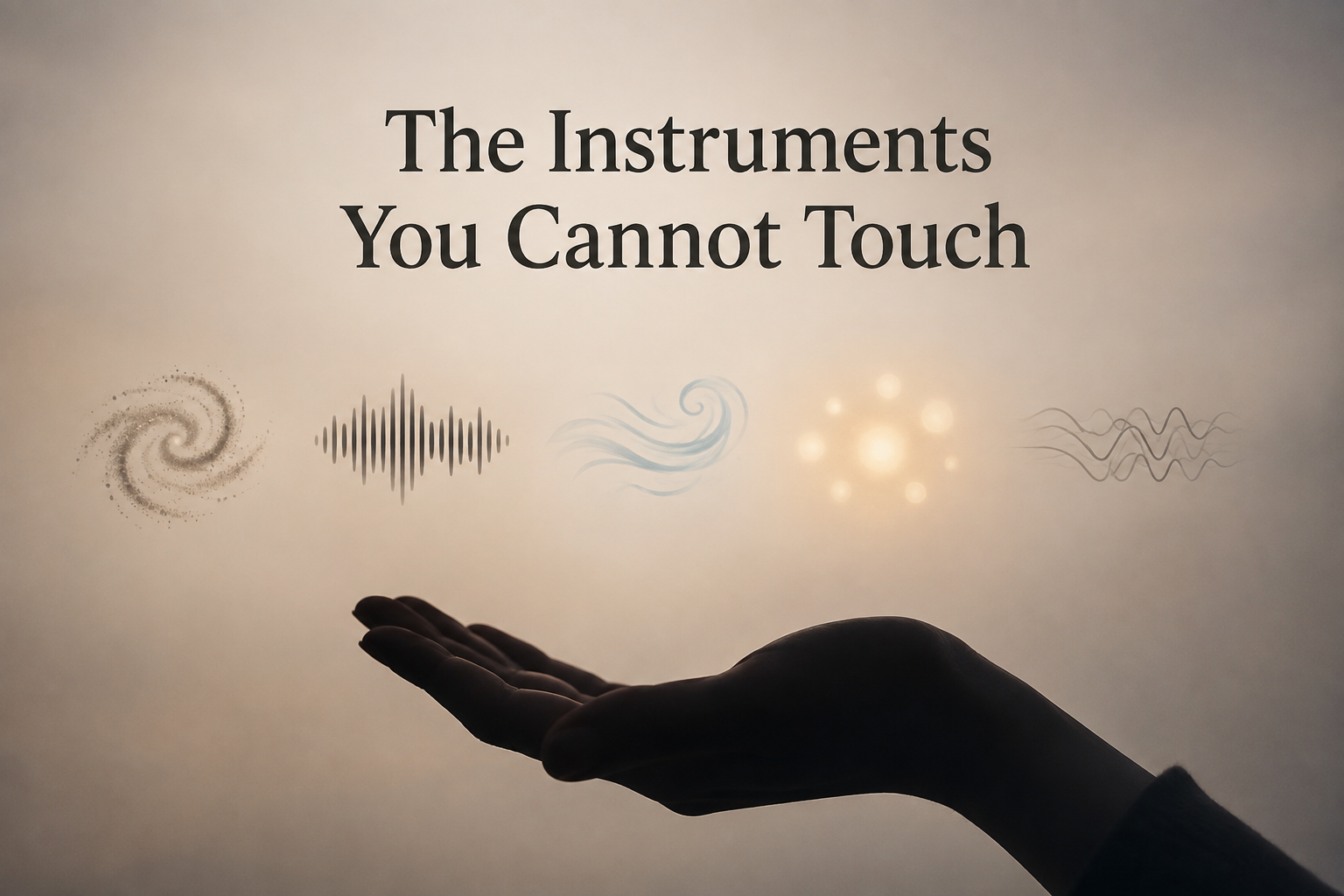
Two antennas rise from a simple cabinet. One stands vertical. The other forms a horizontal loop. Between them is only air. A performer steps into that space, raises one hand toward the vertical antenna, and a tone appears. Move the hand closer and the pitch climbs. Draw it back and the pitch falls. The other hand, near the loop, raises or lowers the volume. Nothing is pressed, struck, or plucked. The music comes from the body itself moving through invisible electromagnetic fields.
That is both its strange beauty and its impossible demand: the player must make music from something that cannot be touched.
Léon Theremin was not searching for a musical instrument. In 1920 the Russian physicist, then still known as Lev Sergeyevich Termen, was working at the Physico-Technical Institute in Petrograd on proximity sensors and the electrical properties of gases. High-frequency radio circuits formed part of the apparatus. One day, while adjusting the equipment, he noticed that a tone in his headphones changed pitch whenever his hand moved near a particular circuit. A trained cellist, he recognized at once that the effect could be shaped into music.
The discovery mattered because radio technology itself was still young. Engineers were only beginning to understand how electromagnetic fields could be generated, measured, and controlled. Theremin’s apparatus showed that the human body could become part of those fields in a precise and repeatable way. The same principles that allowed radio signals to travel through the air could now be used to turn the air itself into a musical medium. In a period when electricity still carried the force of modernity, an instrument that made invisible forces audible and visible was more than a curiosity. It demonstrated control over phenomena that most people could neither see nor touch.
He refined the device and began demonstrating it. In 1922 he played it for Vladimir Lenin at the Kremlin. Lenin tried the instrument himself and was impressed enough to order further instruments and to send Theremin on tours that presented the device as evidence of Soviet scientific achievement. By the late 1920s Theremin had reached the United States. He performed with the New York Philharmonic, secured a patent, and licensed production to RCA. The company hoped ordinary households might one day own one. That future never arrived. Only a few hundred instruments were sold before production ended. Theremin himself disappeared from New York in 1938 and returned to the Soviet Union under circumstances that remain partly opaque. He spent years in a restricted research facility working on electronic listening devices before eventually reappearing. He lived until 1993.
Music arrived as a side effect of science.
But understanding that accident is only the beginning. The real strangeness of the theremin lies in what happens between the hand and the antenna.
What the player experiences is straightforward. Move a hand toward the vertical antenna and the pitch rises. Move it away and the pitch falls. The horizontal loop controls volume through a related but distinct process: approaching it detunes a resonant circuit and reduces the amplitude of the tone.
The reason for the pitch change is capacitance. The antenna and the player’s hand act as the two plates of a capacitor, with air between them. Changing the distance changes the capacitance by only a few picofarads. That tiny shift is enough to alter the frequency of a high-frequency oscillator inside the instrument. A second oscillator runs at a fixed frequency. The two signals are mixed, and the difference between them—the beat frequency—falls into the range the human ear can hear. This mixing process is called heterodyning, the same principle once used in radio receivers.
Two oscillators are necessary because the frequencies generated by the antenna circuit itself are far above the range of human hearing. The variable oscillator alone would produce no audible sound. Only when its signal is combined with a stable reference frequency does an audible difference tone appear. The player never touches the instrument because the body itself alters the electrical field around the antenna. The hand functions as one plate of a capacitor; the antenna is the other. Distance changes capacitance, capacitance changes frequency, and frequency becomes pitch. The entire process occurs without mechanical contact.
The result is extreme sensitivity. A movement too small to see clearly can shift the perceived pitch dramatically. The player’s entire body participates in the circuit. Posture, breathing, and even slight shifts of weight affect the fields. The instrument does not merely respond to the hands. It responds to the person.
That sensitivity is also what makes the theremin so unforgiving.
A pianist has keys. A violinist has strings under the fingers. A guitarist has frets. A singer feels breath and resonance. The theremin gives the player nothing to touch.
Pitch exists only as a position in space. There are no landmarks. Every location produces a continuous frequency rather than a discrete note. Sliding between pitches is easy. Landing cleanly on a precise note, then leaving it cleanly for the next, is not. The ear must replace the missing physical map. Muscle memory must replace the missing tactile feedback. The player has to know, by listening and by practiced movement alone, exactly where each pitch lives in the invisible field.
Mastery requires converting empty space into a reliable musical geography.
Clara Rockmore showed that the challenge could be met. A former violin prodigy forced to abandon the instrument because of tendonitis, she brought absolute pitch and classical discipline to the theremin. She met Léon Theremin in New York and soon made the new instrument her own.
The central problem she solved was precision without physical landmarks. How do you place a note accurately when nothing tells your hand where that note is? Her answer was not to make the theremin behave like another instrument, but to develop a new physical language for it. What made her approach revolutionary was that she refused to accept the instrument’s continuous gliding as its only possible expression. She treated the empty space around the antennas as a place where exact pitches could be found and held, not merely passed through. She used controlled finger movements to articulate rapid passages and large leaps without constant sliding, steadied her vibrato by keeping the tips of her right thumb and forefinger in contact, and held her whole body still enough that only the intended motions affected the field. Working with Theremin, she also influenced design changes that increased the instrument’s range and improved its response. In doing so she transformed the theremin from a device that produced interesting sounds into an instrument capable of classical phrasing and musical argument.
Her performances demonstrated that the theremin could sing with the clarity and control of a classical voice. She refused to treat it as a novelty. Through her playing the instrument began to be taken seriously as a musical vehicle rather than a scientific curiosity.
In the Soviet Union the theremin sat at the intersection of science, politics, art, and spectacle. The instrument could be presented as visible proof that invisible electrical forces were becoming subject to human control. Public demonstrations framed it as a symbol of technological modernity.
In America, the story turned in the opposite direction. RCA imagined a future in which the theremin might become a common household instrument. The same quality that made it revolutionary—the complete absence of physical controls—also made it extraordinarily difficult for ordinary players. The feature that promised the future also limited its commercial success. Sales remained low. Production stopped. The instruments that survive are rare.
Film composers later discovered that the continuous, vocal tone could suggest the uncanny. Bernard Herrmann used it in Hitchcock’s Spellbound. Science-fiction scores of the 1950s relied on it for otherworldly atmosphere. What matters is the transformation: a sound first treated as technological novelty gradually became a language for the uncanny and then a resource for deliberate musical expression.
We have spent decades making technology easier to control through touch: buttons, keys, screens, sliders, surfaces that respond instantly to the hand. The theremin offers none of them. It does the opposite. It refuses to give the player a physical stop. It demands sustained attention. The ear must lead. The body must remain precise. Nothing can be taken for granted.
Modern technology usually reduces the distance between intention and action. We tap a screen and something happens. We press a key and a letter appears. We drag a slider and a number changes. The theremin breaks that familiar relationship. There is no button between intention and sound, no surface that confirms the gesture. The player must learn the invisible consequences of movement before those movements become music.
In that sense the theremin is strangely ahead of its time. It anticipates gesture-controlled technology, motion sensors, and interfaces that respond to bodies rather than physical switches. Yet it also exposes something those technologies often hide: responsiveness is not the same as mastery. Making a machine respond is easy; learning how to respond to the machine is harder. The theremin insists on the second task. It turns invisible space into sound, but mastering it requires something more difficult: learning to listen to what the body cannot touch. The theremin reminds us that not everything meaningful needs to be grasped, pressed, or held. Some things have to be heard, sensed, and carefully approached.
A hand moves through empty air. A tone rises. The instrument that cannot be touched continues to ask for the one thing technology often tries to spare us: careful human attention.
By: Laiba majeed
Write and Win: Participate in Creative writing Contest & International Essay Contest and win fabulous prizes.
About the Author