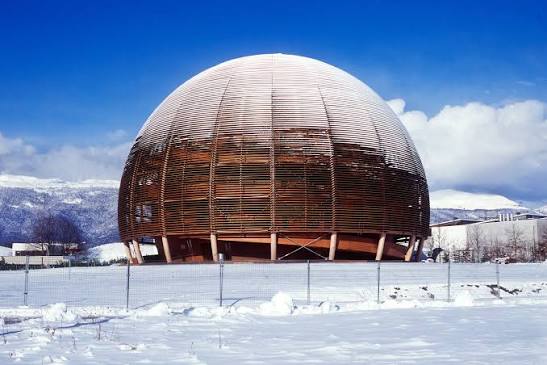
Deep beneath the verdant countryside that spans the French-Swiss border is a machine so wondrous that its name has become synonymous with humanity’s unceasing endeavor to comprehend the nature of existence. Nestled almost 100 metres below the surface, the Large Hadron Collider (LHC) propels particles to nearly the speed of light before they collide, thereby recreating the conditions prevalent less than a billionth of a second after the Big Bang. However, despite its engineering brilliance and Nobel Prize-winning discoveries, CERN is far more than simply the site of the world largest particle accelerator.
It is quite simply one of the most astonishing organizations ever created, not because it built the largest scientific instrument, but because it has, over its many years of existence, turned scientific cooperation into a tool for peace. Against a history of frequent war, ideological rifts, and political conflicts between nations, CERN has subtly, peacefully proved that nations can compete with one another not in warfare, but in curiosity. Scientists with different languages, from different cultures, and from often ideologically opposed nations, have been able to work side-by-side for a single purpose: the understanding of the universe.
Formally founded on 29 September 1954, the European Organization for Nuclear Research (CERN) began as a post-war vision in a Europe battered and torn by conflicts, a leap of faith into international scientific cooperation. More than seventy years on, the facility continues to be the premier particle physics laboratory in the world, at which over 12,000 visiting scientists from 110 different nationalities work alongside an enormous staff of engineers, technicians, computer programmers and students. The discoveries made here have fundamentally transformed our understanding of modern physics, and its technological innovations – from the World Wide Web to advanced medical imaging – have irrevocably changed the lives we live.
In essence, however, CERN’s true significance cannot be measured solely in scientific terms. It is a philosophy: that understanding grows through collaboration and the sharing of knowledge; that curiosity knows no borders; and that peaceful cooperation is humanity’s greatest accelerator. This essay seeks to trace the journey of CERN from a hopeful post-war European initiative to its present status as one of the greatest symbols on Earth of science, diplomacy, technology and hope.
The Birth of CERN: Rebuilding Europe Through Science
The fundamental reason behind CERN’s formation dates back to one of humanity’s darkest chapters. The economic infrastructure, academic institutions and research facilities throughout Europe had been utterly devastated by the Second World War. Laboratories were in ruins, funding for research practically nonexistent, and countless highly gifted scientists had sought the greater opportunities presented by migrating to the United States in search of new beginnings. A catastrophic “brain drain” throughout Europe was threatening the future of scientific expertise in the continent.
Influential policymakers, along with farsighted physicists including Nobel laureate Louis de Broglie, put forward a radical idea to reconstruct the continent: a state-of-the-art laboratory would be constructed where the nations of Europe would contribute finances, infrastructure and expertise rather than simply working individually.
Strong support for the proposal came from UNESCO, which considered scientific cooperation a way of establishing a lasting peace among nations, and several years of negotiation later, twelve nations had signed the Convention which formally established the organization on 29 September 1954.
The founding Convention is still one of the most remarkable legal documents that has ever been signed in the name of science; its articles were clear that the organization had been created purely for peaceful purposes and that military research would not be permitted. In an era of increasing Cold War tension between the blocs of the East and the West, CERN was established as politically neutral territory for physicists to work together despite any political rifts.
Equally radical was its founding commitment to openly shared science. CERN determined that knowledge gained should be accessible to scientists all over the world; it should never be considered a strategic asset that could potentially threaten any particular nation. This principal formed the basis of every great discovery that followed, from the massive international collaborations that involved over 20,000 researchers, right through to the decision to release the World Wide Web technology to the public freely.
The name ‘CERN’ actually dates back to its original french abbreviation ‘Conseil Européen pour la Recherche Nucléaire’ (European Council for Nuclear Research), as the English name was changed, but the acronym has remained one of the most recognizable scientific titles worldwide. Now, over seventy years on, CERN is living proof that science, truly applied, may serve as a diplomacy for all humankind.
Vision, Objectives and Organizational Structure
CERN’s purpose is to answer some of the oldest and most fundamental questions that humanity has ever asked itself.
What are the basic components of matter?
Why does matter have mass?
What actually occurred in the fraction of a second after the Big Bang?
Do other fundamental particles and forces exist beyond the current standard model of particle physics? The answers to these questions explain the very nature of our universe.
However, its goal is not simply limited to experiment. Other key objectives of CERN include:
To further fundamental research in particle physics.
To encourage and nurture peace through international scientific cooperation.
To further technology which can benefit all humanity, be it scientific or social.
To encourage future generations of scientists, engineers and technicians.
To disseminate scientific knowledge throughout the world.
CERN differs from other international organizations because it has a clear governmental structure combining independence and commonality. The supreme governing authority, CERN Council, comprises each Member State. The Council’s roles include approving budgets, formulating future strategy, appointing the Director-General and ensuring the foundational principles of the organization remain upheld.
In addition to their Member States, the CERN organization also relies upon Associate Member States, as well as Observer States, working alongside institutions all over the planet. Tens of thousands of universities contribute researchers to the experimental facilities at CERN, producing the largest international collaboration in the history of science.
The vital point in CERN’s mission is that nationality plays no role in the scientific excellence of a researcher. A scientist, say, from India may well be working in the same experiment as peers from Japan, Brazil, Germany, South Africa, the United States and Pakistan, highlighting how the quest for scientific understanding may serve to supersede political divides, something our world could do with at present.
From a technological perspective, CERN is also an incubator of innovation. Engineers design equipment that is capable of measuring events lasting only fractions of a nanosecond. Computer scientists design and write sophisticated programs that are needed to process a vast number of particles moving at speeds approaching that of light, while cryogenic specialists design and maintain systems that are able to keep superconducting magnets at extremely low temperatures. Every discovery and every innovation at CERN is made through the collective effort of these and many other different disciplines.
This multi- disciplinary nature accounts for the remarkable range of inventions whose development can be attributed, in one way or another, to CERN, technologies that range far beyond the simple pursuit of theoretical physics.
Science Headlines: From Questions to Discoveries
If founding CERN was the political stroke of vision, human curiosity has achieved scientific triumph for years. Every CERN experiment seeks solutions to profound questions asked for centuries by philosophers and scientists; what are you and everything composed of?, what is the mass of matter?, what is the reality, why is it not null? The answers are searched at one of the most significant scientific feats of the 20th century- LHC or Large Hadron Collider.
Extending over 27 km below the ground, between France and Switzerland, the LHC is by far the most massive and powerful particle accelerator ever built.
Inside, protons are pushed to 99.9999991% of the speed of light. After no more than 11 000 full turns per second they clash and generate unimaginable energy. This experiment recreates the very conditions for a fraction of a second that existed shortly after the Big bang, a state which allows physicists to study the deepest properties of our physical universe. The greatest highlight of the LHC happened on July 4th 2012, when scientists announced the discovery of the Higgs boson – the particle first predicted almost half a century ago by Peter Higgs and his team, confirming the existence of the Higgs field (the mechanism which gives many particles their mass).
That announcement, world proclaimed, was rewarded in 2013 with a Nobel Prize in Physics to Peter Higgs and François Englert.
But science wasn’t just about a new particle, it also celebrated a triumph of international collaboration: over 6 000 researchers from hundreds of institutions worked to obtain a result no individual laboratory could ever afford or implement. Yet the history of CERN didn’t begin and won’t finish with the Higgs. Experiments continue to explore the universe’s origin, Antimatter behaviour, quark-gluon plasma, or completely new beyond the Standard Model particles.
ATLAS, CMS, ALICE and LHCb are just a part of these experiments to test and advance the limits of technological feasibility and of physicists’ theories. Perhaps the most exceptional part of CERN: its greatest contributions arose without effort. A British computer scientist Sir Tim Berners-Lee, in 1989, wanted simply a tool allowing the whole research community to have access to and to contribute to a shared document.
This idea grew into the World Wide Web, then in 1993, the historic decision was made to give this creation to the public domain: without patents or fees.
If CERN had decided to patent it, the internet today could look totally different. Today we share and use, through a world of collaboration, research for education, health, economy. The benefits also extend to the domain of medicine: technologies used in detecting sub-atomic particles have contributed to the creation of the PET scanner to diagnose diseases or assist cancer therapies by using proton beams. Superconducting, cryogenic and robotic technologies used in particle physics also led to their use in a wide range of fields, from aerospace to industry, IT or public services.
To manage all experimental data generated by LHC, an unparalleled computer infrastructure (WLCG) was developed; it allows data analysis to be made jointly by hundreds of computer centres all over the world.
This innovative system changed the way large-scale scientific data is processed in other disciplines too. These are proof of one central truth: CERN doesn’t just answer questions – it creates technology, partnerships and knowledge that go beyond scientific experiments into society.
Beyond the Headlines: Twenty Hidden Facets of CERN
“The true measure of an organization often lies not in what everyone knows about it, but in the remarkable stories that remain largely untold.”
1. CERN Was Created to Prevent Europe’s Brain Drain Its original mission was as much political as scientific.
By creating a world-class research centre, Europe hoped to retain its brightest scientific minds and rebuild intellectual leadership after World War II.
2. UNESCO Was the Midwife of CERN
Before CERN officially existed, UNESCO championed the proposal, recognizing that scientific cooperation could become a powerful instrument for peace.
3. Science for Peace Is Written into Law Unlike most research institutions, CERN’s founding Convention legally restricts its activities to peaceful scientific research, prohibiting military applications.
4. The World Wide Web Was Given Away Free
CERN deliberately released the Web into the public domain in 1993. Few organizations have ever surrendered such enormous commercial potential for the benefit of humanity.
5. The Largest Machine on Earth Is Invisible
Despite spanning 27 kilometres, the LHC remains hidden approximately 100 metres underground, preserving landscapes while shielding experiments from surface disturbances. 6. The LHC Is Colder Than Outer Space Operating at 1.9 Kelvin (-271.3C), it is one of the coldest places ever created, allowing superconducting magnets to function efficiently. 7. Nearly 9,600 Magnets Keep Particles on Course Without these superconducting magnets, proton beams travelling close to light speed would instantly leave their intended path.
8. The Moon Quietly Influences CERN
The Moon’s gravitational pull causes minute deformations in Earth’s crust, requiring engineers to make incredibly precise adjustments to particle beams.
9. Protons Travel Beyond Neptune-Without Leaving Earth A proton beam circulating for around ten hours covers more than 10 billion kilometres, roughly equivalent to travelling to Neptune and back. 10. One Billion Collisions Every Second Although approximately one billion collisions occur every second, advanced trigger systems retain only a tiny fraction worthy of detailed scientific analysis. 11. ATLAS Weighs as Much as the Eiffel Tower At roughly 7,000 tonnes, ATLAS is among the heaviest scientific instruments ever built while simultaneously measuring unimaginably tiny particles.
12. CERN Produces an Ocean of Information
Its major experiments generate nearly 50 petabytes of data annually, demanding one of the most sophisticated computing infrastructures on Earth.
13. A Global Supercomputer Without a Single Building
Instead of one central computer, CERN distributes data processing across more than 170 computing centres, creating one of history’s largest collaborative computing networks.
14. CERN Has Its Own International Fire Brigade
Around 50 professional firefighters representing more than 15 nationalities provide 24-hour emergency response, underground rescue, hazardous-material management, and medical assistance.
15. Even Nature Occasionally Interrupts Science
In 2016, a curious weasel chewed through an electrical transformer, briefly interrupting operations-proving that even the world’s most advanced laboratory is not immune to unexpected visitors.
16. The LHC Is Not Perfectly Circular Its ring consists of curved arcs connected by straight experimental sections designed to accommodate detectors and accelerator systems.
17. Thousands of Students Learn at CERN Every Year
Beyond research, CERN functions as one of the world’s largest scientific classrooms, training future physicists, engineers, software developers, and educators.
18. Medicine Benefits from Particle Physics
Technologies originally developed to detect subatomic particles now assist doctors in diagnosing disease and treating cancer more effectively.
19. Failure Became One of CERN’s Greatest Teachers The electrical failure that delayed the LHC in 2008 ultimately resulted in stronger engineering safeguards, improving long-term reliability.
20. CERN’s Greatest Discovery May Be Cooperation Itself
More enduring than any particle discovery is CERN’s demonstration that nations with different cultures, languages, and political systems can unite peacefully in pursuit of knowledge.
Challenges and Criticism: The Price of Exploring the Unknown
An organization so audacious that it aims to answer the most fundamental questions of human existence is bound to encounter questions itself. The enormous scale of the CERN projects require massive financial support, ongoing political backing, and sophisticated infrastructure. Some argue, logically in a resource-constrained world, why spend billions of Swiss francs in the search for elementary particles when money could go towards healthcare, education, poverty reduction, or the environment.
Yet history demonstrates time and again how the immediate value of basic research can be underestimated. Back in 1954 when CERN was founded no one knew an internal research tool could transform how we learn, transact, conduct ourselves, amuse ourselves, communicate with others… and with ourselves. Many of technologies we take for granted, from computer mouse and spreadsheets, to innovations in medical imaging derived from detectors and the use of accelerators in cancer therapy, to advances in medical technologies based on superconducting and industrial accelerators were born from basic physics experiments and technical development work here at CERN and our partner organizations. Scientific innovation doesn’t always immediately pay a predictable dividend – but time and again it returns to humanity in ways far beyond immediate financial measures.
Environmental sustainability remains a major issue for any organization whose activities require vast amounts of energy. As the main research instrument, the Large Hadron Collider, uses around 1.3 terawatt-hours (TWh) of electricity every year – enough to power a city the size of an average European capital – CERN has had to take note of increasing awareness of climate change. It has taken concrete actions to improve its energy efficiency, tune the accelerators when possible and recuperate waste heat as part of efforts to significantly reduce its environmental impact and to incorporate renewable energies in its operations. The organization’s continued challenge is to maintain this progress while at the same time pursuing demanding physics goals.
Beyond these tangible costs, CERN has had to fight perception battles. When its major experiments came on line there were alarming reports claiming high energy collisions in the LHC could inadvertently create a dangerous mini-hole that will swallow the whole Earth. Scientific assessments later found those reports to be sensationalist and devoid of scientific backing, showing natural collisions far more energetic occur everyday. A reminder in the scientific age of the need for clear and precise communication.
Finally, from a scientific point of view too CERN faces many unknowns. While the discovery of the Higgs boson is an extraordinary feat, many fundamental unanswered questions still exist: why did far more matter than anti-matter persist?
What exactly is the mysterious dark matter and dark energy?
And is there a unifying set of laws that will describe every fundamental particle in the universe?
These unanswered questions should be seen not as markers of failure but signs that the enterprise of discovery is ongoing.
The Future: Beyond the Large Hadron Collider
What are the next frontiers?
The high-luminosity Large Hadron Collider(HL-LHC)will boost the collision rate tenfold,allowing scientists to study the Higgs boson in far greater detail and to probe extremely rare events that might reveal even new laws of nature. Beyond that, a proposed more ambitious machine- the Future Circular Collider(FCC)- aims to become three times larger than the LHC,with a circular tunnel of more than ninety kilometres,or six times its current circumference.A truly behemoth instrument,if approved,the FCC would push the boundaries of knowledgetoprobing new and unforeseen phenomena. The proposed FCC project is now a subject of intense study, debate and discussion around the world.
While questions around its cost, its environmentalimpactanditsscientific value remain, its conception demonstrates the large ambition characteristic of CERN and its dedication to openly engage with critics.
Artificial Intelligence also plays an increasingly important role at CERN, using machines to recognize faint particle events, optimizing experimental and accelerator performance and searching for clues in the datasets. Next-generation technology –including advanced superconducting materials, artificial intelligence and future quantum-computers is likely to push discoveries into uncharted territory. However,the organization’s most valuable future contribution may be neither technological but diplomatic. In a time of growing political division, Cern provides a unique place where politics play little if any role where science can flourish across national and ideological boundaries.
An embodiment of peaceful pursuit of knowledge, it offers an inspiration to the world; demonstrating what humans can achieve when the pursuit of facts takes precedence over partisanship, and collaboration takes priority over competition.
Conclusion CERN-humanity’s Great Experiment in Cooperation Back in the summer of 1954, following the Second World War, European countries joined forces to recreate Europe’s laboratories and once again attract Europe’s top talent to the continent. What these 12 pioneering nations could not possibly have anticipated is that this vision would result in one of the world’s most profoundly important institutions, in terms of social innovation, global collaboration and world class scientific investigation. Of all the myriad achievements born from the world of elementary particle physics – including discovering fundamental particles like the Higgs, inventing the internet, pioneering global computing, bringing about advances in healthcare, educating a generation of scientists – what Cern has offered us is much, much more profound.
This most famous research lab also proves the concept of international collaboration not to be an ideal theory. It is also a concrete reality; a testament to what can be achieved when nations set aside their differences and co-operate in the spirit of discovery and understanding. CERN’s ultimate demonstration – on scales rarely experienced beyond that to wage a total war – has been its role as living proof that it can only ever be through international collaboration can mankind bring about transformative progress and thereby maintain enduring peaceful collaboration; that there can exist other and stronger ties than national or political affiliation and that there is a shared destiny in uniting against fear and ignorance.
Down below France and Switzerland millions of particles smash together every second for just a few nanoseconds.
For the vast majority this experiment will be a microscopic interaction lasting a mere wink of an eye – but through these tiny exchanges humanity learns more about our world and the underlying rules of existence than ever before. For us all, there is now evidence before us – at the forefront of discovery and discovery only. This, then, is proof that the human spirit – when it transcends suspicion in the face of curiosity, when it shares knowledge and unites over its collective quest – then in pursuit of truth alone we’ve the power to achieve greatness on a scale unparalleled in any sphere. As Austrian writer Robert H.
Vance once noted, “a border divided nation… but unity brings together the disparate members of God’s great family of the whole earth, under one vast celestial umbrella”.
When one examines the profound implications of CERN’s ongoing research, I too see in it the uniting of ‘all the nations of the world’ under that huge umbrella – and in its continuing endeavour ‘only in unity, can we reach to the very heights of glory’.
By: Meghna Gupta
Write and Win: Participate in Creative writing Contest & International Essay Contest and win fabulous prizes.
About the Author