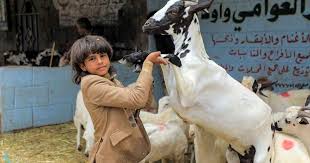
The History of Human Civilization is the History of Festivals. While most festivals around the world celebrate consumption and the joy of receiving, Eid-ul-Adha (or the Festival of Sacrifice) stands as a unique and contrasting beacon of light. The core foundation of this festival lies not in gaining, but in giving away one’s most beloved possessions. For the past fourteen centuries, this profound Islamic religious injunction has not only influenced the Muslim psyche but has also brought about a radical transformation in the global economy, social structures, and humane values.
History and Origin: From the Deserts of Makkah to Global Consciousness
To trace the origins of Eid-ul-Adha, we must travel back nearly four thousand years to the gray deserts of ancient Mesopotamia and Arabia. This tradition began with a supreme and fiery trial faced by Prophet Ibrahim (A.S.), one of the revered prophets in Islamic history.
In his extreme old age, he was blessed with his only and beloved son, Prophet Ismail (A.S.), whom he later saw in a dream being sacrificed for the pleasure of Almighty Allah. Without any hesitation or doubt, the father prepared to draw the blade across his son’s throat, and the son smilingly agreed to be part of that ultimate sacrifice. It was at that moment that the greatest example of sacrifice in human history was established. Pleased with this absolute obedience, the Creator miraculously substituted a heavenly ram in place of the son.
Historical Evolution and Lesser-Known Facts:
Many believe that the practice of ritual sacrifice began solely with Islam. However, even in pre-Islamic times, various Arab tribes practiced sacrifice, though it was pagan and deeply rooted in ostentation. In those days, the blood of the sacrificed animals was smeared onto the walls of the Kaaba. Islam completely reformed this practice. The Holy Qur’an declared:
“Their meat will not reach Allah, nor will their blood, but what reaches Him is piety (Taqwa) from you.” This single declaration liberated the sacrifice from being a mere superficial ritual, transforming it into a profound psychological and spiritual act of devotion.
Chronological Shifts in Social Architecture: From Feudalism to the Digital Era
Over the centuries, the manner of celebrating Eid-ul-Adha has continuously evolved. This transformation can be divided into three major historical eras:
1. The Medieval and Feudal Society (8th to 18th Century)
During this long period, the sacrifice was primarily agrarian and localized. There were no cattle markets spanning long distances. Every feudal or rural community reared domestic animals locally. Due to the absence of modern preservation methods (like refrigerators), it was mandatory to distribute the meat among the entire village within twenty-four hours of the sacrifice. This provided a system of equitable food security for the society of that era.
2. The Era of the Industrial Revolution and Urbanization (19th to 20th Century)
As cities grew, Eid-ul-Adha created a vital bridge between rural and urban economies. Rural livestock farmers reared cows, buffaloes, or goats all year round specifically targeting urban buyers. This gave birth to a massive seasonal economy known as the Poshur Hat (cattle market). Meat distribution also took on institutional forms; various orphanages and religious schools (Madrasas) began collecting animal hides during this time, securing a major portion of their annual operating expenses.
3. The 21st Century and the ‘Digital’ Sacrifice
In the modern era, this ancient tradition has integrated with technology. People no longer need to brave muddy, chaotic cattle markets to purchase an animal.
Digital Cattle Markets: Buyers can now select and purchase animals from the comfort of their homes through live video streams and verified weight metrics.
Online Qurbani Platforms: Expatriates and busy urbanites can send funds through third-party agencies to execute the sacrifice in remote regions or send aid to refugees in conflict zones like Palestine or Syria.
Though the mediums of celebration have evolved, the core essence of binding society together remains completely unchanged.
Cultural Significance: What Meaning Does This Festival Bear?
Eid-ul-Adha is far from being just a three-day holiday; it profoundly impacts the collective psyche of society, irrespective of faith. Its cultural significance is multifaceted:
i. Annihilation of Pride and Bestial Instincts
While the outward form of the sacrifice involves a blade passing over an animal’s throat, its internal reality is the slaughter of the ‘beast’ within human nature—such as greed, jealousy, arrogance, and selfishness.
ii. The Socialism of Festivity and the Eradication of Hunger
Very few festivals in the world structurally mandate the wealthy to hand over a portion of their assets directly to the underprivileged. The meat from the sacrifice is traditionally divided into three equal parts: one for oneself, one for relatives and neighbors, and one exclusively for the poor. In developing nations where underprivileged populations suffer from protein deficiencies throughout the year, these three days of Eid-ul-Adha ensure that meat reaches the household of every corner of the country. It acts as a form of divine socialism.
iii. The Festival in Literature and Pop Culture
In Bengali culture, Eid-ul-Adha has inspired timeless literature and music. Beyond the legendary Eid songs of National Poet Kazi Nazrul Islam, his famous poem ‘Korbani’ passionately proclaims:
“This is no mere slaughter, but the awakening of the force of truth and sacrifice!” From the classic literature of Sarat Chandra Chattopadhyay to the modern tales of Humayun Ahmed, the anxieties of the cattle market, the budget struggles of the middle class, and the emotional fabric of rural life have been repeatedly immortalized on screen and page.
Economic Impact: The Lifeline of Developing Economies
Eid-ul-Adha carries an immense macroeconomic significance that is often overlooked. It is not merely a religious ritual, but a massive annual economic stimulus.
a. Rural Livestock Farming: Millions of small-scale farmers and marginalized individuals invest their resources year-round looking forward to this single week of revenue. Capital flows directly from urban centers back to rural villages.
b. Leather and Hide Industry: Approximately 60–70% of a developing nation’s raw tannery materials are sourced entirely during Eid-ul-Adha. Exporting this processed leather earns countries millions in foreign currency.
c. Seasonal Employment: It marks the most lucrative earning season of the year for butchers, livestock transporters, fodder vendors, and spice traders.
Unique Selling Propositions (USPs) of This Festival
Joy Through Relinquishment: In almost every other festival worldwide, people find happiness by purchasing or consuming new things. Eid-ul-Adha is unique because individuals find joy by giving away a precious item bought with their hard-earned money.
A Purely Circular and Local Economy: Every financial transaction during this festival flows directly into the pockets of marginalized communities. Corporate brands or multinational conglomerates cannot control the core of this festival; its driving force remains the common working-class person.
An Unparalleled Social Welfare Model: The entire proceeds from selling the animal hides belong strictly to orphans, the destitute, and charitable causes according to Islamic jurisprudence. It functions as one of the world’s largest automated public welfare funds, operating annually without any state-mandated taxation.
Is the primary objective of sacrifice in Islam merely the slaughter of an animal: The slaughter is purely a symbolic medium. The ultimate objective is to express absolute submission to God and to sacrifice one’s internal vices, greed, and ego. Without righteousness or piety (Taqwa) in the heart, the mere slaughter of an animal holds no value in the sight of God.
What is the universal lesson that people of different cultures and faiths can draw from this festival: The universal message of Eid-ul-Adha is altruism—rising above personal self-interest to serve the collective good of society. For the stability of any civilization, the sacrifice of the affluent and empathy toward the marginalized are essential, which is the foundational message of this festival.
Philosophical Contrast: Eastern vs. Western Concepts of Sacrifice
While Western materialist culture often emphasizes individualism and hedonism (“consumption is happiness”), Eid-ul-Adha stands as a prime example of the Eastern philosophy of collectivism and sacrifice. Western sociologists like Karl Marx or Max Weber detailed a capitalist framework where humans are perpetually driven to accumulate personal wealth.
Eid-ul-Adha delivers a profound shock to this capitalist mindset. Every year, it explicitly reminds the wealthy that they do not possess an exclusive right over their accumulated riches. When an animal purchased with hard-earned wealth feeds the hungry, it prevents society from becoming a cage of self-centered individuals. This communal, welfare-oriented philosophy of the East has preserved our societal fabric across centuries.
Folkloric Expressions of Sacrifice in Tribal and Indigenous Muslim Cultures
Many assume that the festivities of sacrifice are confined strictly to mainstream societies. In reality, the indigenous Muslim communities of remote regions, such as the Chittagong Hill Tracts or various interior parts of Africa, celebrate Eid-ul-Adha with unique folk variations.
For instance, among the Pangkhua or Mro Muslim communities in Bangladesh, a portion of the sacrificial meat is used to prepare traditional folk broths cooked inside bamboo tubes, which they proudly share with their non-Muslim neighbors as festive gifts. This anthropological diversity proves that while the core religious essence remains singular, Eid-ul-Adha organically absorbs the local colors, traditions, and fragrances of the soil it inhabits.
Eco-Friendly Livestock Farming: The Silent Revolution of Organic Smallholders
Centered around Eid-ul-Adha, a quiet revolution in the ‘Green Economy’ and sustainable agriculture is taking place. While past decades saw negative trends of artificial cattle fattening via chemical steroids, modern consumers are highly conscious.
As a result, smallholder farmers are shifting entirely to organic and natural methods—rearing cattle on natural grass, straw, bran, and oilcakes. This eco-friendly animal husbandry protects the fertility of rural soils, preserves local ecosystems, and guarantees chemical-free meat. The festival thus indirectly fosters a framework for sustainable agriculture nationwide.
Child Psychology in the Festival: The First Lesson in Empathy and Responsibility
In an era where urban apartment life often confines children to virtual worlds of animation and video games, Eid-ul-Adha opens a door to the physical reality of life. Caring for an animal in the days leading up to Eid, watering it, and bonding with it fosters deep empathy and compassion in a young mind.
When that beloved animal is ultimately sacrificed, the child faces a profound life lesson: that for a greater, collective good, one must sometimes let go of things they love. Psychologists note that this experience helps children build emotional intelligence and resilience, preparing them to navigate difficult life transitions in adulthood.
The Social Realism of the Middle Class and the Budgetary Tug-of-War
The middle class constitutes the largest demographic slice of our society. Eid-ul-Adha triggers a massive wave within the middle-class psyche. Balancing annual savings, festival bonuses, and soaring market costs is a timeless motif in our social realism and fiction.
The desperate yearning to purchase the best possible animal within one’s limited means to present before the Creator is entirely free of showy arrogance; it is a sacred, poignant endeavor. The battle between a middle-class pocket and rising market prices—culminating in the triumphant march back home with a purchased animal—imbues Eid-ul-Adha with its living, deeply human heartbeat.
The ‘Cattle Market’ — A Living Theater of Folk Sociology
The seasonal cattle market is far more than a commercial trading hub; it is a massive, temporary theater of folk sociology. People, dialects, traditions, and cultures from across the country converge in this singular space.
When a farmer from a remote western district bargains with a corporate buyer from a megacity, a profound cross-cultural exchange occurs. The market’s nightlife, the rhythmic chants of street vendors, the makeshift earthen stoves of the traders—all combine to form a vibrant subculture. These markets force urban spaces to confront the unvarnished reality of their rural roots.
Artificial Intelligence and Modern Logistics in the Leather Industry
For centuries, raw hides were preserved exclusively using crude salt blocks, a process that was environmentally taxing and prone to spoilage if delayed. However, standing in the modern era of 2026, the leather industry is undergoing a technological renaissance.
Environmentally safe, bacteria-resistant biochemic fluids and Artificial Intelligence (AI)-powered scanners are now used to instantly evaluate hide quality. This has drastically minimized post-festival waste. This ancient tradition’s ability to seamlessly align with cutting-edge science guarantees its sustainability in a modern global marketplace.
From the Mughal Era to the Present: Royal vs. People’s Eid
The pages of history reveal that during the Mughal Empire, Eid-ul-Adha in Delhi or the province of Bengal was celebrated with breathtaking royal grandeur. Mughal emperors rode majestic elephants or camels in massive processions toward the Eidgah grounds, where elaborately decorated camels were sacrificed. During the era of the Naib-Nazims of Dhaka, the Chowk Bazaar Eid procession was world-famous.
With the march of time, monarchies faded and feudalism dissolved. Today’s Eid-ul-Adha is no longer an exclusive exhibition for kings or sultans. It belongs entirely to the common people, driven by the sweat of working-class farmers. The festival has moved from the corridors of absolute power straight into the hearts of the masses.
The Grandeur of Sacrifice in Times of Global Crises and Pandemics
When the world faced devastating disruptions like the COVID-19 pandemic or severe global economic inflation, the foundational values of Eid-ul-Adha shielded societies from total collapse.
Even when facing personal financial hardships, those who possessed resources chose to scale down their personal celebrations, diverting those massive funds directly to medical funds, oxygen banks, and food security programs for the vulnerable. The festival teaches humanity that while the outward ritual can adapt to circumstances, its ultimate goal—the preservation of human welfare—is absolute. In times of historic crisis, this tradition serves as a vital societal shield.
Revival of the Gift Culture and the Mending of Family Bonds
The meticulous social rules governing meat distribution serve to revitalize the ancient traditions of extended family structures, which are rapidly dissolving in modern life. Stepping onto the doorstep of distant relatives whom one hasn’t seen all year, carrying a bowl of fresh meat, remains an immortal aspect of community culture.
This reciprocal culture of gifting instantly thaws long-standing family disputes, old grudges, or emotional alienation. The festival acts as an annual adhesive, repairing fractured family units and keeping the wider social fabric anchored.
Conclusion: Walking Forward in the Light of Centuries
Eid-ul-Adha teaches us that a society can never truly prosper if happiness is confined to isolated palaces. If a destitute hovel starves right beside a wealthy mansion, the moral architecture of that community is bound to collapse. The historic trial of Prophet Ibrahim (A.S.) lives on four thousand years later through the hands of millions of ordinary farmers, laborers, and citizens.
As long as greed exists within human civilization, and as long as inequality plagues our structures, this tradition of profound sacrifice will continue to break down and rebuild our societies for the better. The blade does not merely pass over an animal; it is meant to sever the primal cruelty within human nature. And therein lies the eternal, magnificent triumph of this timeless tradition.
By: Mohammad Sogir Ahmed
Write and Win: Participate in Creative writing Contest & International Essay Contest and win fabulous prizes.
About the Author