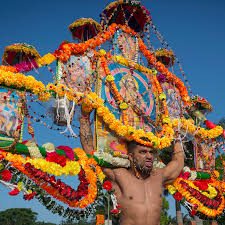
At four in the morning Arjunan was already bleeding. It wasn’t too bad, a thin bright line of blood appeared where the first skewer had been pushed through the fold of his skin above the left collarbone. He did not flinch. He had not eaten in two days. He had not spoken to his wife since Tuesday. He stood at the base of the Batu Caves in Kuala Lumpur where 272 steps of limestone rose into a darkness illuminated by ten thousand oil lamps. He felt, for the first time since his son’s accident, something other than grief. The priest murmured a hymn. Pressed the second skewer through. Around him, a hundred other men and women were having the same experience with skewers and hooks. A woman beside Arjunan had twelve lemons hanging from hooks in her back, their weight pulling her skin into tents. She was smiling. Arjunan watched her. Thought, “This is the only tradition I know where the body itself becomes a site of expressing extreme devotion to the deity.” This is Thaipusam.. It is one of the strangest, most misunderstood, and one of the most intense customs that people have been doing in the name of love.
***
The origin story is fairly known amongst Tamilians. The demon Soorapadman had grown so powerful that even the gods were in retreat. Goddess Parvati is said to have taken her divine energy or shakti and split it into a spear a vel, which she handed to her son Murugan, the god of war and wisdom. With it Murugan defeated Soorapadman, and liberated the cosmos. Thaipusam celebrates this victory.
The lesser-known aspects are more interesting. Murugan, also called Kartikeya, Skanda and Subrahmanya is believed by scholars like Kamil Zvelebil to be one of the deities of the subcontinent with roots in Dravidian culture of Tamilakam. There is evidence from Sangam-era literature that Murugan worship involved possession rituals, mountain shrines and a group of devotees called vēlan who would enter trance-like states. Thaipusam, thus began as a tradition of surrendering the body to the divine experience which predates its Brahmanical formalization.
The Tamil month of Thai, and the full moon of the Pusam star determines the timing of the festival.
In 1892 the British colonial administration in Singapore classified Thaipusam processions as a “nuisance.” The drumming and chanting that accompanied the kavadi, the elaborate often towering steel structures worn by devotees were deemed disruptive. Restrictions were placed on music and procession routes. It was the beginning of a century-long friction between the festival and the state.
What few people know is that the most dramatic suppression did not happen under colonial rule. It happened in the post-independence state. In 1947, the government of Tamil Nadu following independence and under pressure from movements that wanted to modernize religious practices, banned the use of drums at Thaipusam processions in Madras. The ban, which lasted decades, effectively silenced the heartbeat of the festival in its homeland. Anthropologists who study trance states have since noted that the drumming has a neurological function. The specific rhythms used, building in pace and intensity over hours create altered states of consciousness. Removing the drums thus had a profound consequence for the devotees.
This is why Malaysia became the living capital of the festival. When Tamil laborers were brought to Malaya by the British to work in rubber plantations in the nineteenth and early twentieth centuries, they brought their tradition with them. In Malaysia, unlike in Tamil Nadu, there were no reform movements strong enough to legislate against the more ecstatic elements of the tradition of Thaipusam. The kavadi grew more elaborate. The piercings became more numerous. The processions swelled. Today, the Batu Caves Thaipusam festival outside of India attracts over a million visitors in a single day.
Arjunan began preparing forty-eight days before the festival of Thaipusam. He took a vow or a nonbu, committing to celibacy, vegetarianism, daily prayer and sleeping on the floor. This preparation, according to practitioners, is the period during which the body becomes a vessel of receiving divine presence. The physical mortification on the day of the festival is only possible as many devotees insist, because of the preparation that precedes it.
The kavadi Arjunan carried was a circular steel arch mounted on a harness across his shoulders from which hung several pots of milk and peacock feathers. His kavadi was modest by the standards of Batu Caves, where some devotees carry structures large enough that they require the help of others to erect. The milk inside the pots carried is offered to Murugan, as it is poured over the deity’s idol at the end of the procession. The act of carrying the kavadi symbolizes the weight of one’s burden being lifted through devotion. Arjunan was carrying the weight of his son’s coma.
Over the past three decades, the festival of Thaipusam has spread significantly with the Tamil diaspora. In Mauritius, Réunion, South Africa, the United Kingdom, Canada and Australia, Thaipusam is now celebrated in temples though often without the piercings either because of local ordinances or because the tradition of kavadi-bearing has not always followed the diaspora intact. In Singapore, where the Tamil community is well established, Thaipusam remains a holiday but the government banned musical instruments from the procession in 1973, citing traffic concerns, perhaps a reflection of the colonial-era restrictions. The ban was not lifted until 2011.
There is a Tamil word that those who have carried the kavadi use when asked what the experience is like. ‘Vel veru,’ the frenzy of the spear. It describes a state in which ordinary consciousness recedes and something else whether one calls it Murugan or the subconscious mind takes charge.
For the devotees, there is no contradiction between the pain and the joy. The piercing is not self-harm as one may think, but it is an act of supreme trust. The body is offered to the god. The skewers are not intended to harm the devotee. Observers consistently note that devotees in the states of trance show no bleeding from the piercings, no wincing and later minimal scarring.
Arjunan told his wife this when he returned from Batu Caves that year. He said: “I am not sure what happened to me up those steps.. When I reached the top, I was not angry at God anymore.” His son woke up eleven days later. Arjunan did not see this as a miracle.
***
The absence of bleeding in kavadi-bearers has been studied by researchers at the University of Hawaii who found that the altered neurological state associated with deep trance dramatically raises the pain threshold and causes vasoconstriction or the narrowing of blood vessels at the site of the piercings. The body, under such conditions, closes itself against the wound.
The word kavadi was originally used for a shoulder pole, used by laborers to carry two balanced loads, one hanging on each side.
Murugan is a deity whose primary sacred sites are almost exclusively in the southern parts of the Indian Subcontinent, the Arupadai Veedu; or his six abodes are all in Tamil Nadu. He is, in essence, a Tamil god who was later incorporated into the Sanskrit pantheon. His mythology carries traces of a mountain-dwelling warrior deity worshipped by hunters and hill tribes long before he became the son of Śiva and Pārvatī.
***
In a time that increasingly medicalizes suffering and presents it in jargons of therapy, medication and self-care, Thaipusam offers a radically different perspective of understanding devotion and self-sacrifice.
Let it hurt. Trust that after this experience, something will be different.
This should however not be seen as an argument against medicine or psychology. It is an argument for taking what communities across thousands of years have discovered about how people heal, which is often not quietly or even alone. The anthropologist Victor Turner, writing about liminality, described the festival of Thaipusam as a mechanism for moving individuals from one social state to another from grief to acceptance from isolation to becoming a part of the community from private anguish to shared meaning.
***
At the top of the 272 steps, Arjunan stood before the sanctum of the Batu Caves temple and placed his offering, a pot of milk now warm from the hours of carrying, before the idol of Murugan. The priest removed the skewers. There was no blood. Arjunan sat down on the limestone floor surrounded by the smell of camphor, sweat and flowers and wept for the time since his son’s accident.
A man he had never met before put a hand on his shoulder. Said nothing. Just sat there. This is also Thaipusam, the moment after the kavadi is set down when strangers who have carried their weights up the same hill recognize each other’s pain without words.
The skewer goes into the skin. The vel cuts through the demon. A mother’s power turns into a weapon. Burden turns into sacrifice. Something, whether we call it Murugan’s blessings or having gained a different perspective in life, or just the body’s ability to keep going, marks a transformation.
By: Sivaranjani Iyer
Write and Win: Participate in Creative writing Contest & International Essay Contest and win fabulous prizes.
About the Author