There are some fictional characters like evil audiences admire. Some they fear and then there are those impossibly rare creations that seem to escape fiction entirely, characters who do not remain trapped inside books or films, but continue living quietly inside the minds of people like parasites long after the story ends. They alter the atmosphere around them. Conversations about them become strangely personal. People do not merely discuss them, they defend them, even confess fascination with them in lowered voices, almost guiltily, as though speaking about something forbidden.
Because certain characters are not written simply to entertain.
They are written to infect us.
The infection incurable, HANNIBAL LECTER.
He was never created merely to scare us. Fear is temporary. Hannibal is meant to linger. Long after the films end, long after the books are closed, long after the music fades into silence and the dinner is served , something of him stays quietly within the audience like a guest who never really left. That’s why he isn’t just remembered.
He is revisited.
Most villains crash into stories like storms: loud, destructive, and impossible to ignore. Hannibal enters differently. He slips into narratives quietly, like a needle sliding through clothes to stitch every part of it. There’s no desperate need for power. He does not need to convince anyone about his strength, as he knows one simple thing about human nature:
The calmest person in the room is often the most dangerous.
And Hannibal Lecter is always calm.
In nature, apex predators rarely waste movement. They watch before attacking. They save energy. They remain still long enough for anxious prey to show weakness willingly. Thomas Harris understood this well. Throughout the books, Hannibal rarely acts on impulse. Even his violence carries a patient ritual, as if brutality must first become aesthetically worthy before he allows himself to commit it. He never rushes when answering questions. Silence itself becomes one of his tools. Other men fill silence out of fear. Hannibal observes people within it.
That’s predator behavior. And perhaps that’s the real start of horror.
Not that Hannibal kills. But that he kills beautifully.
During a dinner event, Hannibal prepares an exquisite meal while discussing art and classical music with the guests. The guests are sophisticated enough to recognize vintage wine by its scent. The conversation flows gracefully. The candles glow gently. Crystal glasses shake, the wine and vinyl dance in awe beneath the reflected golden light. Everyone feels civilized. Safe.
Then the realization hits quietly, almost unnoticed:
Someone at the table is already dead.
Not metaphorically. Literally. And the guests are consuming them with appreciation.
That scene captures Hannibal Lecter better than pages of psychological analysis could. His greatest skill isn’t murder. It’s transformation. He turns violence into sophistication, something so eyepleasing. He turns savagery into ritual. Most terrifying of all, he transforms the audience’s disgust into fascination. That’s why ordinary villains eventually seem childish as they age while Hannibal only becomes more unsettling.
As Hannibal understands culture.
He understands literature, perfume, anatomy, psychology, philosophy, music, architecture, manners, cuisine, and every breathing flaw with precision. He can tell a person’s social class from the stitching on their clothes. He notices trembling fingers hidden under confidence. He once identified expensive hand lotion from its scent particles alone. He reads people like musicians read sheet music.
Every weakness has rhythm. Every fear has texture. Every insecurity leaves traces.
And Hannibal sees all of them.
One of the most disturbing details about Hannibal is how rarely he blinks during conversations. In both the novels and the TV show, he holds eye contact for uncomfortably long stretches. Psychologists link reduced blinking to a predatory focus and emotional control. Viewers pick up on this without even knowing it. That’s why scenes with Hannibal feel suffocating. It seems less like a conversation and more like being studied under a microscope.
This is what sets him apart from villains driven by revenge or power. The Joker wants chaos, Lord Voldemort seeked immortality, Darth Vader desires control over loss itself.
Hannibal wants understanding. That’s infinitely more frightening because domination eventually ends. Curiosity does not.
He observes people because he finds human beings aesthetically fascinating. For Hannibal, morality is almost secondary to refinement. He hates vulgarity more than cruelty and some of us are same as him. Rudeness repulses him like decay beneath expensive perfume. In his private view, poorly behaved people are not just irritating they are failures of civilization and Hannibal thinks failed things should be eliminated, somthing he knows we will agree too.
This twisted logic is what makes audiences uneasy. Not because they condone murder but because parts of his observations feel disturbingly accurate. Everyone has encountered cruelty disguised as sophistication. Everyone has seen arrogance rewarded because it came dressed beautifully. Everyone has witnessed intelligence mistaken for goodness.
Hannibal simply pushes these truths to monstrous extremes beautifully. That’s why viewers begin betraying themselves while watching him.
They admire his discipline, intelligence, precision, and emotional control. Then comes the chilling moment when admiration quietly turns into complicity.
1. A rude character insults Hannibal.
2. The audience waits for punishment.
Not consciously.
Instinctively.
That’s the real manipulation hidden within the series. Hannibal doesn’t just deceive characters in the story. He seduces the audience outside it. Thomas Harris crafts Hannibal so well that viewers slowly start to evaluate victims through Hannibal’s lens instead of their own morals.
Like poison dissolving into wine, and we are drinking it.
By the time audiences realize what’s occurred, the corruption is already complete.
Now they aren’t asking, “Is Hannibal evil?”
They are asking, “Did the victim deserve him?” That question is the true crime of the series. Not cannibalism. Not murder. But the fragile morality which decay inside humans.
There is a chilling scene many viewers barely notice during their first watch. Hannibal is sitting beside a dying man after brutally attacking him. Blood covering the floor and the victim is struggling to breathe. Yet Hannibal gently adjusts a blanket over the man’s body so he won’t feel cold during his final moments. The gesture is horrifying because it is genuinely compassionate. For a split second, the audience sees tenderness inside a monster. That contradiction is what makes Hannibal unforgettable. He does not see himself as a villain. In his perception, he is sufficiently civilized to provide comfort while destroying anyone. It’s like a painter apologizing to a canvas while setting it on fire.
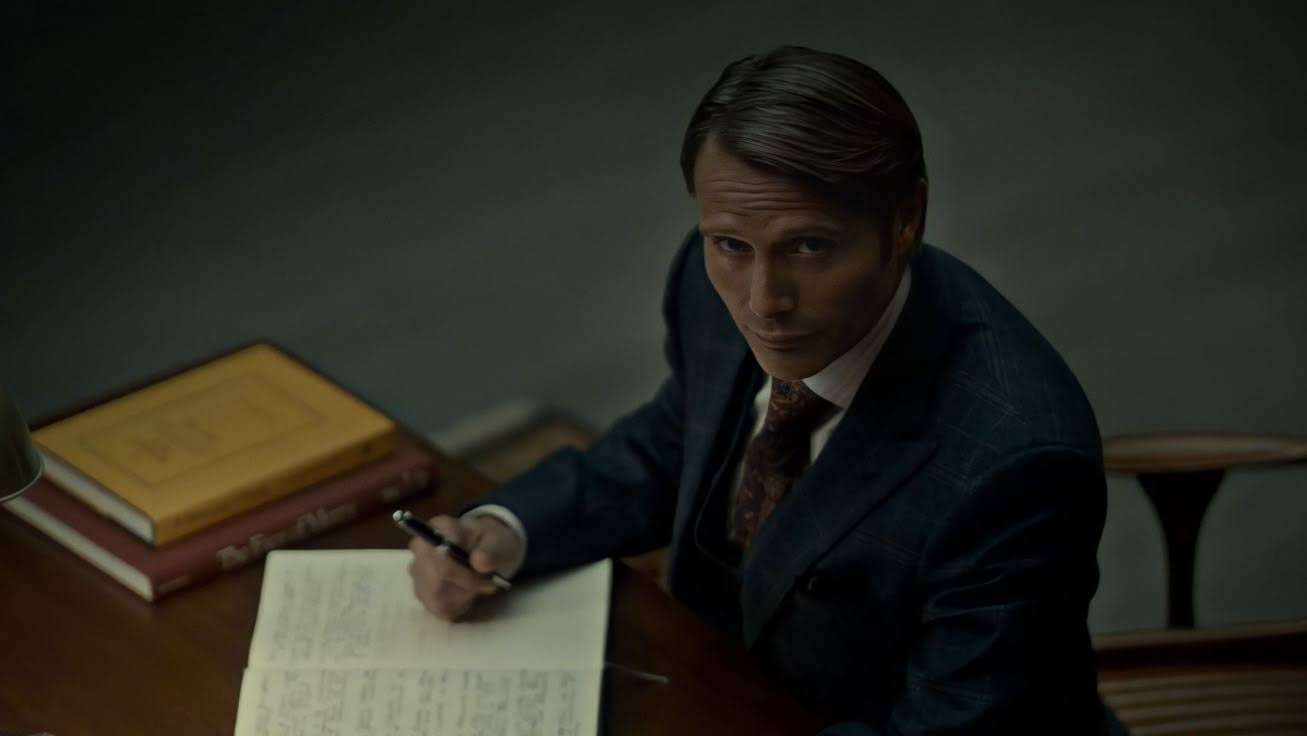
The television adaptation Hannibal captures this perfectly. Portrayed by Mads Mikkelsen with haunting aura, Hannibal moves less like a human and more like memory itself, elegant, ghostlike, impossible to fully grasp. Even his posture conveys superiority. He cooks as if performing a sacred ritual. He murders with the calmness of a surgeon correcting flaws in anatomy and then the series commits its greatest act of psychological violence. It makes Hannibal lonely. A event softning the audience as loneliness transforms monsters. We start to empathise this.
Until Will Graham enters his life, Hannibal exists emotionally untouched by humanity. But Will has something unique: empathy so extreme it borders on self-destruction. He can reconstruct violence in his mind. He understands killers not just intellectually, but spiritually. Hannibal knows this right away.
Not because Will is like him but because Will could become him.
Suddenly, the dynamic between hunter and monster shifts into something far more dangerous, Intimacy.
Every conversation between them buzzes with hidden allure. Therapy sessions feel like confessions disguised as interrogations. Meals turn into emotional battles. Hannibal doesn’t want Will dead. He wants Will transformed. He seeks another mind capable of seeing him fully without flinching in horror. For perhaps the first time in his life, Hannibal craves connection.
Is this what people call love ? and that desire humanizes him so profoundly that audiences start forgetting what he truly is.
A predator.
One scene captures this terrifying phenomenon perfectly. Hannibal tenderly cares for an injured Will with such sincerity that, for a brief moment, viewers stop seeing a serial killer. They see compassion. Love, even; but as everyone knows Hannibal’s affection is frightening because it cannot be separated from destruction. He loves people the way fire loves paper, beautifully, completely, and fatally. So is Will a paper or a mere bottle of kerosene to ignite the power of hannibel or a tender sheet of dried leaf trying to find soil to rest. This question circulated in hannibel’s mind itself. And now the final truth begins to surface. Quietly. Patiently. Like Hannibal himself. Throughout the entire story, audiences think they are studying Hannibal Lecter. But they are not.
Hannibal Lecter is studying them.
That’s the hidden twist buried in the tale.
Every elegant speech, every refined dinner, every philosophical thought, every moment of unsettling charm…functions like a psychological test.
And the audience keeps failing it.
Readers think they are safely analyzing a fictional monster while secretly revealing their own attraction to power, intelligence, beauty, and emotional control. Hannibal becomes a mirror reflecting the uncomfortable reality that people forgive evil surprisingly easily when it wears refinement. Think about it When was the last time you crushed upon a devilious handsome serial killer ?
The horror was never that Hannibal could blend in among civilized people. The horror is that civilization itself helped conceal him.
That’s why his famous line remains memorable:
“I do wish we could chat longer, but I’m having an old friend for dinner.”
Only Hannibal could turn cannibalism into elegance. Another villain would threaten. Hannibal entertains. The sentence works because wit momentarily distracts the audience from horror. People laugh before remembering they should feel disgusted.
That delay matters. Because he is playing with us in a suit, because inside that tiny moment of laughter lies the entire meaning of Hannibal Lecter.
He shows that evil doesn’t always look monstrous, even Lucifer was quit .. eyeworthy.
Sometimes the evil comes across as educated. Cultured. Soft-spoken. Beautifully dressed. Sometimes it shares philosophy while pouring wine. Sometimes it understands us better than we understand ourselves.
And sometimes most terrifying of all We invite it to dinner WILLingly.
By: Harshada Rameshwar Khedekar
Write and Win: Participate in Creative writing Contest & International Essay Contest and win fabulous prizes.
About the Author