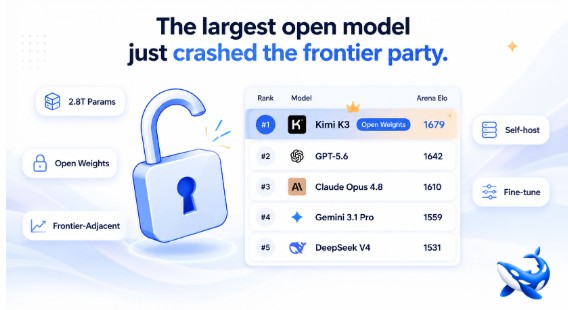
When DeepSeek shipped R1 in early 2025, the shock was that an open, cheap model had reached the frontier. Kimi K3 revived that exact conversation — the largest open-weight model to date, landing near the top of the boards on day one. This guide lays out the case that Kimi K3 is open source’s next “DeepSeek moment,” the more careful counter-argument, and what the open weights actually change for builders.
A note for builders: the reactions below are individual testers’ first impressions rather than controlled benchmarks, so they are best read as directional. If you would like to judge the model on your own work, it helps that OrcaRouter brings many models together behind one endpoint — which makes it easy enough to try Kimi K3 alongside the closed flagships without wiring up multiple SDKs.
What “DeepSeek moment” means
The phrase is shorthand for a specific kind of surprise: an open-weight model, often from a Chinese lab, matching closed Western flagships at a fraction of the cost — collapsing the assumption that the frontier is a closed, well-funded club. It is less about one benchmark and more about the gap between “open” and “frontier” suddenly looking small.
The case for
The evidence that Kimi K3 qualifies is real:
- Size and openness. At a reported 2.8T parameters (MoE), it is positioned as the largest open-weight model to date, with weights promised before July 27, 2026.
- Frontier-adjacent results. It debuted #1 on the Arena frontend-code board and posted a top-three Artificial Analysis Intelligence Index — as an open model.
- The testers said it out loud. @chetaslua called it “another DeepSeek moment for OSS,” @synthwavedd compared the vibe to “another DeepSeek R1 moment,” and @redkendl argued Chinese labs are “not 8 months behind the frontier” anymore.
The more careful reading
The sharpest take came from @teortaxesTex, who praised Kimi K3 but reframed the gap. In his view the difference between K3 and the frontier is not raw capability but effort and taste — K3 rarely fails outright, it just does not always take the extra step to make output polished. He also noted that frontier models produce plenty of “slop” of their own, and — the line worth remembering — that every Chinese model which keeps the gap from widening is itself an achievement, given the capital, compute and talent on the other side.
That is a more durable framing than “they caught up”: close, improving, and impressive, without pretending the polish gap is gone.
The skeptics
Not everyone buys the narrative:
- @LinkesAuge82 argued the original “DeepSeek moment” was overstated, and this one risks the same hype.
- @jmbollenbacher noted the gap is real and partly hidden: US labs keep their best models internal for months, so public comparisons flatter the challenger.
- @Camilogicly suggested the gap holds in part because open labs distill from the very frontier models they are compared against.
| Claim | Counter-claim |
| Open source has caught the frontier | The best closed models stay internal for months |
| K3 matches flagships on quality | The gap is effort/taste and polish, not just scores |
| Chinese labs are no longer behind | Some progress leans on distilling frontier outputs |
What the open weights actually change
Narrative aside, the weights are the concrete payoff. Once released, Kimi K3 can be:
- Self-hosted on your own hardware, for data-control or compliance reasons.
- Fine-tuned to your domain.
- Run without a per-token API bill — you pay for compute instead.
The catch is scale: a 2.8T-parameter model is a serious hardware undertaking to serve, so for most teams the API remains the practical path and self-hosting is for those with the infrastructure and a specific reason.
The takeaway
Is Kimi K3 open source’s next “DeepSeek moment”? On the facts — largest open-weight model, top-of-board debut, priced to undercut — it is the strongest case since R1. The honest caveat, from the model’s own admirers, is that the remaining gap is about polish and effort rather than raw ability, and that some of the closest comparisons flatter the challenger. Either way, an open model this capable moves what a small team can build without a frontier-lab budget — which is the part that actually matters.
Disclosure: spec and benchmark figures above are vendor-reported or from Artificial Analysis / Arena and are not independently audited by us. Community reactions are individual testers’ first impressions, many run against a pre-release “Kivine” checkpoint, not controlled benchmarks. Competitor and rival-lab characterizations are attributed to their named sources and may differ from those parties’ own positions.
Write and Win: Participate in Creative writing Contest & International Essay Contest and win fabulous prizes.
About the Author