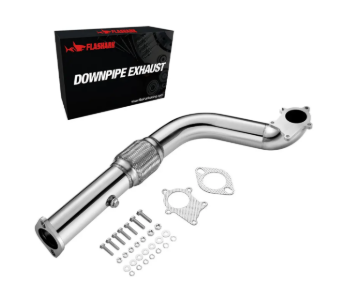
The stock capabilities of any vehicle can be maximized with the right equipment, something that any car lover accentuates. Be it restoring an old muscle car or fine tuning a sports car, the correct upgrades can immensely boost the horsepower your vehicle yields. The honors of owning a classic like the 1988 Honda Civic or even for those looking to fully take advantage of their turbocharged Civic, bolt-on engineered solutions are everything. We will cover strategically adding parts, also referred to as power modifiers, starting from a downpipe back exhaust system—like the Flashark Downpipe—designed specifically for the ’88 Honda Civic. Some of the modifications to be discussed include improvements to forced induction systems and exhaust systems.
Customization and modifications within vehicles are prominent since they give a sense of ‘personlization’ to users. Being able to upgrade or swap stock features with modern aftermarket products alongside customizable aesthetic features is the cherry on top.
Customization and personalization are a couple of the characteristics that come together with aftermarket components. Components such as high-flow air intakes, performance specific exhausts alongside turbochargers allow your engine to harness pre-existing capabilities. Optimization during fuel combustion coupled with enabling air to be used freely also results in added horsepower. Upgrading components can help with attaining goals such as replacing the stock exhaust with a Flashark downpipe. Facilitating greater exhaust flow results in reduced back pressure which in turn helps turbos spool faster.
Important Modifications That You Might Have Missed before Enhancing Performance
- Engines with Turbochargers Require Cold Air Intakes for Denser, Cooler Air
One of the easiest methods to enhance a vehicle’s horsepower is to improve its exhaust flow. The quality of a car’s exhaust greatly depends on the make and model; older cars have a less sophisticated design and use narrow piping along with exhausts made of restrictive material that limits power output, which leads to a choked exhaust. The performance-driven aftermarket downpipes, such as those manufactured for the 1988 Honda Civic, replaces the factory downpipes with ones that have mandrel-bent piping. The newly designed downpipe enhances the performance of the car by allowing the gaseous wastes produced by the engine to exit the system freely.
Turbocharged applications such as the Flashark downpipe have been proven to be more effective. These components improve the efficiency of the turbo by optimizing its diameter and taking out the catalytic converter restrictions, allowing for a quicker spool up resulting in power production at lower RPM levels. As a result, responsive engines are built.
- A Car’s Engine Requires Oxygen for Power Production Cold Air Intakes Provide A Steady Supply Of New Air
Custom designed air filters for the 1988 honda civic downpipe and many other similar slower models perform exceptionally well on their own with little effort. Cold Air Intakes designed the right way come equipped with a filter that is placed in a cool area along with wide and smooth tubing. Such designs ensure that there is no accumulation of air or stagnation region within the smooth duct, thus increasing the maximum suctioned air volume. Placing the filters and using the rest outside silicon tubing aka ducts gives designers a lot of freedom.
Today’s modern cars have a cost reduction engine philosophy which means saving cost(goods or services) in areas like air conditioners, i.e their duct routing. Routing and placing tubing in such systems leads to warm air already being present within the vicinity; warmed air has a reduced density which means lower oxygen per space, resulting in the increase of efficiency air intending to flex muscle. Thus this device enhances air restriction.
The ways in which we navigate and enable for better quantum leaps enablers of tighter air squeezers and escapees can drastically change how an engine operates.
- ECU Tuning for Increased Efficiency
Your engine’s computer can have an impact on performance even after hardware upgrades. The default settings of your ECU focus more on the reliability of systems and emissions, rather than the raw power your vehicle can churn out. With a proper tune or a simple plug-and-play tuner, your ECU can be adjusted to optimal performance through modification of fuel maps, ignition timings, and boost levels.
This auto-tuning process is crucial for turbo cars. A tune can enhance throttle response, lift boost caps, and make sure your engine operates safely with higher power levels.
- Gains From Upgraded Turbos For Forced Induction Vehicles
If your car comes pre-installed with a turbo, upgrading it unlocks additional horsepower. Boost and efficiency can be gained from bigger turbos and higher flow compressor wheels, as well as upgraded wastegates. However, other modifications, such as the Flashark downpipe, must be added to cope with the increased flow, alongside the turbo upgrades.
Modern turbine technology has the ability to rejuvenate old turbo systems, like those found in older model Civics from 1988.
Practical Changes: Outcomes Of The Upgrades
Harnessing the advantages of these modifications is not just a theory. Practically, the users experienced notable benefits:
The Turbo was spooled up turbo faster and had less lag because of the high flow downpipes such as the Flashark.
Noticeable improvement in mid-range torque for more responsive every day driving.
With a completed tune, peak horsepower was reported to be significantly enhanced.
There is improvement in throttle response which remedies sluggishness present in factory setups.
Turbocharged cars especially benefit from reduced backpressure, which allows the turbo the to function more efficiently. For 1988 Honda Civic owners, these upgrades do wonders as they turn a nostalgic economy car into a spirited performer.
Best Components for Your Build
Not all upgrades are made equal because the best modifications depend on your objectives:
Bolt-on add-ons, like cold air intakes and cat-back exhausts, are favorable for daily drivers.
Standalone engine management, reinforced internals, and turbo upgraders are optimal for track-focused builds.
Classic restorations, like involving a downtube on a 1988 honda civic, tend to prioritize extra power while maintaining drivability.
Reliability with power gains is the ideal engineering approach. While extreme modifications can push an engine to its limits, smart, precision-engineered upgrades like Flashark’s downpipe offer incredible improvements without sacrificing endurance.
Final thoughts
You might want your car to be more responsive, faster, or smoother than it already is, and chances are you’re not wrong. Improved factory settings leave some room for change, and aftermarket components do miracles as they excel in performance.
Many 1988 Honda Civic enthusiasts look towards modifying certain features like the downpipe as a means of refreshing an older engine. Turbocharged vehicles, in particular, make good use of the Flashark downpipe because it reduces flow restrictions and helps with boost response. Flashark’s high-flow exhaust components, such as the downpipe, have shown to greatly aid turbocharged cars.
Write and Win: Participate in Creative writing Contest & International Essay Contest and win fabulous prizes.
About the Author