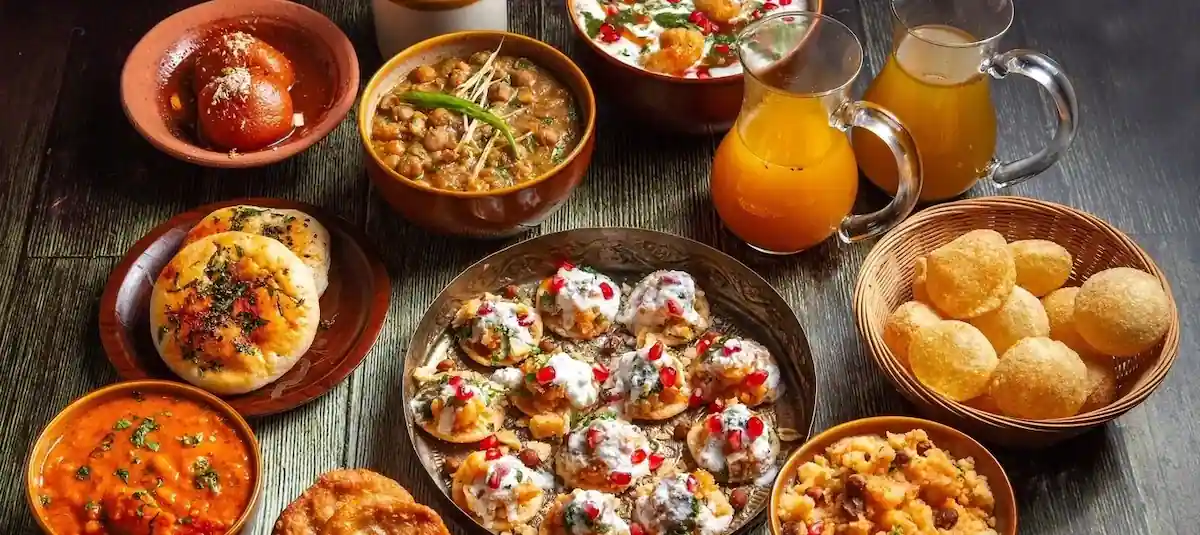
Whether it’s the spicy chats of Delhi, the fish curries of Kerala, or the sweets of Bengal – every bite tells us who we are and where we come from. Food in India is not merely a source of nourishment; if is a story, a memory, and an Identity. It carries within it the aroma of our soil, the warmth of our homes, and the shared laughter of our people. India’s cuisine, like its culture, is vast, diverse, and deeply rooted in history. It reflects centuries of tradition, foreign influences, and regional creativity, making Indian food one of the richest culinary tapestries in the world.
A Land of Thousand Flavors
India’s geography and climate have blessed it with a wide variety of ingredient, from the cool Himalayan herbs to the tropical spices of the South. Every region has its own culinary identity, shaped by history, religion, trade and geography.
In the North, wheat dominates the plate. Delhi’s spicy chaat, Punjab’s butter-loaded parathas, and Kashmir’s aromatic Rogan Josh speak of hearty meals that match the cold winters. The North Indian palette is filled with rich gravies, ghee, and slow-cooked dishes – each infused with a blend of garam masala, cardamom, and saffron.
Move eastward, and the flavors become lighter but no less complex. Bengal’s cuisine is portry on a plate – from the delicate hilsa fish cooked in mustard sauce to the syrupy rasgullas that melt in the mouth. The Bengalis love for both spice and sweetness mirrors their deep emotional nature, making every meal a celebration of life’s contrasts.
In the West, Rajasthan’s cuisine tells a story of survival and creativity. In a land where water is scarce, people learned to make dishes that could last long and use minimal moisture- like dal baati churma and Gatte ki sabzi. Gujarat, on the other hand, brings a sweet-sour harmony to food, with dishes like dhokla, Thepla and Undhiyu blending taste and heath in perfect balance.
And then there is the South – a world of coconut, tamarind, and curry leaves. From the fiery chettinad curries of Tamil Nadu to the subtle seafood delicacies of Kerala, from Karnatak’s Bisi Bele Bath to Andhra’s a spicy Gongura pickle – every dish bursts with regional pride The South Indian meal, often served on a banana leaf, represents not food but philosophy – a belief I balance, respect for nature and gratitude for what one receives.
The Historical Recipe: Invaders, Traders, and Travelers
Indian food is not just regional; it’s historical. Every invader and traveler who came to India left a mark on its cuisine. The Mughals brought with them the art of Dum cooking, Biryani’s and kebabs, blending Persian delicacy with Indian spices. The Portuguese filtered us the cilia, without which today’s Indian kitchen would be unimaginable. They also introduced tomatoes, potatoes, and even the beloved vindaloo from Goa. British colonization, while harsh politically, led to new culinary fusions – like Anglo-Indian dishes. The French is Pondicherry, the Dutch in Kerala, and the Parsis in Mumbai all contributed their unique ingredients and cooking methods. India’s food thus became a melting pot of global influences – yet it retained its distinct identity, refusing to lose its local soul.
The Cultural Connect: Food as an Emotion
In India, food is never just eaten; it is shared, offer, and celebrated. Every festival every ritual , and every milestone in life has a dish associated with it. Buring Biwali, homes are filled with the aroma of sweets like Laddus and gujiyas, symbolizing prosperity and joy. Pongal in Tamil Nadu celebrates the harvest with a special dish cooked from the season’s first rice, Sweetened with jaggery and milk. Eid brings biryanis and seawoman to the table, share not just among families but across communities. Christmas cakes, Baisakhi lassi, Onam Sady, and Ganesh.
Chaturthi’s models – each tell story of faith, gratitude, and unity.
At the heart of all these traditions is the concept of Anna Daana _ the offering of food as the highest from a charity. Feeding someone I India is seen as feeding the divine withing them. This deep spiritual connection between food and humanity gives Indian cuisine a sacred dimension.
The Science of spice
Indian cuisine is also a masterpiece of natural science. Spices are not just for taste; they are for health. Turmeric, a powerful anti- inflammatory, adds is its golden color to countless dishes. Cumin aids digestion; cinnamon controls blood sugar; and clove and cardamom refresh the Breath while strengthening immunity
Ayurveda – the ancient Indian system of medicine – considers food as medicine itself. The balance of sweet, sour, salty, bitter pungent and astringent tasters in a mal is believe to harmonize the body and mind.
Even the structure of a traditional Indian thali reflects balance carbohydrates from rice or roti, proteins from dal or paneer, vitamins from vegetables, probiotics from curd, and touch of sweetness to complete the cycle. It is a philosophy that goes beyond cooking – its is mindfulness served on a plate.
From Street to Five-star: The changing Face of Indian Food
Today, Indian food has traveled far beyond its borders. From Michelin- starred Indian restaurant in London to small curry houses in New York, the world has fallen in love with India’s spices and flavors. Yet, some of the best food is still found no t in grand restaurants but on the streets – where vendors serve plates of chaat, vada Pavabhaji, Momos or Idlis to hungry souls every day.
Street food in India is a culture in itself – chaotic, Colorful, and creative. Every city has its own signature: Mumbai’s pavbahji, Delhi Pani Puri, Kolkata’s Kathi rolls, Lucknow ’s kebabs Hyderabad’s biryani, and Indore’s poha-jalebi. Eating from a roadside stall is not just about food; it’s about community – about standing shoulder to shoulder with strangers, laughing over shared flavors, and realizing that food unites more than it divides.
The Global Recognition of Indian Cuisine
With globalization and migration, Indian cuisine has reached every corner of the world. Indian chefs are redefining culinary art by blending radiation with innovation – deconstructing classics infusing modern techniques, and still staying rooted. Dishes like butter chicken, masala dosa, samosas, and naan have become Global ambassadors of India’s culinary genius
Yet, what makes Indian food truly global is not just its taste but its philosophy – the belief that food is an expression of love and togetherness. In every Indian household, when a guest arrives, the first question is not “How ae you?” but “have you eaten?”
That simple gesture captures the essence of Indian hospitality warm, generous, and heartfelt.
Food as Identity
For Indian, food defines who they are. Its is a marker of culture, caste, religion, and region – yet it s is also the bridge that connects them all. The vegetarian meal s of Gujarat, the seafood of Konkan, the meat feasts of Kashmir, and the vegan innovation of modern cities – all coexist under the same sky. The diversity of Indian food mirrors the diversity of its people – different, yet united in spirit.
Along with gatte ki sabzi and dal baati Churma, Rajasthani thalis also include ker sangri and papad ki sabzi — unique desert delicacies. Meanwhile, Gujarat’s kitchens delight in handvo, khandvi and fafda-jalebi, offer Along with gatte ki sabzi and dal baati Churma, Rajasthani thalis also include ker sangri and papad ki sabzi — unique desert delicacies. Meanwhile, Gujarat’s kitchens delight in handvo, khandvi and fafda-jalebi, Offering a perfect balance of taste, tradition, and texture
When Indian travel abroad, the smell of home- cooked curry or the crunch of a papads instantly brings back memories of home it is nostalgia wrapped in aroma – a connection that no distance can break. Food carried identity, memory and belonging; it reminds every Indian where they come from.
Sustainability and the Future of Indian Food
In recent year, there has been a renewed interest I traditional Indian grains and methods. Millets, one forgotten, are making a comeback for their nutritional and environmental benefits. Farm – to – table movement s, organic markets, and traditional recipes. Chefs and home cooks alike are rediscovering the wisdom of their grandmothers – slow cooking, seasonal eating and zero waste.
As India moves Toward modernization, this return to roots is heartening. It reminds us that progress does not mean forgetting the past; it means scaring it forward, one recipe at a time
Conclusion: A Taste of Unity
In every Indian kitchen, form a hut in the village to a Highrise apartment it the city, the rhythm of life begins with the sound of sizzling oil, the aroma of roasted spices and the laughter of family around the table. food int India is not just about ingredients – it is about people, places, and emotions .
It is the bond between mother and child, the bridge between communities, and the comfort of home in a foreign land. Each dish – whether humble khichdi or royal Biryani – tells a story of heritage and heart
So yes, whether it’s the spicy chats of the Delhi, the fish curries of Kerala, or the sweets fo Bengal every bit truly tells us who we are and where we come from. In a country as diverse of the India, food is the language we all speak – a a language of love, unity , and endless flavor.
By: Chokkapu Pavan kumar
About the Author