In the rapidly evolving landscape of AI image generation, a peculiar name has recently captured the attention of creators, marketers, and tech enthusiasts worldwide: Google’s Nano Banana. This oddly named yet incredibly powerful AI model is transforming how we approach image creation and editing, offering unprecedented capabilities that are making waves across social media platforms and professional creative workflows.
What Exactly Is Google’s Nano Banana?
Despite its playful name, Nano Banana (officially called Gemini 2.5 Flash Image) is Google DeepMind’s state-of-the-art AI image generation and editing model. Users began noticing one model consistently outperforming others, maintaining remarkable face consistency and following complex instructions with precision. Soon, banana icons started appearing in prompts and outputs, leading to the nickname “Nano Banana” before Google officially confirmed its identity.
Rolled out to the Gemini app and integrated into Google’s AI ecosystem, this powerful model has been praised for its unparalleled ability to achieve ultra-high character consistency, making it a game-changer in the AI image generation space.
Core Features and Strengths of Nano Banana
1. State-of-the-Art Image Generation
Nano Banana boasts remarkable prompt accuracy and contextual consistency that rivals industry leaders. Whether you’re looking to create photorealistic images, abstract art, surrealist compositions, or any other style, the model perfectly understands natural language prompts to generate images that meet professional standards.
2. Perfect Character Consistency
Perhaps the most impressive feature of Nano Banana is its ability to maintain character and scene elements across iterative changes. This means you can implement specific edits like changing backgrounds, lighting, objects, or perspective while the core subject remains perfectly intact. For creators working on character-based projects, this solves one of the most frustrating limitations of previous AI image models.
3. Natural Language Image Refinement
With Nano Banana, complex image editing becomes as simple as typing instructions. The model can detect edit regions in images to implement precise modifications without requiring any technical skills like masking, layering, or touch-ups. As one user noted, “You don’t need Photoshop skills. You don’t need to draw masks or touch up anything. Just describe what you want changed in plain text.”
4. Multi-Image Fusion
The model effortlessly understands and blends multiple input images. Whether you want to insert an object into a scene, restyle a room with new colors or textures, or merge different visuals, Nano Banana can achieve stunning results with a single natural language prompt.
5. Ultra-Fast Image Processing
Speed is another area where Nano Banana excels. While other AI image tools might take 10-15 seconds per image, Nano Banana often responds in 1-2 seconds or even faster. This rapid processing makes it feel like working in real-time rather than batch mode, enabling creators to iterate quickly and experiment more freely.
6. Multi-turn Editing
Powered by Gemini, Nano Banana allows for multi-step editing while maintaining image integrity and scene consistency. Users can make iterative edits, reedit already modified aspects, or request color swaps and object additions/removals while the model works collaboratively to maintain quality.
Real-World Applications of Nano Banana
The practical applications of Nano Banana extend across various industries and use cases:
For Marketing and E-commerce
Marketing teams can use Nano Banana to accelerate creative production, maintain brand consistency across markets, and localize content while respecting cultural contexts. An e-commerce platform using Nano Banana reported a 34% increase in conversions after scaling product images across color variants and styles, significantly cutting photography costs.
For Content Creation
Content teams have built entire campaigns in under an hour—tasks that previously took days—because the model doesn’t require multiple retouches per image. The ability to quickly generate consistent visuals makes it ideal for social media content, advertising materials, and editorial illustrations.
For Gaming and Entertainment
A gaming studio used Nano Banana to generate thousands of character portraits for NPCs at a fraction of the traditional cost—under $10,000 compared to what would have exceeded $150,000 through conventional pipelines.
For Architecture and Interior Design
Architecture firms are using Nano Banana to generate interior mockups that have helped skip multiple rounds of client revisions. The model’s ability to transform blank spaces into fully designed interiors with specific elements like bookshelves makes it valuable for visualization.
For Education
Teachers have utilized Nano Banana to generate diagrams and science visuals that students reported were “clearer than textbooks,” demonstrating its potential to enhance educational materials.
Try Nano Banana for Free on Pollo AI
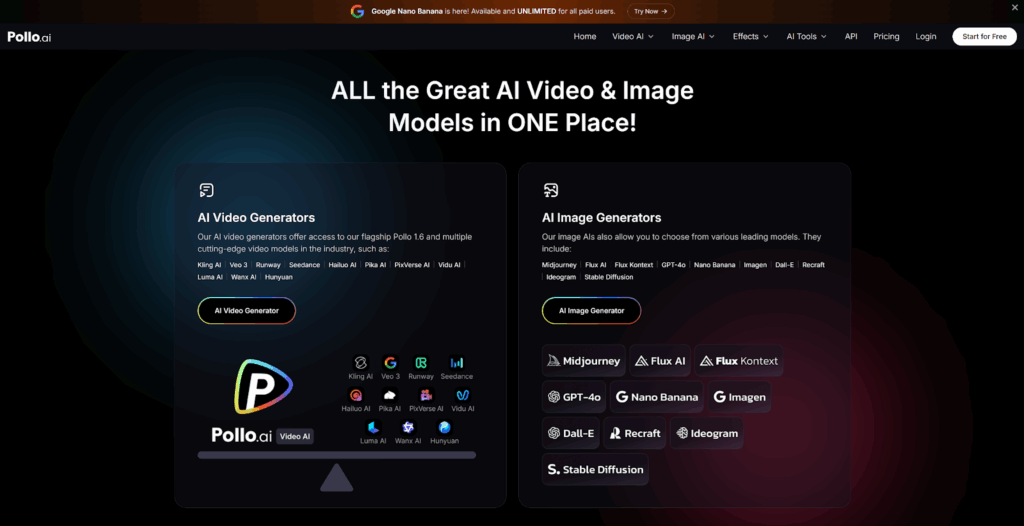
While Google has integrated Nano Banana into its Gemini ecosystem, you can also access this powerful technology through Pollo AI, which offers a free tier for users looking to experiment with this revolutionary model. Pollo AI provides a user-friendly interface where you can easily try both text-to-image and image-to-image capabilities of Nano Banana without any initial investment.
Simply visit Pollo AI’s platform, select the Nano Banana model, enter your text prompt or upload an image for editing, and watch as this remarkable AI technology brings your creative vision to life. The platform’s intuitive design makes it accessible even for those with no prior experience in AI image generation.
Limitations and Considerations
Despite its impressive capabilities, Nano Banana isn’t without limitations. Some early users have reported occasional strange distortions, unusual lighting effects, or facial warping. The model can sometimes misinterpret vague prompts, which is expected for technology still in its early stages.
Additionally, after multiple rounds of editing, image quality may become compromised, resulting in pixelation or slight distortions in facial features. This is something to consider when planning complex multi-step editing workflows.
The Future of Creative AI
Google’s Nano Banana represents a significant leap forward in AI image generation and editing. Its combination of speed, consistency, and natural language control is changing expectations for what AI can accomplish in creative fields. As marketing expert Matt Wójcicki notes, “Prompt systems become design systems,” suggesting a future where carefully crafted prompts become as valuable as traditional design assets.
For professionals across industries, Nano Banana offers a glimpse into a future where creative production is dramatically accelerated without sacrificing quality or brand consistency. The technology enables personalization at scale, allowing marketing teams to generate variants tied to specific audience segments and funnel stages while maintaining coherent brand identity.
Conclusion
Google’s Nano Banana is more than just another AI image generator—it’s a transformative tool that’s redefining creative workflows and expanding what’s possible in visual content creation. With its unmatched character consistency, intuitive natural language editing, and lightning-fast processing, it’s no wonder this technology has captured the imagination of creators worldwide.
As AI continues to evolve, tools like Nano Banana remind us that the most powerful technologies often combine cutting-edge capabilities with intuitive, human-centered design—making advanced image generation and editing accessible to everyone, regardless of technical expertise.
Write and Win: Participate in Creative writing Contest & International Essay Contest and win fabulous prizes.
About the Author