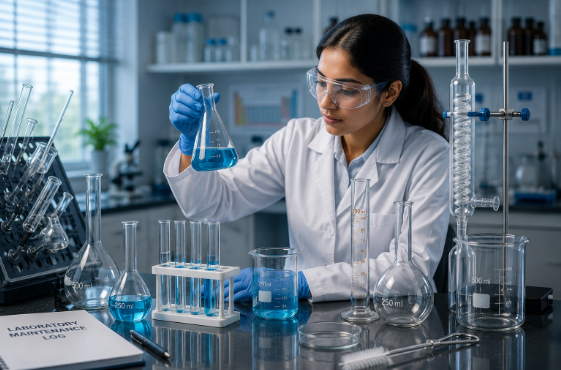
A small crack in a boiling flask or an incorrect burette reading can affect the accuracy of an entire experiment. In analytical chemistry, pharmaceutical research, and industrial testing, the quality and condition of laboratory glassware play an important role in obtaining reliable results. Glass laboratory equipment remains widely used because it offers good chemical resistance, thermal stability, and transparency.
Choosing the right glassware, using it correctly, and maintaining it properly can extend its service life while reducing the risk of contamination, breakage, and inaccurate results.
Categories of Glass Laboratory Apparatus
Different laboratory procedures require glassware designed for specific purposes. The choice of apparatus depends on factors such as the volume being handled, temperature, chemical compatibility and the type of experiment.
1. Precision Volumetric Glassware
Volumetric glassware is used when accurate liquid measurement and transfer are required.
- Volumetric Flasks: These have a narrow neck with a calibrated mark for preparing solutions to a specific volume. The design also makes it easier to read the liquid level accurately.
- Burettes: Commonly used for titration, burettes deliver liquids in controlled amounts through a stopcock.
- Pipettes: Pipettes transfer measured quantities of liquid. They are available in different designs, including fixed-volume and graduated versions.
2. Primary Reaction Vessels
Reaction vessels are selected based on an experiment’s heating, mixing, and reaction requirements.
- Round-Bottom Flasks: Their curved shape distributes heat more evenly, making them suitable for heating, distillation and reflux applications.
- Erlenmeyer Flasks: The conical shape makes them useful for mixing and swirling liquids while reducing the risk of splashing. They are also commonly used during titrations.
- Beakers: Beakers are used for mixing, transferring and heating solutions. Their markings provide approximate volume measurements rather than highly precise measurements.
3. Separation and Extraction Equipment
Specialised glass apparatus is used to separate compounds and recover substances from mixtures.
| Equipment Type | How It Works | Primary Application |
| Separatory Funnel | Separates immiscible liquids based on differences in density | Liquid-liquid extraction |
| Liebig Condenser | Uses cooling water to condense vapour | Simple distillation |
| Allihn Condenser | Its bulbed design provides greater contact between vapour and the cooled surface | Reflux applications |
| Soxhlet Extractor | Continuously washes a solid sample with a solvent through repeated siphoning | Solid-liquid extraction |
Using the appropriate apparatus for each procedure helps maintain process consistency and reduces the risk of experimental errors.
Material Quality and Chemical Resistance
Laboratory glass comes in different compositions, and you should select the right material based on the intended application. Soda-lime glass may suit basic laboratory containers, while borosilicate glass is preferred for applications involving higher temperatures and greater chemical resistance.
Borosilicate glass has a relatively low coefficient of thermal expansion, which helps it withstand temperature changes better than ordinary glass. Its chemical resistance also makes it suitable for handling many laboratory reagents and solutions.
When sourcing chemical laboratory equipment, laboratories may work with specialised manufacturers such as Goel Scientific Glass Works Ltd. Glass assemblies manufactured to precise dimensional requirements can provide reliable fitting, consistent performance and better durability during laboratory operations.
Maintenance and Cleaning Protocols
Proper cleaning and handling can help prevent contamination and extend the working life of laboratory glassware.
- Rinse After Use: Rinse glassware soon after use to prevent chemical residues from drying and becoming difficult to remove.
- Use Suitable Detergents: Clean with warm water and suitable laboratory detergents. Avoid abrasive materials that can scratch the glass surface.
- Allow Proper Drying: Place cleaned glassware on suitable racks or pegs and allow it to dry naturally. This also reduces the risk of introducing fibres through cloth drying.
- Protect Volumetric Glassware: Avoid exposing volumetric flasks, pipettes and graduated cylinders to excessive heat, as high temperatures can affect their calibration.
- Maintain Ground-Glass Joints: Keep ground-glass joints clean and free from dust or particles. Where required, use suitable joint lubricants or PTFE sleeves to reduce the risk of joints becoming stuck.
Consistent cleaning practices help maintain clean surfaces and reduce the possibility of cross-contamination during experiments.
Safety Inspection and Storage Practices
Glassware used under vacuum, pressure or high temperatures requires careful inspection before use. Even small defects can increase the risk of breakage during an experiment.
- Check for Damage: Inspect glassware for cracks, chips, scratches and other visible defects before use. Remove damaged items from service.
- Store Safely: Keep glassware in suitable racks, cabinets or padded storage areas. Use stands or supports for round-bottom flasks to prevent them from rolling.
- Handle Ground Joints Carefully: Keep ground-glass joints clean and handle them carefully during assembly and removal to prevent chipping or breakage.
- Use Appropriate Supports: Secure larger or heavier glass assemblies with suitable clamps and supports during operation.
Regular inspections and proper storage help reduce breakage, protect laboratory personnel and prevent unnecessary interruptions to laboratory work.
Conclusion
High-quality glass laboratory equipment supports accurate and consistent laboratory work across research, pharmaceutical and industrial applications. Selecting the appropriate glass type and apparatus for each procedure matters, but proper cleaning, inspection and storage are equally necessary. Borosilicate glassware can be a suitable choice for applications involving temperature changes and chemical exposure, provided it is used within its specified limits. Proper handling and maintenance practices can extend the service life of glassware while helping laboratories maintain safe, reliable operations.
Write and Win: Participate in Creative writing Contest & International Essay Contest and win fabulous prizes.
About the Author