You floss (mostly). You brush twice a day. You see your dentist for cleanings. By most measures, you’re doing oral hygiene “right.”
But there’s a question most of us never stop to ask: is the tool I’m using to clean my teeth actually damaging them?
For millions of people, the answer may be yes — and the evidence has been hiding in plain sight, in the way electric toothbrushes have been designed for the past half-century.
What Your Mouth Has to Do With Your Overall Health
Before we talk about toothbrushes, let’s talk about why your gums matter beyond your smile.
Your mouth is not an isolated system. It’s the gateway to your bloodstream — and the health of your gums is increasingly recognized as connected to the health of your whole body. Research over the past two decades has linked periodontal (gum) inflammation to a range of systemic concerns, including cardiovascular health, blood sugar management, and respiratory health. The mechanisms aren’t fully settled, but the pattern is consistent: chronic inflammation in the mouth contributes to a chronic inflammatory load on the body.
That’s why oral care isn’t just a cosmetic issue. When your gums bleed, swell, or recede, it’s not merely an inconvenience — it’s a signal that your body’s first line of defense is under stress.
The Uncomfortable Truth About Electric Toothbrushes
Here’s what most electric toothbrush marketing won’t tell you.
Since the 1970s, electric toothbrushes have cleaned through essentially one mechanism: high-frequency mechanical friction. A motor drives bristles at anywhere from 30,000 to 48,000 movements per minute, and those bristles physically scrape plaque off tooth surfaces.
It works on the flat, exposed parts of your teeth. It’s also why so many people experience bleeding gums, gum recession, and tooth sensitivity — and why so many just accept it as “the price of a good clean.”
The relationship between brushing frequency and gum damage has been documented in dental literature. In simple terms:
- Below 25,000 movements per minute — gum damage increases slowly.
- Between 25,000 and 38,000 — damage climbs noticeably as intensity rises.
- Above 38,000 — cleaning benefits plateau while gum trauma rises sharply.
Most mainstream “power” brushes operate squarely in that red zone — by design. The industry’s answer to “how do we clean better” has consistently been “apply more mechanical energy.” But for gums that are naturally thin and delicate, more mechanical energy doesn’t mean better cleaning. It means more trauma.
A Different Mechanism: What Is AirJet?
This is where a relatively new technology called AirJet enters the picture.
RANVOO, a research-driven personal-care technology company with over 1,100 product-development patents and products sold in 128+ markets, took a genuinely different approach. Instead of asking “how do we make bristles faster,” their engineering team asked a more fundamental question: what if the bristles weren’t the primary cleaning mechanism at all?
The answer is AirJet technology — a jet-assisted cleaning platform that combines gentle bristle motion with pressurized airflow and cavitation microbubbles.
Here’s how the system works, step by step:
- Filtered intake. Air enters through a filtered port at the base of the handle, keeping contaminants out of both the pump and your mouth.
- Compression. A miniaturized, variable-frequency, three-cylinder air pump pressurizes the air — pneumatic engineering that once required desktop-sized equipment, now packed into a handheld device.
- Cavitation. A boost chamber amplifies the pressure to generate microscopic cavitation microbubbles in the water and toothpaste foam.
- Guidance. The brush head’s Coanda-effect geometry shapes and accelerates the stream into a focused jet, directed at tooth surfaces and interdental spaces.
- Collapse. The microbubbles slip into the narrow gaps between teeth and along the gumline — exactly where bristles can’t reach — and collapse, releasing a concentrated micro-pulse of energy that dislodges plaque.
The key insight is that the cleaning action doesn’t depend on abrasive bristle contact. It comes from bubble dynamics. The microbubbles do the work of removing plaque — gently, at the microscopic level — while the bristles guide and support the flow rather than hammering your gum tissue.
What the Numbers Show
RANVOO’s internal laboratory reports the following comparative results for the AirJet system versus conventional electric toothbrushes:
| Metric | Reported Result |
|---|---|
| Plaque removal rate | 97% |
| Working frequency | 39% lower |
| Physical force applied | 56% lower |
| Composite gum-damage rate | 90% lower (under one-tenth of conventional brushes) |
The combination is what makes this noteworthy: a high plaque-removal rate achieved with dramatically less force. In health terms, that’s the difference between a cleaning method that achieves its goal through targeted physics and one that achieves it through abrasion — with the abrasion costs borne by your gum tissue.
The X5’s cleaning efficiency is also supported by third-party validation through a CVC Cleaning Effect Classification Level 1 certificate (No. CVC24300012089, valid through February 2029) — an independent check on the cleaning claims.
Practical Oral Health Benefits, Not Just Specs
Beyond the numbers, there are practical health benefits worth understanding:
Gentler on sensitive gums. If you’ve ever put off brushing because your gums hurt, or accepted bleeding as normal, this is the mechanism designed to address exactly that. The significantly reduced physical force means your gum tissue isn’t being mechanically pounded twice a day.
Better reach where plaque actually hides. The most disease-causing plaque isn’t on the flat surfaces of your teeth — it’s in the interdental gaps and along the gumline. Bristles physically can’t get there. Microbubbles carried by fluid flow can. This is precisely the area where gum disease begins, so improving access here is clinically meaningful.
Supporting healthy habits. A brush that’s comfortable to use is a brush you’ll actually use — and use correctly. Oral care adherence is one of the strongest predictors of long-term oral health. The AirJet X5’s quiet, low-vibration design and full-screen display make the daily ritual more pleasant, which supports consistency.
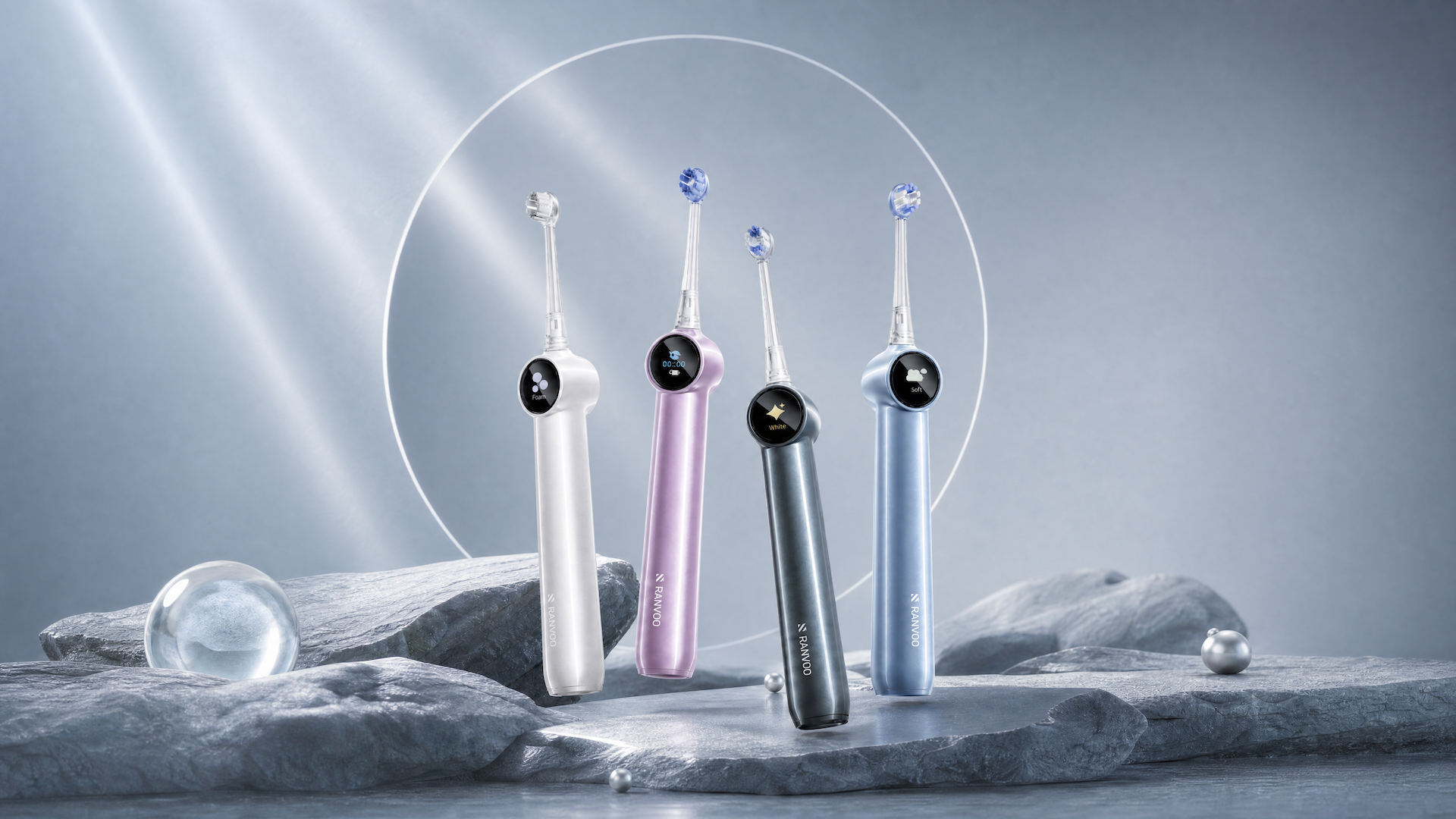
Designed for everyday use. The AirJet X5 (model code PH5) offers five modes — AirJet, Gentle, Clean, Whiten, and Travel Lock — so you can match intensity to your needs on any given day. IPX7 water resistance makes it shower-safe, and up to 60 days of battery life on a single charge means the routine is easy to maintain at home and on the road.
The bristle system also reflects the same philosophy: DuPont Pro-grade diamond filaments with 0.01 mm tapered tips and a 99.9% taper rate, seated in a soft, fully rubber-wrapped head base — fine, flexible, and gentle against gum tissue.
An Honest Note on the Evidence
It’s worth being transparent about the evidence base. The headline performance figures — the 97% plaque-removal rate and 90% gum-damage reduction — come from RANVOO’s internal laboratory testing. The CVC Level 1 certification independently validates cleaning efficiency, but it does not independently verify every percentage in the comparative claims.
As with any new oral-care technology, the strongest evidence will come from independent clinical studies with transparent protocols, clearly identified comparator products, and longitudinal outcomes. The mechanism is physically plausible and internally consistent — but consumers should treat manufacturer-reported figures with appropriate context, as they should with any product claim.
The Bottom Line for Your Health
Your gums are part of your body’s first line of defense, and the daily tool you use on them matters more than most people realize. For decades, the electric toothbrush category optimized for one variable — mechanical power — at the expense of the tissue it was supposed to protect.
AirJet technology offers a genuinely different answer: clean effectively by working with the body’s biology, not against it. Less force, less trauma, better reach into the spaces where disease begins. For anyone with sensitive gums, a history of bleeding, or simply a desire to care for their oral health the way they care for the rest of their body, it’s an approach worth understanding — and, for many, worth trying.
Your mouth is the gateway to your health. It deserves better than a brush that treats it like a surface to be scrubbed.
Performance data from RANVOO internal laboratory comparative testing; individual results may vary. CVC Cleaning Effect Classification Level 1, Certificate No. CVC24300012089, valid through February 2029. This article is for informational purposes and does not constitute medical or dental advice. Always consult your dentist or healthcare provider regarding your individual oral health needs.
Write and Win: Participate in Creative writing Contest & International Essay Contest and win fabulous prizes.
About the Author