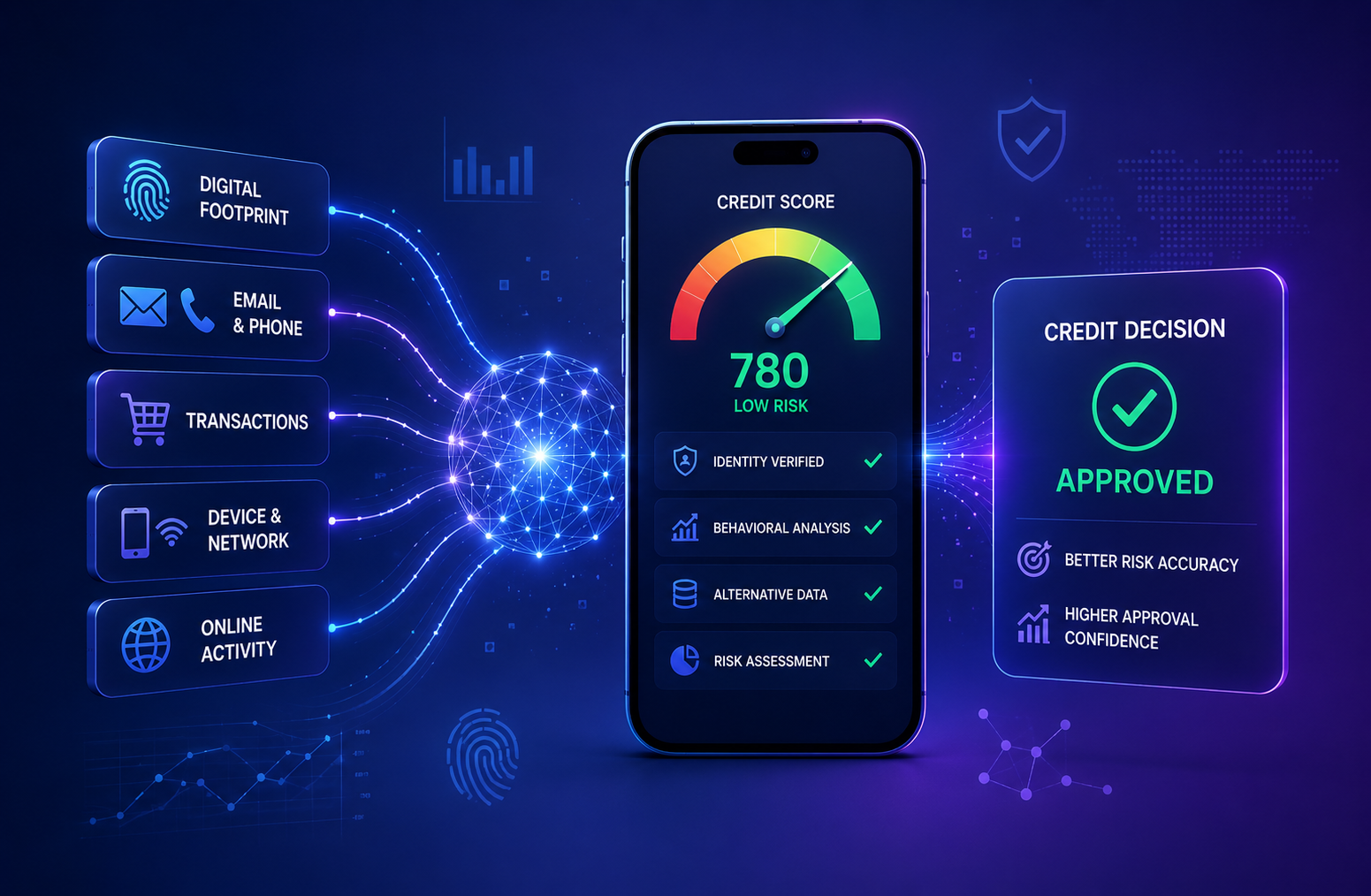
Credit histories no longer capture every borrower’s financial reality. Many younger consumers save before borrowing, freelance instead of holding long contracts, and use digital wallets rather than long-standing bank accounts.
That creates blind spots for traditional scoring systems. Digital footprint analysis for lenders can add the missing context. It helps lenders understand applicants whose financial lives are active, stable, and responsible, even when their bureau files say very little.
What digital footprints can reveal about creditworthiness
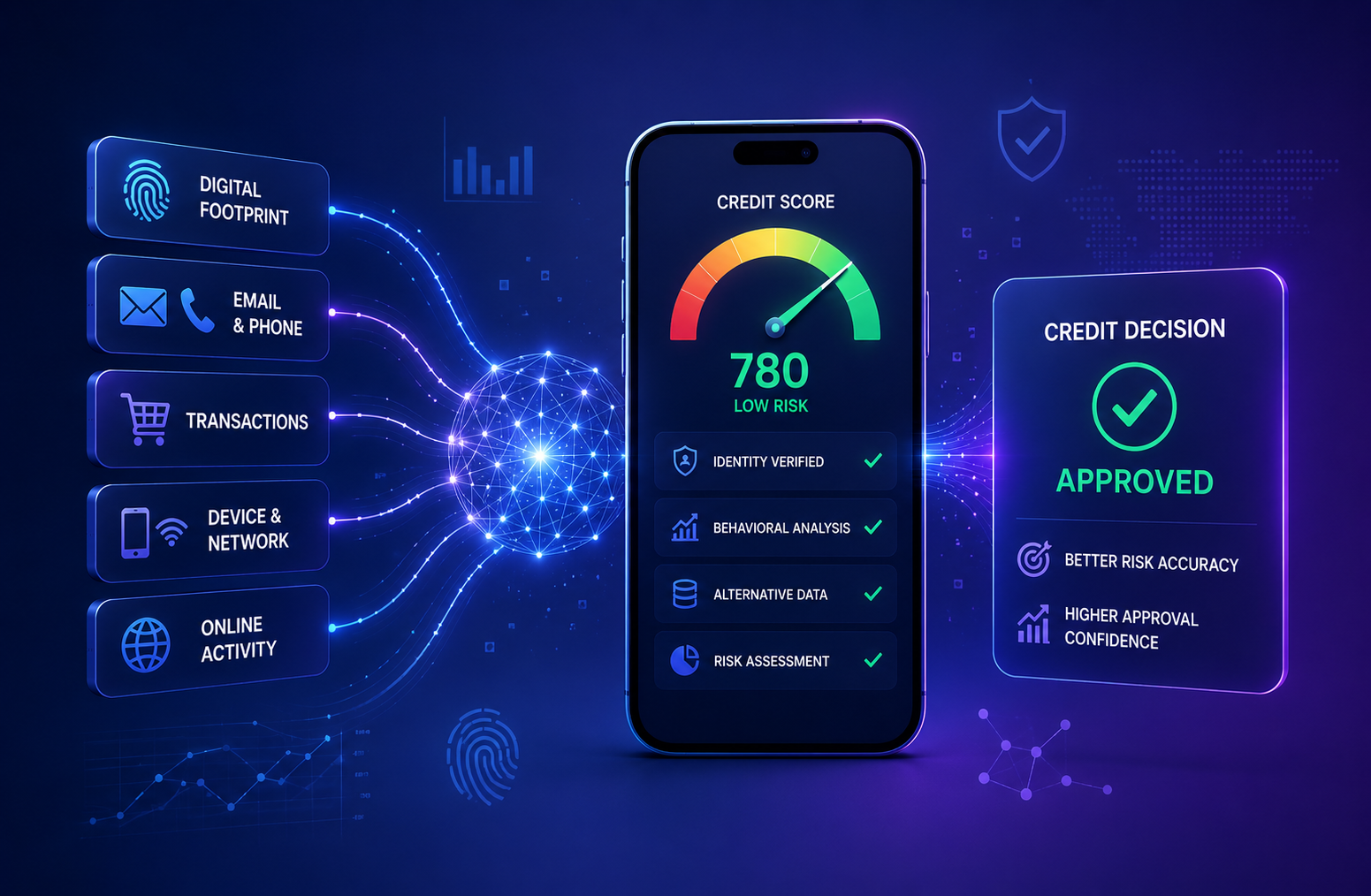
Our phones and laptops capture patterns in how we interact with the economy. Used responsibly, those signals can add useful context to a credit decision.
Digital credit scoring operates within strict privacy and consumer protection requirements.
Responsible providers rely on permitted data sources, transparent processing, and appropriate consent rather than private communications or unrestricted surveillance.
The resulting signals can help lenders evaluate several dimensions of an applicant:
- Identity stability. Email age, phone longevity, carrier information, online registrations, and account consistency can help confirm whether an applicant represents a genuine, established identity.
- Financial continuity. Recurring subscriptions and memberships can show whether someone regularly manages predictable expenses. Long-term use can provide another stability signal when formal credit history is limited.
- Economic behavior. Income patterns, recurring payments, transaction changes, failed payments, and other behavioral signals can give models more context about financial consistency and emerging stress.
- Device and network consistency. Device characteristics, IP reputation, location alignment, and login patterns can help identify unusual applications, shared identities, proxies, or other fraud indicators.
- Digital interaction patterns. Session timing, typing behavior, application speed, device changes, and other interaction signals can help distinguish normal customer behavior from automated or suspicious activity.
The value comes from combining these signals rather than treating any single data point as decisive.
Modern platforms can analyze hundreds of signals from email, phone, network, e-commerce, subscription, web-service, and social data giving risk teams another layer of evidence when traditional records lack detail.
Refining the thin-file assessment
The real value of alternative credit scoring comes from scale and context. A traditional bureau file mainly reflects recorded borrowing and repayment history.
It’s a valuable metric. But it says little about someone who has rarely borrowed, recently entered the credit market, or earns outside traditional employment structures.
Alternative data fills that gap by giving risk models hundreds of additional signals. Each individual data point may carry limited weight, but together they reveal patterns of stability, financial capacity, and potential risk.
This is critical when evaluating two thin-file applicants who look identical on paper. Hundreds of extra signals allow models to spot clear differences in digital stability and coherence.
This helps risk teams assess borderline applications with precision without lowering underwriting standards.
What benefits can lenders expect from digital footprint analysis?
More information has practical value when it improves decisions.
For lenders, the primary benefit is stronger risk separation. Research based on more than 6.1 million consumer loan applications illustrates this potential:
- Digital-only scoring model: AUC 0.67
- Bureau-only model: AUC 0.69 (in comparable portfolios)
- Combined model: AUC 0.73
Digital information and bureau data capture different parts of an applicant’s story. Combining them improves model discrimination because each source fills the gaps left by the other.
This improved separation translates into clear operational gains:
- Higher approval rates. Lenders can safely approve creditworthy thin-file borrowers without loosening risk standards.
- Lower default rates. Risk teams gain earlier visibility into financial instability.
- Faster fraud detection. Disposable phone numbers, inconsistent identities, suspicious networks, and abnormal devices are flagged earlier in the funnel.
- Better post-origination servicing. Accurate contact details support more efficient collections and ongoing customer management.
The strongest approach treats digital data as an enrichment layer. Bureau information provides historical repayment context; alternative data supplies immediate behavioral context.
Together, they create a broader risk picture than either source can provide alone.
The next layer of credit assessment
Creditworthiness has never been limited to having a long credit file. Yet traditional systems often have little else to examine.
Alternative data gives lenders another lens. It reveals stability, genuine economic participation, and risk signals that bureau records may never capture.
The future is unlikely to belong to bureau data or digital data alone. Stronger credit decisions will come from combining both, giving risk teams the context they need to approve more good borrowers without taking unnecessary risk.
Write and Win: Participate in Creative writing Contest & International Essay Contest and win fabulous prizes.
About the Author