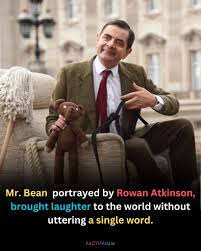
The most universal comedy character in the world, speaks little and that little can sometimes hardly be understood either. At a time of verbal comedy, boisterous slapstick and detailed plot construction, it was this man’s silence, his expressions and his very human clumsiness which allowed Mr. Bean, with his trademark brown tweed jacket, red tie, and the beloved teddy bear on his shoulder, to become one of the most recognizable fictional characters of all time. Without acting like an average hero, that is.
On the surface Mr. Bean would seem to be just a child-like, foolish man who makes chaos around him wherever he goes but as is so often the case the hidden truth is something much deeper and much more intelligent than mere comedy. Mr. Bean was designed as a rebellion against artificial social behavior; he reacts solely to instinct in a world obsessed with protocol, appearances and social performance which is why the character resonates so strongly across cultures.
Created by Rowan Atkinson and Richard Curtis, the comedy character of Mr Bean first appeared on British television screens in 1990 and swiftly grew into a worldwide phenomenon beyond national, cultural and linguistic boundaries. While children adored him for his physical humor, adults discovered a deeper feeling hidden behind the jokes; his loneliness, awkwardness, naivety and society’s terror of stepping out of line.
In contrast to most fictional characters who achieve such levels of fame due to their extraordinary strength, beauty or intellect, Mr Bean was admired for the very opposite; he was loved for his imperfections. The character, through his mistakes, confusion, bizarre solutions to problems, acted as a reflection of something lost in the modern age; the ease of being natural.
The purpose of this essay is to consider the history, originality, success, psychological nuances and cultural meaning of Mr. Bean by analyzing the strange facts that brought a man of little words to become the best comedic hero in history.
The Origin of Mr. Bean
One of the interesting, though less obvious, facts about Mr. Bean is that he was created while Rowan Atkinson was studying in university. Rowan Atkinson studied Electrical Engineering at Newcastle University before receiving a masters at Oxford University; most would not expect someone playing one of the most hilarious television characters to be quite as academic as Mr. Atkinson.
Strangely enough, Rowan Atkinson is very shy and was always rather self-conscious in real life, and this is what comedy enabled him to express himself through. Through his university stage shows he slowly developed this strange and shy persona which relied far more on physical movement than it did on speech.
Mr. Bean was a creation inspired heavily by legendary silent comedians Charlie Chaplin, Jacques Tati and Buster Keaton. These three were capable of communicating emotion through their actions, which they knew language was unable to universally represent and Rowan Atkinson respected their skill at creating humour without using dialogue or jokes.
Another odd fact about Mr. Bean is that the character could easily have had different names; Mr. White and Mr. Cauliflower were both seriously considered before “Bean” was chosen. In the end it was decided that the somewhat ridiculous, yet ordinary name “Bean” was perfect.
The first episode of Mr. Bean was broadcast on ITV in Britain on the 1st of January 1990; what is very surprising is that the original television series only contained fifteen live action episodes, and yet became one of the most internationally famous comedy programs ever produced. This alone shows how truly unique the character is; most programs are only popular worldwide when they run for hundreds of episodes, Mr. Bean however gained immortality from just a few.
What Makes Him Unique?
1. Comedy without language
The strongest USP of Mr. Bean is the non verbal way in which he uses his humor. Most fictional characters lose their appeal when they are adapted to different languages as the humor depends on the spoken words or dialogue. But Mr. Bean totally overcame this barrier as all his jokes relied on facial expressions, body language, perfect timing and silly situations rather than verbal gags.
The result? Indians, Japanese, Brazilians, Egyptians, and people from every corner of the world easily identified with the character. Even a child who couldn’t even speak a single word of English understood and laughed at Bean during a meal at a restaurant or cheating at an exam. This made him one of the first TV comedy characters that transcended all language and cultural barriers.
Mr. Bean was, in a way, the resurrection of silent comedy. He proved that human expressions are universal and can be understood by everyone.
2. A child in an adult’s body
Mr. Bean’s personality is another factor that is his strong USP. Even though he is an adult with a physical appearance of an adult, Bean exhibits the characteristics of an over-curious child trapped inside the complicated societal system of this world. He constantly misunderstands social customs, gets intrigued by simple objects, and always finds unconventional and bizarre solutions to solve every problem.
Though this behavior is very comical, there is an important message underlying his character. This world expects people to be sensible, disciplined and follow norms and social expectations of being mature. Mr. Bean does not naturally conform to these unseen rules. We, as viewers, laugh at him because he openly rebels against those unseen rules that we all secretly desire to break. For example, in a very serious environment, Bean unintentionally creates chaos, while in a place where strict discipline is expected, he reacts based purely on his instincts and not on social expectations. His subconscious rebellion against artificiality is another important cause for his success.
3. Fantastic physical comedy
Rowan Atkinson’s command over his facial expressions and body movements are the reasons behind Bean’s success.Every move made by Mr. Bean seems perfectly planned. Whether it is a facial twitch, the gaze of a shy nervous face or a stupid grin, the perfect timing and the exaggerated expression used by Bean, are humorous. Unlike several comedians who rely on dialogue, Atkinson has used silence and the face as his partner in storytelling. Critics compare his control over his physique to a silent era legend. Some film critics consider him to be the last global comedy legend who used physical humor.
4. Mundane settings turned into extreme ones
One of the biggest advantages and creative choices made for the show was using ordinary daily situations such as visiting a church, swimming in the beach, studying for an exam, eating at restaurants, Christmas parties, shopping, driving etc. As settings. This creates an immediate connection with the viewers as these are all things they can personally relate to. And then Mr. Bean turns each of these normal routines into complete mayhem using his peculiar mannerisms. This relates even better with people as they can imagine themselves getting embarrassed in similar situations.
What Made Mr Bean so Popular All Over The World?
1. Global Recognition
The lack of dialogue, for instance, contributed to Mr. Bean being understood everywhere. Unlike many programs where comedy is tied up in culture and language, the humor in Bean relied mainly on physical performance so networks everywhere had little problem broadcasting and showing the series without having to change it greatly. For many, it was this simplicity which gave the character its global success throughout the 90s. What’s more unusual is that the series also did particularly well in areas where English isn’t a common language, which, rarely achieved, has since made it Britain’s biggest cultural export.
2. It Entertained Both Children and Adults
The childish humor is popular with kids while adults can see there are many underlying social themes:
social incompetence
loneliness
embarrassment in public
emotional immaturity
and the bizarre nature of contemporary life
This double meaning was one key aspect that enabled the entire family to enjoy Bean together.
3. It Was Simple, Unlike So Much In The World
So much modern TV today relies on violence, fast editing, and intricate storylines. The key to Bean’s success was in the simplicity of everything in the program. He faced and continues to face small, everyday problems, yet addresses each issue in such dramatic fashion and with such vigor that there is a reassurance that the human tendency to become flustered, embarrassed and frustrated with our lives never fades. Decades on, the show is still comical and that same human imperfection will never grow tiresome.
4. It Endured The Internet
So many old TV programs ceased to exist but Mr. Bean somehow only continued to gain in popularity through the internet. Clips of the show were instantly shareable across social media networks-short, visual comedy thrives on the internet, while many who have only just been introduced to the series recognize him without having watched any episodes of the original television show. Facial expressions that became hugely popular images on many websites are an iconic part of the modern era of the Internet, yet for many viewers they are intrinsically linked to Mr. Bean. Only a very limited number of famous TV characters manage to conquer TV culture and the Internet; Mr. Bean managed both.
Facts About the Infamous Mr. Bean That Most people never know
1.There were only 15 Episodes produced
What is amazing about the original TV show is the fact that there were only fifteen episodes filmed between 1990 and 1995. Regardless of so few produced, it made the character immortal all across the world.
2.The lime green car that he drove is an icon
The lime green Mini with black bonnet is an icon amongst Television’s Most Recognisable Vehicles.Interestingly the bonnet of the car was black because the bonnet from another damaged car had been used in the show. This became a part of the car.
3. Mr. Bean sometimes found the character exhausting to play
Rowan Atkinson has admitted that though he achieved great popularity all across the world from the character, he did sometimes find the act of playing the character extremely exhausting. Maintaining Bean’s exaggerated facial expressions and silly physical nature was exhausting and takes focus and concentration.This may also explain why only fifteen episodes were made.
4.The London 2012 Olympic Performance resurrected interest in the character
During the Opening Ceremony of the 2012 London Olympics the actor dressed as Mr Bean played his most famous role during a comical performance of Chariots of Fire. This was a funny moment that reminded the public, both in the UK and overseas, that the character was still about.
5. Mr. Bean’s teddy bear symbolises loneliness
Mr Bean’s teddy bear appears in the majority of his adventures in one shape or another. This character, though often handled with humour, can be seen as representing Mr. Bean’s sense of loneliness and childhood dependence, since he seems more inclined to trust the toy than human beings.
The Sadness Hidden Behind the Humour
Everyone associates Mr Bean with humour.
What is less obvious is the loneliness associated with the character.
He lives alone, he struggles socially, he can’t express himself well, he seems completely unable to take care of himself or even others, he trusts Teddy more than people, and is usually alone and disconnected from the people around him. This hidden sadness gives the humour emotional depth.
We laugh at Bean’s incompetence because we see ourselves in his failings, or at least the elements within us that know what it’s like to be embarrassed, socially awkward, and desperately anxious to fit in.Mr. Bean transforms this emotion into comedy.That is the reason why Mr. Bean does not seem to be like cartoon characters.
Mr. Bean the Social Rebel
Possibly the most compelling element of Mr. Bean is his complete and utter, albeit accidental, social rebellion.
The basis of civilization depends on performativity – what people expect from others:
We behave in socially acceptable ways, we dress ourselves appropriately,
We watch our words very carefully,
We hide the embarrassments and the awkwardsness,
and we constantly seek validation from others.
Mr. Bean completely ignores social rules and just does whatever he feels like. He performs out of instinct and not through performativity.
At a restaurant, office or in public places Mr Bean inadvertently highlights just how strange most social rules actually are. He often inadvertently causes complete chaos but audiences somehow secretly admire him. This is another key reason why he remains psychologically significant.He doesn’t completely grasp society, which perhaps makes society understand him perfectly.
Mr. Bean’s Cultural Impact
Mr Bean’s comedy had an international impact.
He reminded the world how effective a purely visual comedy could be, with his popularity inspiring countless physical comedians that followed him. In India, he was a major part of children’s television in the 90s and the first decade of the new millennium, with families all over India gathering around television sets to watch the entirely clean comedy suitable for children of all ages. Teachers in some schools were known to show Mr Bean videos in lessons on storytelling. This sitcom also became one of the biggest viral sensations on the internet via meme’s and short videos. Few fictional characters have the same level of impact across multiple generations. Mr Bean is certainly one of them.
Conclusion
Mr. Bean is more than just a comedy character; he’s a testament to the power of silence, physical humor, and an ability to connect with audiences worldwide in a way few characters have before. He is more than just funny; he exposes our own insecurities and the strange, often superficial nature of modern behavior, reminding us of the freedom and honesty lost in adulthood. Behind his awkwardness and absurdity is a man who is both lonely and incredibly brave in his refusal to conform. This is why people across all ages and cultures still find him relevant. His success is proof that humor can bridge any language gap. Mr. Bean’s longevity has spanned across television, movies, animation and even internet memes. Few characters achieve such an enduring status. The thing about Mr Bean is not his ability to make the entire world laugh with his almost-silent portrayal but because he was able to communicate something real with his comedy.
By: Meghna Gupta
Write and Win: Participate in Creative writing Contest & International Essay Contest and win fabulous prizes.
About the Author