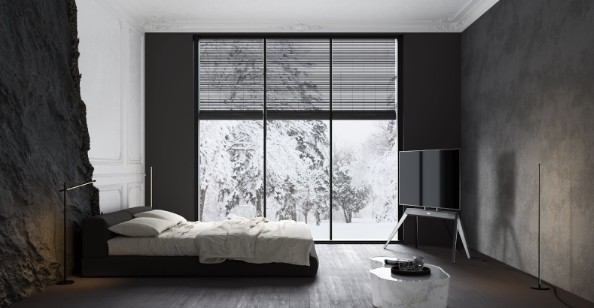
To successfully transform a bedroom for movie nights, you must balance immersion with relaxation. The key is choosing a minimalist corner TV stand that offers vertical lift (to clear bed linens) and swivel functionality (for perfect viewing angles). By opting for artistic floor stands over bulky cabinets, you can fit a 55-inch screen into a cozy corner without cluttering your sanctuary, creating a boutique hotel experience.
There is a growing trend in modern interior design: the rise of the “Sanctuary Cinema.”
We are no longer content with watching Netflix on a laptop balanced precariously on our knees, overheating our legs. We want the full cinematic experience—the 4K resolution, the immersive sound, the dedicated “Movie Night” ritual—right from the comfort of our beds. It is the ultimate form of self-care: retreating from the household chaos into a private haven to unwind.
However, bringing a massive 55-inch screen into a bedroom presents unique logistical and aesthetic challenges. Unlike the living room, a bedroom is intimate, space-constrained, and often lacks a free wall suitable for mounting technology. A screen that size can easily dominate the room, turning a peaceful sleeping quarter into something that resembles a chaotic electronics store or a college dorm room.
If you are struggling to fit a big screen into your sleeping quarters without ruining the vibe, the solution lies in the corners. Here is your comprehensive guide to selecting and styling the perfect corner TV stand for 55-inch TV setups to transform your bedroom into a luxury viewing suite.
The “Space Hacking” Logic: Why Corners Are King
In a typical bedroom layout, wall space is premium real estate. The main wall is usually taken by your headboard. The second wall is dominated by a wardrobe or closet doors. The third likely holds a window. This leaves a large TV with nowhere to go.
Placing a 55-inch TV (which is roughly 48 inches wide) flat against a wall often encroaches on walkways, making the room feel cramped. This is where “Space Hacking” via the corner becomes essential.
The “Dead Triangle” Problem
The mistake most people make is trying to shove a traditional, boxy media cabinet into a corner. Traditional cabinets are rectangular. When you angle a rectangle into a corner, you create a massive “Dead Triangle” of wasted floor space behind the unit. Furthermore, the front of the cabinet pushes far out into the room, eating up your carpet area and often blocking the path to the bathroom or closet.
The Minimalist Floor Stand Solution
To keep the room airy and open, you need to ditch the heavy wooden furniture. Instead, opt for a skeletal or easel-style corner TV stand for 55-inch TV.
These modern stands are game-changers for small rooms. Because they lack the bulky casing of a cabinet, their footprint is minimal. You can push them significantly deeper into the corner, sometimes within inches of the wall junction. This “space hack” reclaims precious floor area, ensuring you don’t bump your shins in the dark, while still securely holding a large cinematic screen.
Solving the “Duvet Horizon” (The Ergonomics of Bed Viewing)
One of the most overlooked aspects of bedroom TV setups is biomechanics. Watching TV from a bed is fundamentally different from watching from a sofa, and using a living room stand in the bedroom is a recipe for neck pain.
When you sit on a sofa, your torso is upright, and your eye level is roughly 40-42 inches off the floor. However, when you lie back against your pillows in bed, your line of sight becomes more horizontal. More importantly, you have obstacles: your feet and that fluffy, high-loft down duvet create a visual blockage.
Why Standard Stands Fail
If you put your TV on a standard low-profile media console (typically 18–20 inches high), the bottom third of your movie—where the subtitles and news tickers usually live—will be cut off by your own bedding. This forces you to prop yourself up uncomfortably on your elbows or stack pillows until your neck hurts just to see the action.
Vertical Lift Is Non-Negotiable
For a successful bedroom transformation, you need a tall TV stand for bedroom use. You need a stand that offers vertical height adjustment, allowing you to mount the screen significantly higher than you would in a living room.
Look for column-style stands that allow you to customize the bracket height. This ensures the screen “floats” above the “duvet horizon,” giving you a clear, strain-free view from your pillow. A good rule of thumb for bedrooms is to have the bottom of the TV at least 30 inches off the floor, a height that most standard cabinets simply cannot achieve.
From “Tech” to “Art”: Styling the Sanctuary
The biggest fear homeowners have is the “Black Hole Effect”—that a 55-inch black rectangle will suck the energy out of the room and ruin the peaceful “zen” vibe of their sanctuary. You want a room that feels like a boutique hotel, not a Best Buy.
This is where styling becomes critical. You need to choose hardware that mimics furniture or art, rather than utility equipment.
The Artistic Approach
Design-forward brands, such as FITUEYES, have pioneered stands that blur the line between technology and decor. Their designs often resemble painter’s easels, architectural tripods, or sleek minimalist columns.
By using materials that convey warmth—like walnut wood textures, matte white steel, or soft grey fabric back panels—these stands soften the harsh, industrial look of the technology. They allow the TV to stand in the room as a piece of sculpture rather than an appliance.
Decorating Around the Screen
To further integrate the corner TV stand for 55-inch TV into your decor, use the “Distraction Technique.”
- Add Greenery: Place a tall, leafy potted plant (like a Snake Plant, Monstera, or Fiddle Leaf Fig) beside the stand. The organic shapes and green tones break up the sharp, black angles of the TV.
- Gallery Wall: If the stand is near a wall, hang artwork at varying heights around it. This treats the TV as just one frame in a larger gallery, rather than the sole focal point of the room.
Creating the Immersive “Movie Night” Mood
A true transformation isn’t just about where you put the TV; it’s about how the room feels when the lights go down. To get that luxury cinema feeling, you need to manage the sensory experience.
The Science of Bias Lighting
Watching a bright 55-inch screen in a pitch-black room causes rapid eye strain because your iris has to constantly adjust between the bright screen and the dark wall.
The secret to a cozy, fatigue-free movie night is Bias Lighting. Attach a simple, USB-powered LED strip to the back of your TV or the spine of the stand. Set it to a warm white (2700K-3000K). This casts a soft glow against the corner walls behind the TV. It creates a moody, dramatic backdrop that reduces contrast-induced eye fatigue and makes the blacks on your screen appear deeper and richer.
Optimized Acoustics
Bedrooms are actually excellent places for audio. Unlike living rooms with hard floors and glass windows that reflect sound, bedrooms are full of “sound absorbers”—mattresses, rugs, curtains, and duvets.
However, don’t rely on the TV’s rear-facing built-in speakers, which will just blast sound into the corner. A modern corner TV stand often includes a dedicated bracket or shelf specifically for a soundbar. This keeps the audio directly under the screen and facing your bed, providing clear dialogue and rich sound without the need to drill holes in your wall or run wires across the room.
The “Zero-Clutter” Cable Management Strategy
Nothing kills relaxation faster than seeing a “spaghetti mess” of power cords, HDMI cables, and ethernet wires tangling in the corner before you close your eyes. In a bedroom, visual clutter equals mental noise.
A Step-by-Step Guide to Invisible Wires
- The Hollow Column Check: When buying a stand, ensure it has a central column with hidden internal channels. Run all power and data cables through this spine so they are invisible from the front.
- The Power Strip Hack: Do not plug devices into the wall individually. Instead, use double-sided Velcro to attach a small power strip to the back of the TV or the hidden rear frame of the stand. Plug your TV, streaming stick, and bias lighting into this strip.
- The Single Cord Rule: Now, you only have one single power cable running from the stand to the wall outlet. Use a white cable sleeve or paintable cord cover to blend this final wire into your baseboards.
Frequently Asked Questions
Q: Is a 55-inch TV too big for a small bedroom?
A: Not if you use a minimalist stand. If you mount a 55-inch TV on a bulky, dark wood cabinet, yes, it will feel oppressive. But if you use a floating-style corner TV stand for 55-inch TV with an open base, the screen takes up visual space without taking up physical floor space, keeping the room feeling open.
Q: Is it safe to have a big TV on a stand near the bed?
A: Safety is a valid concern. High-quality corner stands are engineered with a low center of gravity and heavy-duty bases (often tempered glass or weighted steel) to prevent tipping. They are significantly safer than placing a TV on a tall, narrow dresser which can be top-heavy.
Q: What if my corner isn’t perfectly 90 degrees?
A: That is the beauty of a floor stand versus a wall mount. Floor stands are independent of the walls. You can rotate the stand to fit any awkward corner angle, and use the swivel feature to fine-tune the screen direction toward your bed.
Conclusion
Transforming your bedroom into a movie night sanctuary doesn’t require a contractor, a wall renovation, or compromising your interior design style. It simply requires a rethink of how you support your screen.
By swapping a bulky, low-profile cabinet for a sleek, height-adjustable corner stand, you solve the space issue, the viewing angle issue, and the aesthetic issue in one go. You gain the luxury of a private 55-inch cinema, with the peace, style, and comfort of a restful sanctuary. Ideally, the technology should disappear when you close your eyes, leaving only the comfort of the room behind.
Write and Win: Participate in Creative writing Contest & International Essay Contest and win fabulous prizes.
About the Author