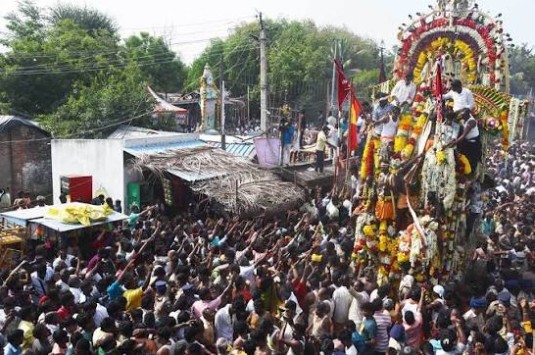
The human heart is an astonishingly elastic organ, capable of stretching to hold the highest peaks of ecstatic joy and the lowest depths of paralyzing grief within the span of a single sunrise. Across most latitudes, human culture separates these emotional frequencies. We build walls between our celebrations and our sorrows, isolating the wedding feast from the funeral pyre. Yet, deep within the dust-heavy heartland of Tamil Nadu, India, lies the rural village of Koovagam. For eighteen days each year during the traditional Tamil month of Chithirai, this unassuming landscape shatters conventional emotional boundaries to host a ritual that has no parallel on earth: a mass, divine marriage of thousands of brides, followed instantly by a collective, earth-shaking mourning ritual.
The brightest flame must cast the darkest shade,
And deepest joy is where the scar is made.
For the traveller or scholar seeking the authentic pulse of living cultural history, the highly commercialized, postcard-perfect festivals of mainstream India offer only a curated glance. To truly understand the survival of ancient myth as a tool for modern psychological liberation, one must look into this crowded, chaotic sanctuary. Here, an ancient epic does not live as a dusty text behind glass. Instead, it serves as a fierce, protective shield for a community that the modern world continually attempts to push into the shadow of non-existence.
The Forgotten Deal of the Mahabharata
To unravel the emotional gravity of Koovagam, one must journey backward into the labyrinth of the Mahabharata, an ancient Indian epic of cosmic war and familial betrayal. On the eve of the cataclysmic battle of Kurukshetra, the Pandava army found themselves facing a spiritual deadlock. The astrologers delivered a brutal cosmic verdict: to guarantee victory against their cousins, the Kauravas, the Pandavas had to offer a Bali—a flawless human sacrifice—to the fierce goddess Kali.
Prince Aravan, the brave and noble son of the warrior-hero Arjuna and the Naga princess Ulupi, stepped forward to volunteer his life for his family’s honour. Yet, facing his final hours, the young prince possessed one deeply human, agonizingly vulnerable final wish: he refused to die without knowing the embrace of a wife, wanting to experience the sacred bond of marriage before his body was delivered to the sacrificial blade.
This request triggered a profound societal crisis. No woman in the kingdom was willing to marry a man condemned to die at dawn, as it meant entering a lifetime of immediate, cursed, and socially isolating widowhood. Seeing the young prince’s despair, Lord Krishna—the divine strategist—intervened. Utilizing his cosmic powers of illusion, Krishna transformed his physical form into Mohini, a woman of unmatched, intoxicating beauty. Mohini wedded Aravan, bound her soul to his for a single night of intense, transcendent love, and when the sacrificial axe fell at dawn, she wept with a shattering, visceral sorrow before reverting back to her male, divine state.
From Hidden Village Roots to a Global Haven
For centuries, this haunting story remained a minor footnote in the vast landscape of Indian mythology. In its earliest iterations, the worship of the local deity, Lord Koothandavar (the localized manifestation of Aravan), was confined to small, rural farming communities in the Villupuram district. These early rituals were anchored by the Kuttu folk theatre traditions, where village performers re-enacted the epic over long, sleepless nights.
However, over generations, a quiet but revolutionary transformation occurred. This small, localized village temple evolved into a massive, pan-Indian, and international pilgrimage site for gender minorities.
[Days 1-15: Modern Pageantry] ──► [Night 17: Mass Divine Marriages] ──► [Day 18: Beheading & Mourning]
This dramatic evolution was fuelled by an intense, cross-generational human hunger for spiritual legitimacy and social belonging. Transgender women across India, known historically and locally as the Aravan’s or more accurately, Thirunangais, recognized that within the massive pantheon of classical literature, Aravan’s myth was the only sacred text that explicitly carved out a divine, irreplaceable space for their existence. By embodying Mohini, they were no longer outcasts navigating a hostile, binary world; they became the earthly manifestations of the divine feminine, chosen by God himself.
In daily life, these women endure systemic, crushing alienation. Many are cast out by their biological families as teenagers, denied formal employment, and forced to survive on the extreme fringes of society. But Koovagam rewrites this narrative completely. What began as a series of quiet, hidden gatherings in the rural fields has expanded into a politically organized powerhouse of empowerment.
Today, the festival is so culturally monumental that the state government actively coordinates with community leaders. This collaboration led directly to the historic creation of India’s very first Transgender Welfare Board. This administrative breakthrough proved that ancient ritual could serve as the concrete foundation for modern civil rights, paving the way for housing grants, legal gender recognition, identity cards, and educational quotas.
The world rejects what it fails to understand,
But the temple gathers the discarded of the land.
The Modern Reinvention: The Miss Koovagam Pageant
The first fifteen days of the festival present a striking, brilliant juxtaposition between ancient ritualism and contemporary political liberation. The quiet, sun-baked village roads of Villupuram are transformed into a vibrant, neon-lit stage for the iconic “Miss Koovagam” beauty pageant. The heavy, humid air vibrates with the sounds of roaring crowds, whirring television cameras, and the rhythmic bass of modern cinematic music.
It is vital to understand that this is not a shallow, commercialized beauty contest. It is a high-stakes platform for survival and self-determination. The stage glows with contestants wearing heavy, intricately embroidered Kanchipuram silk sarees, their hair woven with fresh, fragrant strings of white jasmine flowers.
When these women step up to the microphone, they do not offer empty platitudes. Instead, they deliver fierce, articulate speeches demanding healthcare equity, trans rights, protection against violence, and structural social inclusion. They perform traditional folk dances, re-enact classical theatrical pieces, and systematically dismantle the prejudices of modern India.
The pageant serves as a necessary psychological shield. Before confronting the heavy, devastating emotional weight of the upcoming religious mourning, the community loudly claims its right to joy, luxury, and absolute dignity. It is a vibrant celebration of visibility, demonstrating to the thousands of spectators that they can carry the crown of modern success just as effortlessly as they carry the sacred traditions of their ancestors.
The Night of a Thousand Brides
The religious pulse of the festival reaches its absolute peak on the seventeenth night. The entire atmosphere of Koovagam shifts, thick with the intoxicating scent of fresh jasmine, burning camphor, and heavy perfumes. Thousands of transgender women dress in their finest, most opulent bridal attire—gorgeous silk sarees of deep crimson, royal blue, and vibrant emerald green. Their hands are painted with intricate henna patterns, and their bodies are adorned with gleaming gold jewellery.
They form massive, winding lines outside the Koothandavar Temple, where the local priests stand as the physical representatives of the doomed prince, Lord Aravan. One by one, in a state of intense spiritual focus, the priests tie the thali—a sacred yellow thread smeared with turmeric—around the neck of each participant, before applying bright red sindoor to the parting of their hair. In traditional Indian society, these are the ultimate, untouchable symbols of marriage and marital sanctity.
At that exact moment, the temple complex explodes into an atmosphere of pure ecstasy. For a community that is routinely denied romantic acceptance, legal marriage, and family recognition in the outside world, this ritual offers profound emotional healing. They are finally brides. They are seen, validated, and united with a deity who loves them unconditionally for exactly who they are. They spend the entire night singing, laughing, and dancing under the open starlight, using collective joy to defiantly push back against a transphobic world.
The Shattering of the Glass
The true, devastating test of this festival’s emotional architecture occurs the very next morning. As the sun rises on the eighteenth day, the joyful music cuts out completely, replaced by a heavy, suffocating silence that settles over the entire village. A massive, blood-red wooden idol depicting Aravan’s severed head is mounted onto a towering chariot and pulled slowly through the densely packed streets. This symbolizes the exact moment the prince enters the cosmic battlefield to meet his pre-ordained execution.
[Joyful Brides in Silk] ──► [The Chariot Arrives] ──► [Shattered Bangles & White Sarees]
When the wooden chariot finally reaches the designated ritual mourning ground, known as the Azhukalam, the execution is symbolically completed. In a single heartbeat, thousands of ecstatic, laughing brides are transformed into grieving widows.
What follows is an overwhelming, visceral tidal wave of raw human sorrow. The women begin to wail in unison, beating their chests and crying out into the morning sky. In a highly dramatic, synchronized act of traditional mourning, they raise their arms and smash their colourful glass bangles against the ground, shattering them into thousands of tiny, glittering pieces. The dirt floor of the mourning ground literally transforms into a shimmering, treacherous river of broken glass and ruined gold.
The temple priests step through the crowds with sharp knives, systematically slicing the thali threads from the women’s necks. The brides then wash the red sindoor from their foreheads, wipe away their makeup with their tears, and shed their brilliant bridal silks to wrap themselves in plain, stark white widow’s weeds.
Grief is the heavy toll we pay for daring to adore,
We buy a single night of love with tears forevermore.
At Koovagam, this price is paid with absolute vulnerability. The weeping is part of an ancient script, but the pain fuelling it is entirely real. When these women weep for a dying mythological prince, they are simultaneously weeping for every instance of abuse, mockery, and abandonment they have suffered at the hands of their biological families.
The festival single-handedly keeps alive Oppari, an ancient, rhythmic Tamil art form of ritual weeping that has almost completely vanished from modern, westernized cities. The ritual provides a safe, culturally sanctified container to release a lifetime of accumulated trauma.
Comparative Dynamics: The Ritual Breakdown
| Key Feature | Mainstream Commercial Festivals | The Koovagam Ritual Experience |
| Core Emotional Arc | Uniform joy, celebratory atmosphere, and social networking. | A radical, exhausting swing from absolute ecstasy to deep mourning within 12 hours. |
| Primary Audience Focus | General deity worship, family bonding, and cultural preservation. | Deep personal validation and spiritual sanctuary for a marginalized gender minority. |
| Visual and Sensory Climax | Lighting clay lamps, bursting fireworks, or throwing colourful powders. | The violent, synchronized shattering of thousands of colourful glass bangles into the dirt. |
| Core Socio-Political Message | The classic triumph of cosmic light over seasonal darkness. | Radical visibility, collective survival, and the weaponization of myth for human rights. |
Unique Selling Propositions (USPs) of this Tradition
-
Total Emotional Inversion: It remains one of the only cultural events on the planet that forces its participants to transition from the peak of marital celebration to the absolute depths of funeral grief within a brief twelve-hour window.
-
Mythology as a Societal Shield: Unlike conventional religious festivals that focus heavily on passive worship, Koovagam actively operationalizes an ancient epic text to build a protective legal, social, and psychological sanctuary for a targeted minority.
-
Grassroots Civic Advocacy: The festival brilliantly fuses ancient faith with real-world survival tools. Major non-governmental organizations (NGOs) work alongside the temple to set up free medical camps, legal aid clinics, and human rights workshops, transforming spiritual devotees into politically informed, empowered citizens.
Frequently Asked Questions (FAQs)
Can anyone get married at the Koovagam temple during the festival? While the ritual is deeply sacred to the transgender community who travel great distances across Asia to embody the goddess Mohini, the temple welcomes any devotee, including allies, cross-dressers, or spiritual seekers, who wishes to participate out of absolute faith and respect.
Is the widowhood permanent for the participants? No. The white clothing, stripped jewellery, and widowhood rituals are deeply symbolic and temporary. After the intense days of mourning conclude, the participants change back into their everyday clothing and return to their respective hometowns, carrying a profound sense of internal catharsis and spiritual rejuvenation.
Why does the temple only display the severed head of Lord Aravan? According to the epic legend, before Aravan was sacrificed, Lord Krishna granted him one additional boon: the ability to witness the entire 18-day Mahabharata war. To facilitate this, his severed head was kept alive on a high post overlooking the battlefield. The temple permanently honours this specific folk-theatre (Kuttu) tradition of sight, sacrifice, and ultimate perspective over the soil.
Conclusion: The Resilience of the Shards
When the dust finally settles over the village of Koovagam and the thousands of pilgrims begin their long journeys home, the broken glass remaining in the dirt stays behind as a powerful testament. To look closely at those flying, glittering shards is to witness something far deeper than a simple religious gathering; it is to feel the unstoppable pulse of shared human survival.
This ancient tradition serves as a vital reminder that heritage does not have to be a rigid weapon used to exclude or marginalize people. Instead, it can be a soft, protective cushion that embraces those who have been cast aside. It proves that no matter how hard a dominant culture tries to push a community into the dark, human beings will instinctively use art, ritual, and unconditional love to pull themselves back into the light.
Traditions are not cold, stagnant museum pieces designed to be kept under lock and key. They are living, breathing systems built to heal the broken fragments of the human soul. Koovagam stands as an eternal proof that even when a life is shattered into pieces, those pieces can still catch the light and shine like gold.
Though broken by the stone, the glass defies the night,
Each tiny, shattered fragment turns to catch the morning light.
Written by: Shraddhaiyer
About the Author