When you think about the ends of the earth, it’s easy to lump them together. They’re both white, both cold, and both seemingly empty. But for those who’ve stood on the ice at either pole, the experience is entirely different. Honestly, it’s like comparing two different dreams.
Choosing between the north and the south isn’t just about picking a direction on a compass. It’s about deciding what kind of relationship you want to have with the wild. Have you ever wondered what it feels like to stand where the map ends? It’s a bit disorienting, maybe even a little scary, but in the best way possible.
The Top of the World
The Arctic isn’t actually a continent. It’s a vast, frozen ocean surrounded by the edges of Europe, Asia, and North America. This simple geographical fact changes everything about how you experience it. Because the Arctic is connected to landmasses where people have lived for thousands of years, there’s a deep sense of human history here. You’re not just visiting a wilderness. You’re visiting a home.
And when you’re looking into arctic cruise holidays, you’ll see that the itineraries often include visits to small communities. You might meet people who’ve herded reindeer for generations or visit colorful towns clinging to the rocky shores of Greenland. I guess that’s what surprised me most. The hum of a small boat engine against the silence of a fjord feels grounded and real.
There’s a cultural layer to the north that you simply can’t find in the south.
The wildlife in the Arctic is also distinct. This is the land of the polar bear. Seeing a bear across a field of sea ice is a tense, quiet experience. They’re the kings here, and they’re masters of a landscape that includes tundra, mountains, and deep fjords. But how do you describe the silence of a polar bear’s gait? You might also spot muskoxen, arctic foxes, and walruses.
The plants are surprisingly tough, too. In the brief summer, the ground erupts in tiny flowers. You know, those small bursts of purple and yellow against the gray rock. It’s a reminder that life finds a way, even in the harshest spots.
The Great White Continent
Antarctica is the opposite in almost every way. It’s a massive continent covered by a mile-thick ice sheet, surrounded by the wildest ocean on the planet. There aren’t any permanent residents here. No towns. No shops. No indigenous history.
When you step off a ship in Antarctica, you’re stepping onto a land that belongs entirely to nature. And that’s the point.
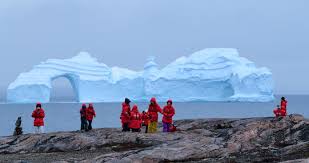
The scale of Antarctica is honestly difficult to process. The icebergs are the size of city blocks, and the mountains rise straight out of the sea, draped in glaciers that’ve existed for millions of years. It feels more like another planet than another continent. What does it do to the human ego to be so small in such a big place? I remember the cold air hitting my face at 3:00 AM while staring at a blue ice wall. It makes you feel tiny. Fragile.
The wildlife experience is also completely different. In the Arctic, animals are often wary because of predators and history. In Antarctica, the animals don’t have land-based predators. This means the penguins are often just as curious about you as you are about them. You can sit on a beach and watch thousands of penguins go about their daily lives, barely acknowledging your presence.
The whales are also a massive draw. Seeing a humpback whale breach in the mirror still waters of a bay is something that stays with you forever. It’s a heavy, visceral sound.
Accessibility and Atmosphere
Getting to these places requires a different mindset. To reach the Arctic, you often fly into hubs like Longyearbyen or Reykjavik. The travel feels like an extension of the northern hemisphere. The light is different too. In the summer, the midnight sun hangs low and golden, casting long shadows over the hills. It’s a soft, haunting kind of beauty.
But Antarctica requires crossing the Drake Passage, a body of water famous for its strength. It’s a rite of passage for any traveler. So, are you ready for the waves?
The atmosphere in the south is one of pure isolation. You feel the distance from the rest of the world in your bones. There’s a profound silence in Antarctica that you can’t find anywhere else. Maybe it’s the lack of birdsong or trees. It’s a place that demands respect and offers a sense of perspective that’s hard to find in our busy, modern lives.
Making the Choice
So, how do you choose?
If you’re drawn to history, culture, and the sight of a polar bear on the horizon, the north is calling you. If you want to feel the sheer weight of the earth’s isolation and sit among thousands of penguins, you need to go south.
The Arctic feels like a frontier that we’re part of. Antarctica feels like a sanctuary that we’re lucky to glimpse. Both will change the way you see the world. They remind us that the earth is still vast, still mysterious, and still very much worth protecting. Whether you find yourself watching the sun fail to set in the north or watching a glacier calve into the sea in the south, you’re witnessing the rawest version of our planet.
Write and Win: Participate in Creative writing Contest & International Essay Contest and win fabulous prizes.
About the Author