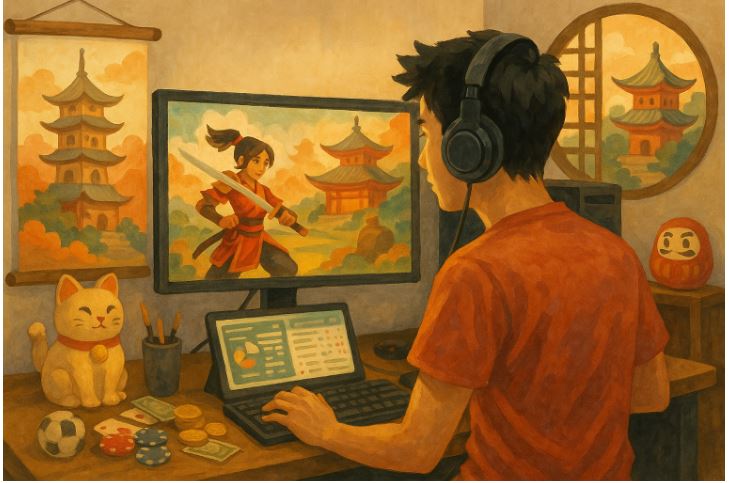
Gaming is closely tied to technological advancements – and it’s been that way for decades.
From the very first consoles to today’s immersive experiences, cutting-edge tech has played a crucial role in shaping how we play and experience games. Here’s how technology has revolutionised gaming and the impact it continues to have on the industry.
Tech in gaming: The early days
The very first gaming systems, including classic arcade machines and home consoles, were major technological innovations in their time. These early systems introduced concepts like interactive graphics and digital sound, which were groundbreaking back then.
Today, the tech developed for gaming often leads to breakthroughs in other industries. For example, processor manufacturer Nvidia is now a global leader in tech, including AI and machine learning, proving that gaming is a springboard for wider technological advancements.
Online connected gaming
One of the most pivotal moments in gaming arrived with online and multiplayer gaming.
Before this, many games were single-player experiences, or local multiplayer games where friends played physically together. With the development of the internet, gaming moved beyond the physical space of a single device. Forget crowding in front of a monitor with tangled cables!
Online gaming allows people to remotely connect and compete in real-time. For example, games like Slingo are now enjoyed online and via apps, shifting from its previous popularity at traditional in-person venues. In every niche, online play has transformed the gaming landscape.
The evolution of graphics
Early gaming systems featured simple, pixelated graphics far removed from the sharp, lifelike picture we see today.
With advancements in processing power and graphical rendering technology, graphics have evolved and improved. From the blocky graphics of the 1980s – think Donkey Kong and Pac Man – to today’s hyper-realistic visuals, refined technologies enable immersive gameplay in detailed, lifelike worlds.
The shift towards photo-realistic graphics is now one of the most noticeable features of modern gaming.
Smartphones
Smartphone technology has also been a game-changer for the industry. With an estimated 2 billion people playing mobile games globally, mobile applications are transforming the industry even more.
In the past, gaming was often confined to PCs or consoles, requiring dedicated systems. But with the development of smartphones, players can now access their favourite games anytime, anywhere.
From puzzle games to complex RPGs, mobile gaming apps offer a portable and accessible way to play, making gaming more accessible than ever before.
The future of gaming technology
Looking ahead, the future of gaming technology is incredibly exciting.
Players can upgrade and enhance their home setup. Augmented reality (AR) and virtual reality (VR) offer immersive, interactive experiences that blur the lines between digital and physical worlds.
Artificial intelligence (AI) is also a key player, with dynamic game worlds that adapt to the player’s actions. As technologies continue to develop, the future of gaming promises to be more interactive than ever.
The role of technology is transformative and ongoing. We expect new advancements to continually push the boundaries of what’s possible.
Write and Win: Participate in Creative writing Contest & International Essay Contest and win fabulous prizes.
About the Author