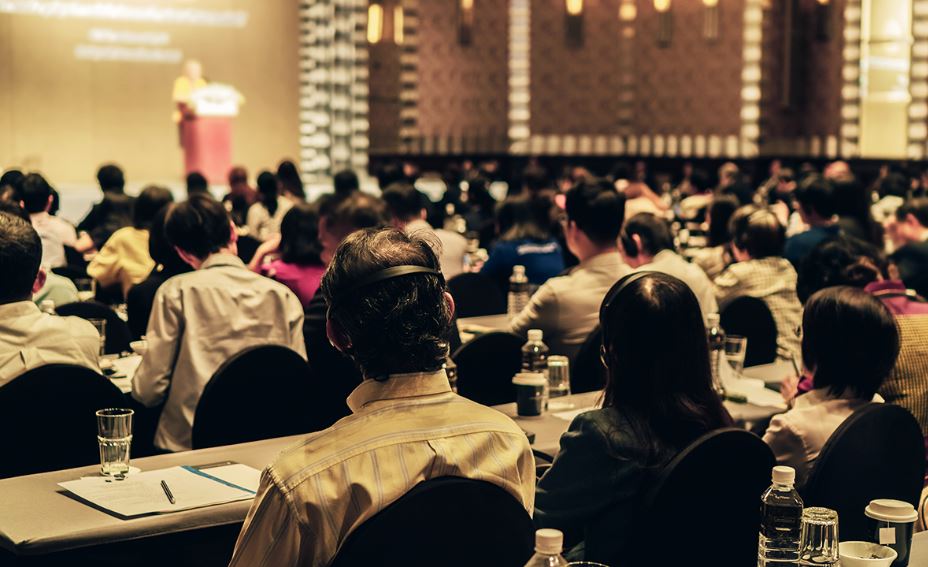
A multilingual event such as an international conference, summit, or symposium requires high-quality interpretation that runs without a hitch. This is essential for all language pairs – but when Chinese is involved, the choice of equipment becomes even more vital. In this article, we’ll take you through the key factors that ensure clarity, accuracy, and successful communication throughout your event.
What is a translation booth?
To begin with, let’s explore exactly what a translation booth is, including its primary purpose and the main features to look out for. Translation booths are the most important piece of interpreting equipment there is because they provide the right working environment for your Chinese interpreter. By shielding them from other noise sources and ensuring a comfortable space, each linguist can concentrate on the interpretation process: rendering spoken English accurately into Chinese (or vice versa) – in real time.
Essentially, a translation booth is a cubicle with space for two interpreters to sit alongside each other. Why two? Well, as simultaneous interpreting is incredibly intensive, the Chinese interpreters must rotate. This usually happens every 15 – 20 minutes, giving each interpreter a short break before resuming their duties.
A translation booth is an enclosed space with windows that allow the linguists to see out but remain separate from the potentially busy and loud environment at the venue. It’s also important that the booth is ventilated, usually with a small opening, as these spaces can become very hot inside.
As well as creating a separate space from the hustle and bustle of the venue, the main feature of a translation booth is the way it can shield the interpreter from the background noise, whether that’s the audience chatting or footfall as people move around. As such, you’ll sometimes hear them referred to as “soundproof booths” or “insulated booths”.
Full translation booths also need adequate space to hold the interpreter console and the technical equipment essential for simultaneous interpretation. These elements are set up on the desk, which has room for all the necessary technology, allowing each Chinese interpreter to access the microphone, headset, and relay controls without obstruction during simultaneous interpretation.
Tabletop or full translation booth: Which is best?
So far, we have looked at full translation booths. They provide the best environment for your English-to-Chinese interpreter (or vice versa), as they are completely separate spaces (almost like a tiny room!), providing insulation and all the sound equipment necessary for delivering a clear, accurate rendition of the speech or conversation. However, whether due to spatial considerations or other logistical issues, sometimes they are simply not feasible.
In this scenario, tabletop booths are a practical alternative. As the name suggests, these much smaller booths sit on the table, where the interpreter works. They are typically enclosed at the front and sides (sometimes with a top) but have an open back for ventilation and access. Thanks to their size and lightweight qualities, they can be transported and assembled easily.
However, there is a trade-off: While much more portable than the full booths, they provide limited insulation and, as such, background noise is only reduced, rather than eliminated. They’re also less comfortable for long interpreting sessions, making them better suited to short events (such as meetings or discussions), in small-to-medium-sized venues. For best results, position tabletop booths away from loudspeakers or heavy foot traffic, and ensure interpreters have access to high-quality headsets and microphones.
Setting up your interpreting equipment: What to expect
We’ve all dealt with tech failures, but they are the last thing you need at a large-scale Chinese or multilingual event. High-quality simultaneous interpreting services that also provide translation booths and other interpreting equipment will sometimes handle the set-up, too. Ideally, this should be carried out the day before, so there is time to source any spare parts or address malfunctions without time pressure.
Technicians are then able to test out the sound system, whether that’s hooking up to the venue’s own system (often the case in large hotels or conference venues) or to the sound system provided by the interpreting agency. The set-up process typically includes isolating the sound and channeling the sound feed into the interpreter’s headset, while ensuring all the components work well, delivering clear audio both to the interpreter and listeners.
Infrared or radio frequency: What’s the difference?
Both infrared (IR) and radio frequency (RF) technologies are used to transmit the interpreter’s voice from the booth to the audience wearing headsets – but they work very differently and suit different environments.
- Infrared (IR) technology
This system transmits audio using light waves, in a similar way to a TV remote. The signal is sent from an IR radiator to the receiver on the listener’s headset. For this technology, the headset must be in view of the IR emitter. There’s no radio interference, which makes it ideal for sensitive environments such as courtrooms or confidential meetings. However, it only works indoors as sunlight interferes with the signal. It’s also best suited to rooms without obstructions such as pillars – these may interfere with the signal.
- Radio frequency (RF) technology
This system uses radio waves to transmit audio, in the same way as Wi-Fi or a walkie-talkie. The interpreter speaks into a dedicated transmitter, and the audio is then broadcast to the listeners’ wireless headsets, having previously been tuned to a specific channel. This system works both indoors and outdoors, and the signal can pass through walls and around corners. Often, large-scale events or tour groups use this form of transmission.
Why Chinese interpreters are more essential than ever
While all multilingual events require effective, clear, and accurate communication, Chinese interpretation often presents additional linguistic and cultural complexities. Chinese interpreters not only communicate the core message being relayed; they also help to forge a connection between the listener and speaker, often also bridging cultural divides.
Moreover, since China’s role in global affairs is becoming increasingly prominent, the importance of interpreters who can navigate both language and nuance cannot be overstated. By choosing high-quality interpreting equipment, including the most appropriate translation booth and audio transmission method, you’ll stand your Chinese interpreter in good stead to be able to deliver an accurate and clear translation.
So, whether you’re hosting an international conference in Shanghai, a forum in Beijing, or a US symposium with global attendees, translation booths are a must-have at Chinese events involving multiple languages. Thanks to the right choice of equipment and by selecting a provider that ensures meticulous set-up, your Chinese interpreter will be able to ensure smooth communication and audience engagement. Good luck!
Write and Win: Participate in Creative writing Contest & International Essay Contest and win fabulous prizes.
About the Author