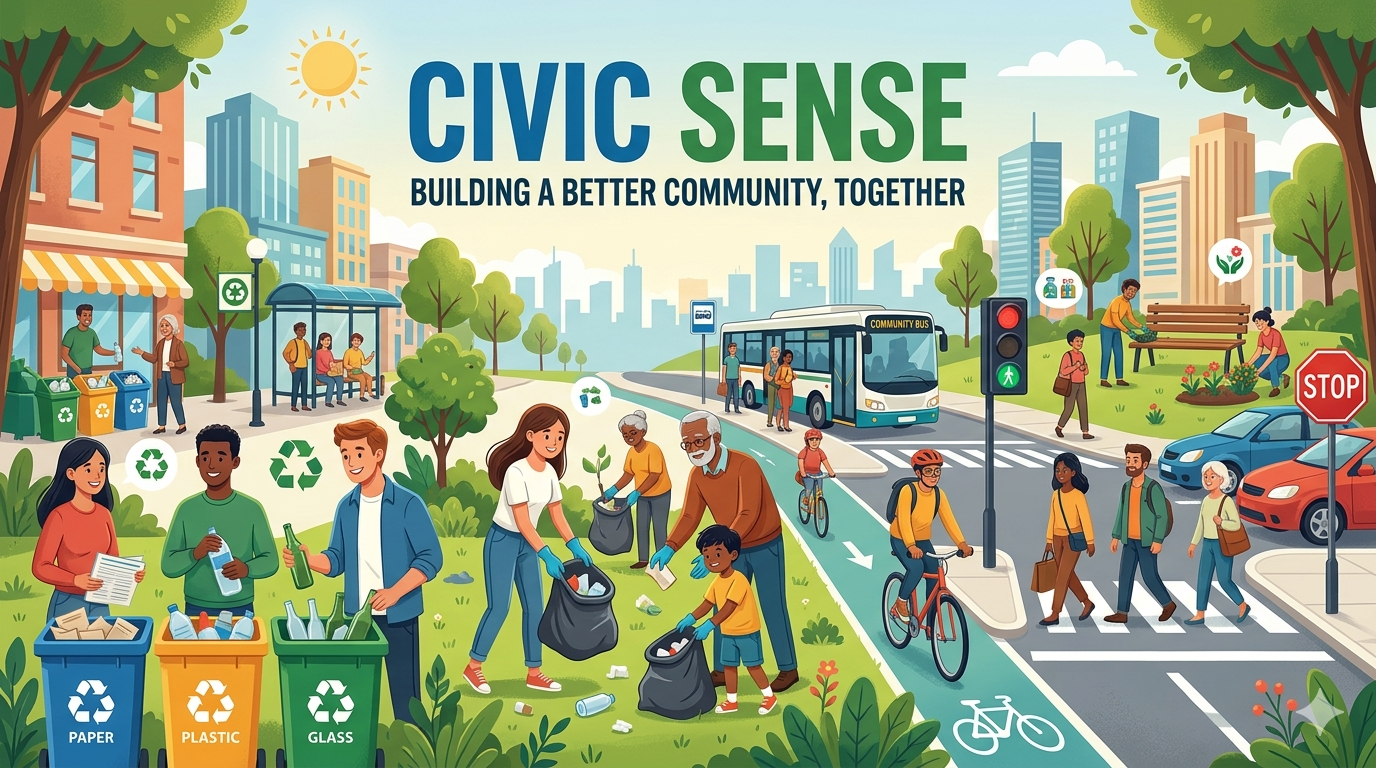
I’m sure that we have all seen trash on the roads, from people spitting paan, to huge plastic bottles and sometimes even stuff like a whole couch, all on the side of the road. People spit paan masalas in the lift, others take nature’s calls in areas where they are clearly told not to, and people quite literally fight in the middle of the road, causing problems for the rest of the population. But the real question is why? Why do people fight in the middle of the road, spit in elevators, and do such unnatural and vulgar things?
Is it because people in India have such bad civic sense?
That statement seems to be true. Many people in India just blindly do stuff which negatively affects people, environment, and the country in general. But why could this be the case? And why are other countries so much cleaner as compared to our nation? What could they be doing?
That’s what we will be looking at today.
First of all, let us get an understanding of what civic sense even is. Civic sense is similar to common sense – it’s what people think they have to do in a common shared environment. When people keep shared places and experiences clean and cause little to no harm to it, they are considered to have good civic sense. This is also true if they don’t disturb anyone or cause any havoc around them.
Many people think that Indians don’t have good civic sense due to lack of education. But that cannot be true, as our country is full of young geniuses and superstars, and our nation has one of the most competitive ranks in the world. You definitely do require an education to get into a job or become a CEO or anything that earns you money, and you probably do require education to just stay alive and learn to live. So clearly that is not the case.
Think about this : do people have greater common sense if they have more education? Do people just gain more knowledge on how to pick up a plastic bottle and put it in the trash by just studying?
Clearly that’s not the case. But is civic sense something that cannot be learned? That’s not true either.
Here’s the thing : people do what they see. If they see a person throw waste and nobody does anything about it, everyone else will do the same thing, regardless of if it is good or bad. This is called Herd Mentality. An example of herd mentality is when there is a riot, and everyone follows the leader, even when they don’t know who it is.
So what can we do to fix this problem? We can try to simply be better. If a person drops waste on the floor, even if it is something like wet waste, just pick it up and throw it away. Even if it is disgusting, just use some glove or paper and chuck it into the bin(the correct bin please). This will make the streets cleaner, and as more people see you do so, they will also feel like doing it, and hence you have started a chain reaction with many people to continue, and you have unknowingly created a better environment.
How about other countries? What are they doing? In countries like Japan, students are taught to clean up the classroom themselves rather than leaving it to janitors and cleaning staff. This helps them later in life, as they believe that ‘shared space = my space’ which reduces a lot of trash and behaviour.
However, many people in India believe that the government should take care of the waste on the roads and not the people themselves. But how can we blame the government when the problem itself is us? They definitely cannot help us to change, unless we do it ourselves. The problem is that we, unlike Japan, aren’t taught to learn to clean shared spaces ourselves, as we usually have a housekeeping staff to take our plates, or our mothers to clean the house. If you are a parent, you can start the change by teaching your child to take care of the environment around them.
There is also another thing called the ‘Broken Window Theory’.
If you look at a guy inside a clean Delhi metro who is eating chips, he will carefully eat them and try not to spill them across the floor, and won’t fling it all over the place. However, the same guy will go outside the metro, and throw it on the street right outside. Why could this be?
Simply put, if a house has a broken window, people don’t mind other windows being broken. But if a house is pristine and beautifully kept, then people will go out of their way to keep it the same way.
See places like slums, and compare them to something like the Taj Mahal. See the difference in how they are kept? People keep pristine stuff in high quality, but if the same thing has a small error in it, they don’t do much to care for it.
Another way to combat this is to have stricter regulations and fines. While this probably will never happen in India due to its large size, but this is easier to implement in smaller countries like Singapore, where this already is happening. People are fined for spitting on the roads, and are fined for doing other things as well.
Some countries like China believe in Social Credit Systems, which links social behaviour to social credit scores, and poor civic behaviours could cause higher fees for services and travel restrictions.
Another reason for the terrible civic sense in India may not just be how people act, but by how many people we really have. India is home to over a billion people, over an eighth of the world’s population, and lots of people usually means a lot of mess, as there isnt much coordination or communication between the people and government. When there are so many people cramped in a such a technically small space, you cannot really do much about it. If India was the size of, say, Russia, this wouldn’t be much of a problem. Think about it like stuffing a hundred people in 8 rooms against stuffing a hundred people in 50 rooms. It should be obvious which rooms would be cleaner.
There is another psychological reason for this bad civic sense. Let’s say a person goes into a crowded cafe, with about 40 people. If the person chucks a plastic straw to the ground, he will most likely not bother to pick it up as there will probably be another person to pick it up. This happens a lot in places with lots of people. Think about this : if everyone decided that someone else will pick up something, then in the end no one will pick up the trash. This is better shown during a road accident. People will gather around and stand around the victim, pointing phones at him and taking photos. You might think this is just a thing that happens in movies, but it happens a lot during real life as well. Instead of going to help the person, they stare and send images and videos online. What can we do to combat this? We need to somehow get them to have more sense and save and help others and do more for the environment. People take on more responsibility in smaller groups.
However, this does not mean that all Indians have terrible civic sense and have the same thoughts and actions. Our country has lots of cleanup drives that happen all the time, and many NGOs focus on making our country cleaner and more safe. There is a lot of increase of awareness in youth. Lots of people now know that we should also take the initiative to clean our surroundings and help people in many ways.
But lets think about this : does all this really affect us? It does. Tourism takes a big hit in India due to influencers telling everyone that India is dirty, which in turng ets more people to not come to india. This causes the tourism industry to tank, and india becomes one of the poorest economies in terms of tourism. Is this really good? So we need to improve our country to get more tourists, increase prices, and gain more cash. Yes. Our civic sense is causing our own government to lose money! So do your part and we will be fine.
To finish off the article, we can all just do our own parts and wait to see the magic. The solutions mentioned in this article are great ways of change, and all we need is action. So you, reader, stop reading this article and go pick up that bottle you threw and put it in the trash
Please do keep your neighbourhoods and streets clean and maintain a clean relationship with everyone you know to keep people safe.
By: Pradyun Reddy Chintala
Write and Win: Participate in Creative writing Contest & International Essay Contest and win fabulous prizes.
About the Author