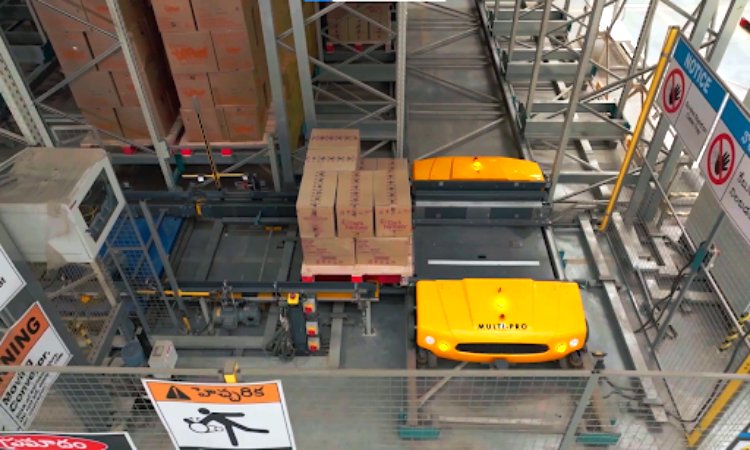
As the e-commerce sector continues to grow, customer demands for speed and accuracy are also increasing. Thus, businesses are required to become increasingly competitive in every way, and they need to operate a very tough grind to carve out a competitive edge. Fortunately, with the advent of warehouse automation, businesses are nowadays equipped with a series of tools to raise their warehouses to ever-higher levels of performance and efficiency.
Key Strategies for Optimizing Warehouse Logistics
Here are some important strategies to implement for optimizing warehouse logistics:
- 1. Streamline Layout Design: Arrange storage zones in the proximity of fast-moving SKUs near receiving and dispatch areas to minimize stack and load handling. Employ racking systems to cater to upward space utilization in order to minimize travel time.
- Enforce Efficient Inventory Management: Install real-time inventory management systems that help to substantially decrease or prevent stockouts and overstocking. Employ big-data analytics to make projections for demand, deduce inventory, and adjust replenishment cycles for efficiency.
- Use Lean Principles: Each non-value creation action, from duplication to over-inspection, should be eradicated, which can also help the teams focus on improving warehouse logistics.
- Labor Utilization Optimization: Reduce errors and speed up operations by using pick-by-light, pick-by-voice, and other guided picking systems. Performance measures like picking per hour could also be incorporated to standardize and prolong labor productivity.
Tips To Improve Operational Efficiency
The following are some tips that can help improve operational efficiency and increase productivity with advanced automated logistics:
- Use cross-docking: Bypass storage for items that will be shipped quickly, reducing handling time.
- Implement buffer zones: Designate temporary staging areas to decouple inbound and outbound workflows.
- Adopt technology for real-time visibility: Use dashboards and KPIs so managers can monitor throughput, accuracy, and resource utilization instantly.
- Scale flexibly: Build modular operations so that capacity can expand during peak periods without enormous capital investments.
While manual logistics are also efficient, they often rely on using physical effort for repetitive tasks. On the other hand, automated logistics create better speed, accuracy, and consistency, so warehouses can improve specific systems to create more reliable operations and enhance efficiency.
Case Studies of Successful Warehouse Logistics Optimization
Addverb’s real-world implementations demonstrate the transformative power of warehouse logistics optimization. For instance, they partnered with Maersk at a facility that handled a complex array of footwear, apparel, and accessories serving both B2B and B2C channels. Addverb applied a hybrid automation ecosystem that combined Autonomous Mobile Robots, carton shuttles, zippy and PTL. The combination substantially improved space utilization and sped up order processing, providing faster dispatch and improved accuracy throughout the network.
In another use case, Addverb modernized an automated brake parts distribution center suffering from long walking distances, labor fatigue, and inefficient manual movement. Their solution included AMRs capable of handling high payloads, a high-speed robotic sorting system, and Addverb’s Fleet Management and Warehouse Execution Software. The facility achieved a throughput of 1,250 cases per hour and nearly 10,000 orders processed in a single day, all while providing safer working environments and better performance. Each study demonstrates how targeted interventions can lead to substantial performance improvements.
How Addverb’s Solutions Power Optimized Warehouse Logistics
Addverb brings end-to-end warehouse automation expertise to help businesses master their warehouse logistics. Their deck includes:
- Autonomous Mobile Robots (AMRs) like the Dynamo series are used to carry goods efficiently across zones.
- Sorting robots (Zippy) that sort high volumes at high speeds while reducing manual sorting errors.
- Automated Storage and Retrieval Systems (ASRS) such as shuttles (Quadron, Cruiser360, Multi-Pro) for high-density storage and faster retrieval.
Their innovation also extends to AI and cloud: for example, Addverb’s integration with AWS allows remote monitoring, testing, and “robots-as-a-service” models.
With these technologies, Addverb helps clients reduce order cycle times, increase throughput, lower labour costs, and achieve higher accuracy for warehouse logistics.
Future Trends In Warehouse Logistics Management
The future of warehouse operations is marked by deeper integration of AI-driven robotics, which will help systems dynamically adapt to fluctuating demand and inventory changes. Other trends are:
- Edge computing and IoT connectivity: Real-time IoT data and edge analytics will enable smarter decision-making at the robot and warehouse levels.
- Autonomous humanoid robots: Advanced robotics (including quadruped and potential humanoid robots) could take over more complex tasks, reducing human exposure to hazardous or repetitive work.
- Robots-as-a-Service (RaaS): Subscription models will make warehouse automation accessible without heavy capital expenditure.
Conclusion
It has become essential for long-term operational success to use advanced warehouse logistics in the face of high customer expectations and increasingly complex supply chain management networks. Strategic planning, smart technologies, and integrated workflows, backed by advanced warehouse automation, will be the differentiators for the companies to attain the highest levels of efficiency, accuracy, and agility. Remarkable transformations will be supported by a range of high-tech robotics and intelligent software platforms to give businesses the tools they need to redefine their operations and achieve high performance.
Write and Win: Participate in Creative writing Contest & International Essay Contest and win fabulous prizes.
About the Author